Navajo Fry Bread, Mutton Stew and Camping on the Jicarilla Apache Reservation
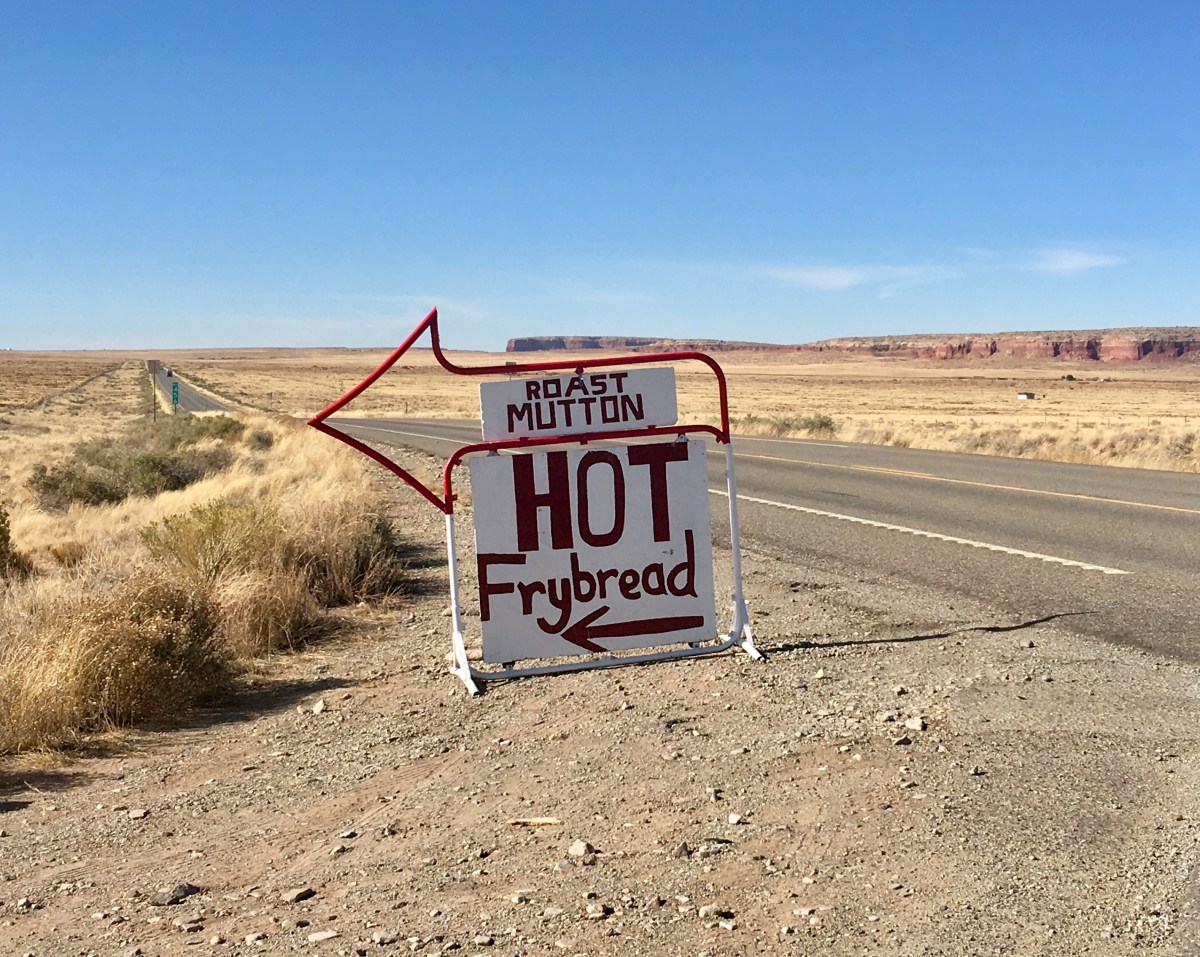
Stopping at Teec Nos Pos, for traditional Navajo food. The food truck was heavily patronized by native people (signifying, I hope, authenticity). It was totally yummy and satisfying !
Fry bread is a flat dough bread, fried or deep-fried in oil, shortening, or lard. Made with simple ingredients, frybread can be eaten alone or with various toppings such as honey, jam, powdered sugar, or hot beef. Frybread can also be made into tacos, like Indian tacos. It is a simple complement to meals.
According to Navajo tradition, frybread was created in 1864 using the flour, sugar, salt and lard that was given to them by the United States government when the Navajo, who were living in Arizona, were forced to make the 300-mile journey known as the “Long Walk” and relocate to Bosque Redondo, New Mexico onto land that could not easily support their traditional staples of vegetables and beans.
For many Native Americans, “frybread links generation with generation and also connects the present to the painful narrative of Native American history”. It is often served both at home and at gatherings. The way it is served varies from region to region and different tribes have different recipes. It can be found in its many ways at state fairs and pow-wows, but what is served to the paying public may be different from what is served in private homes and in the context of tribal family relations.
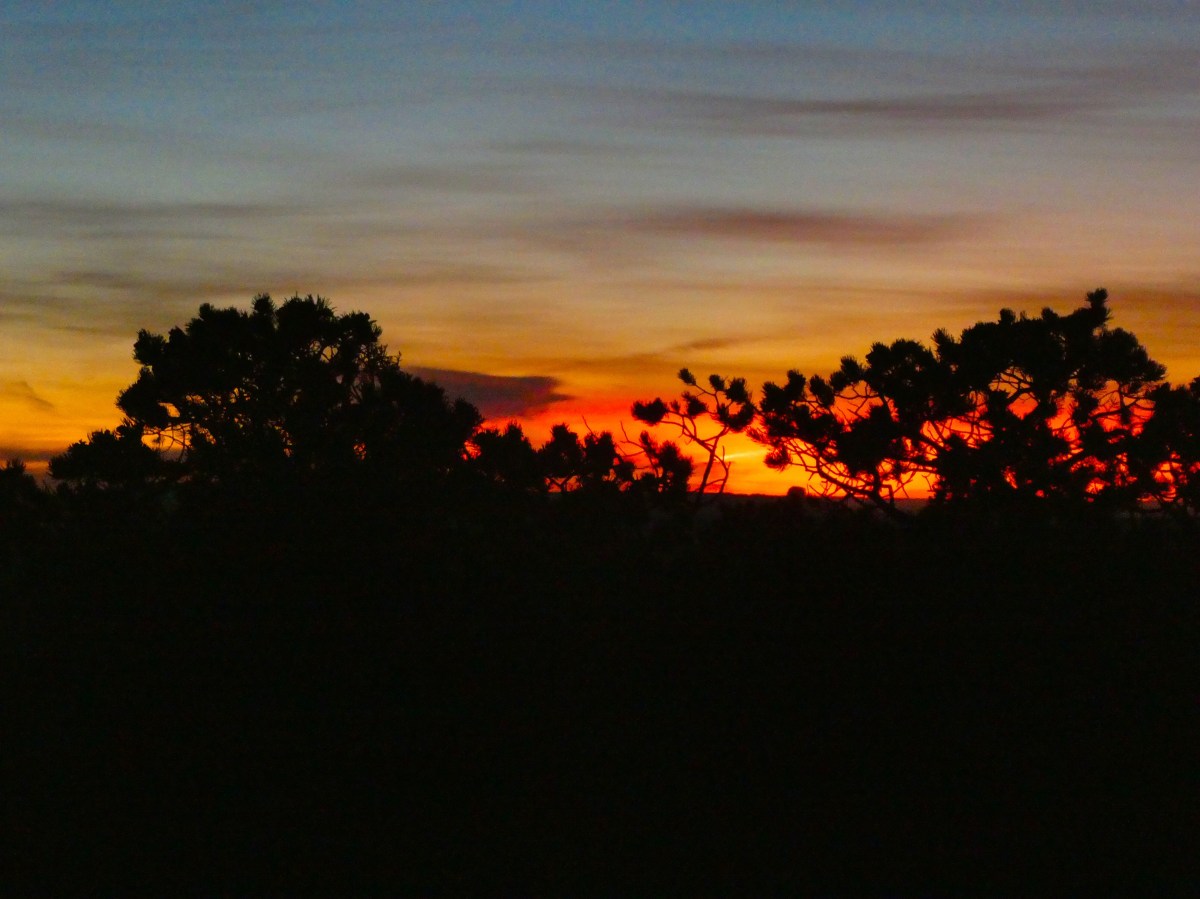
Our cold (12 degrees Farenheit last night) but lovely campsite on the Jicarilla Apache Nation, next to Stone Lake was scenic and inexpensive (free)!
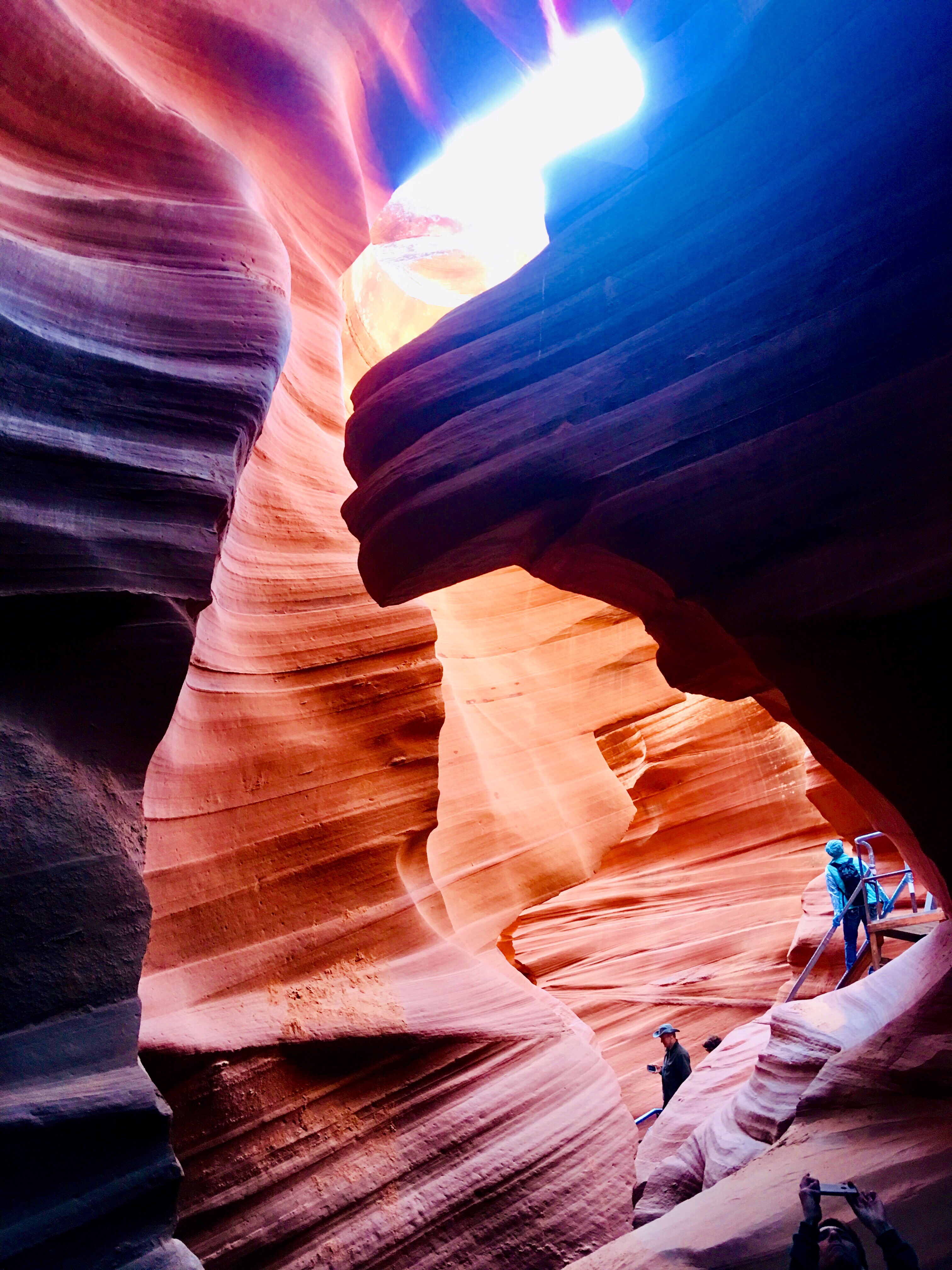
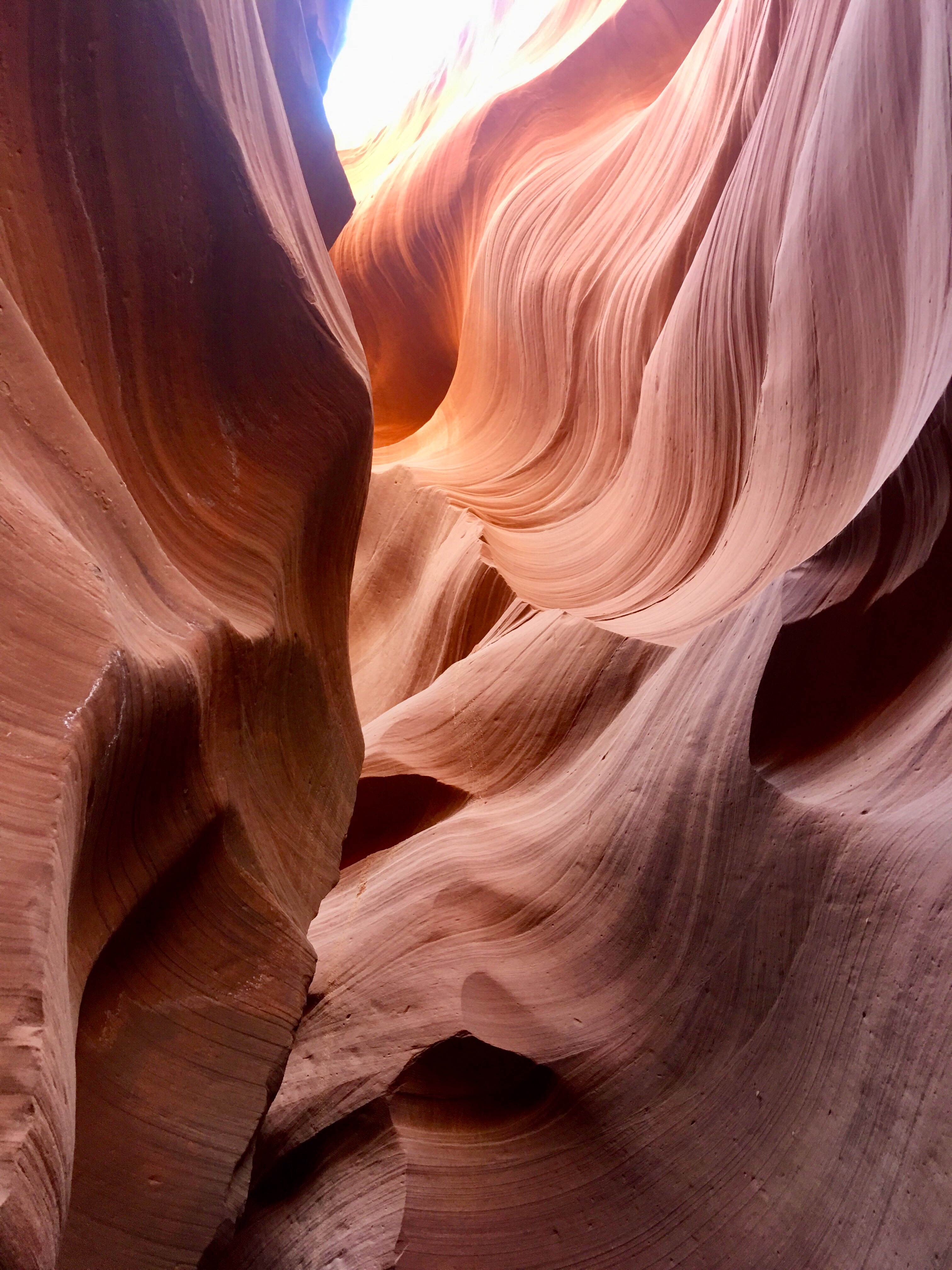
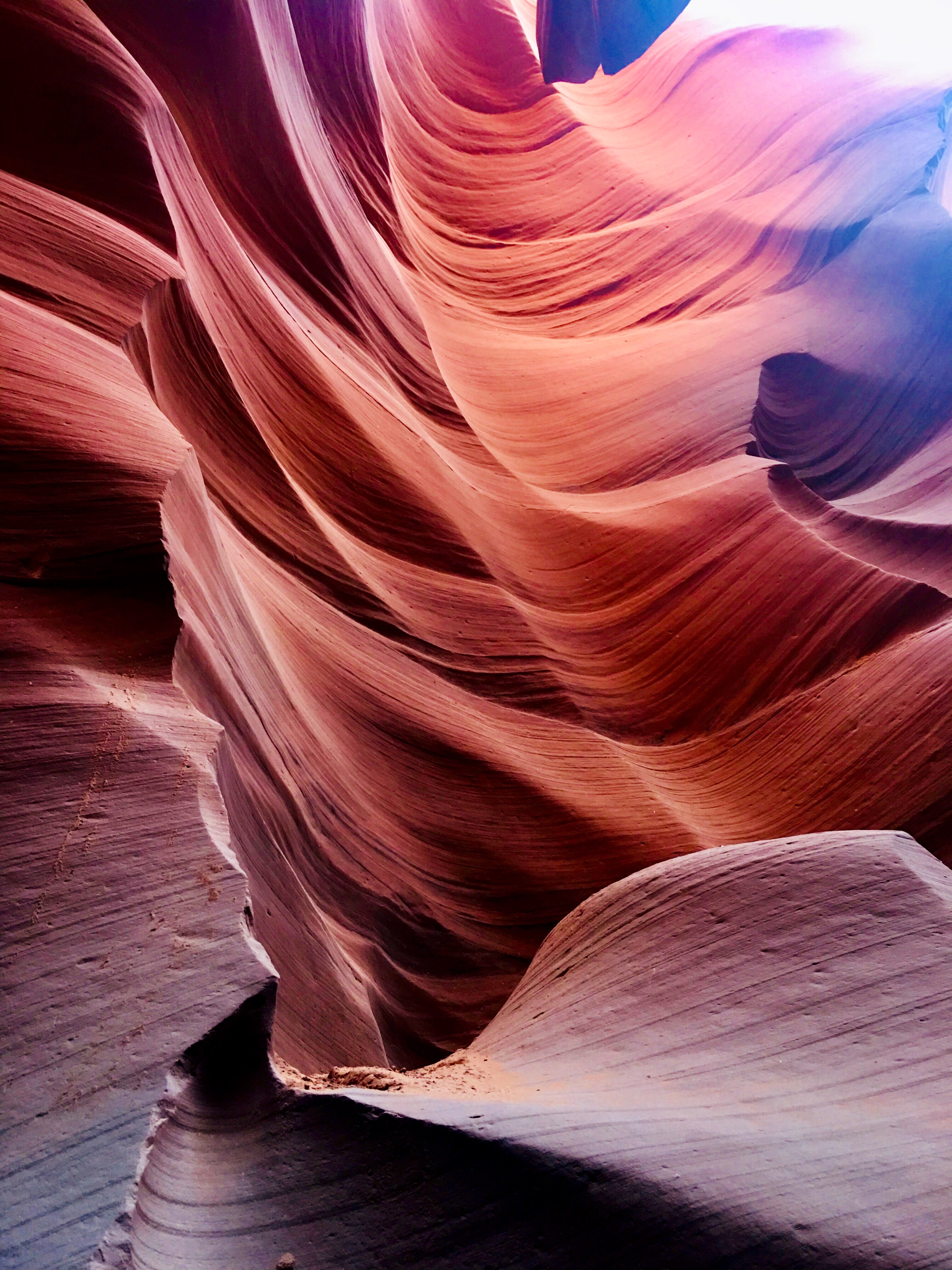
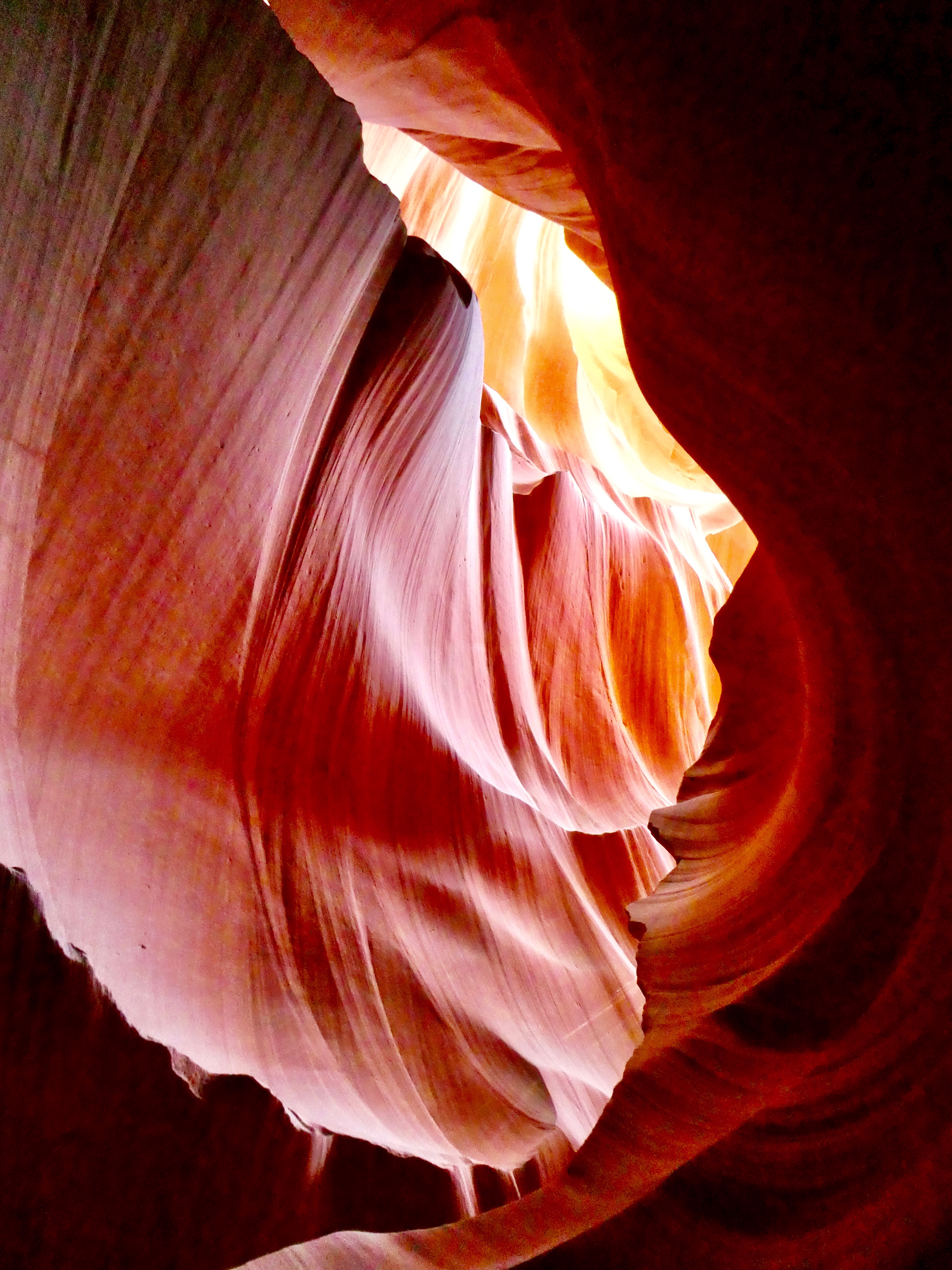
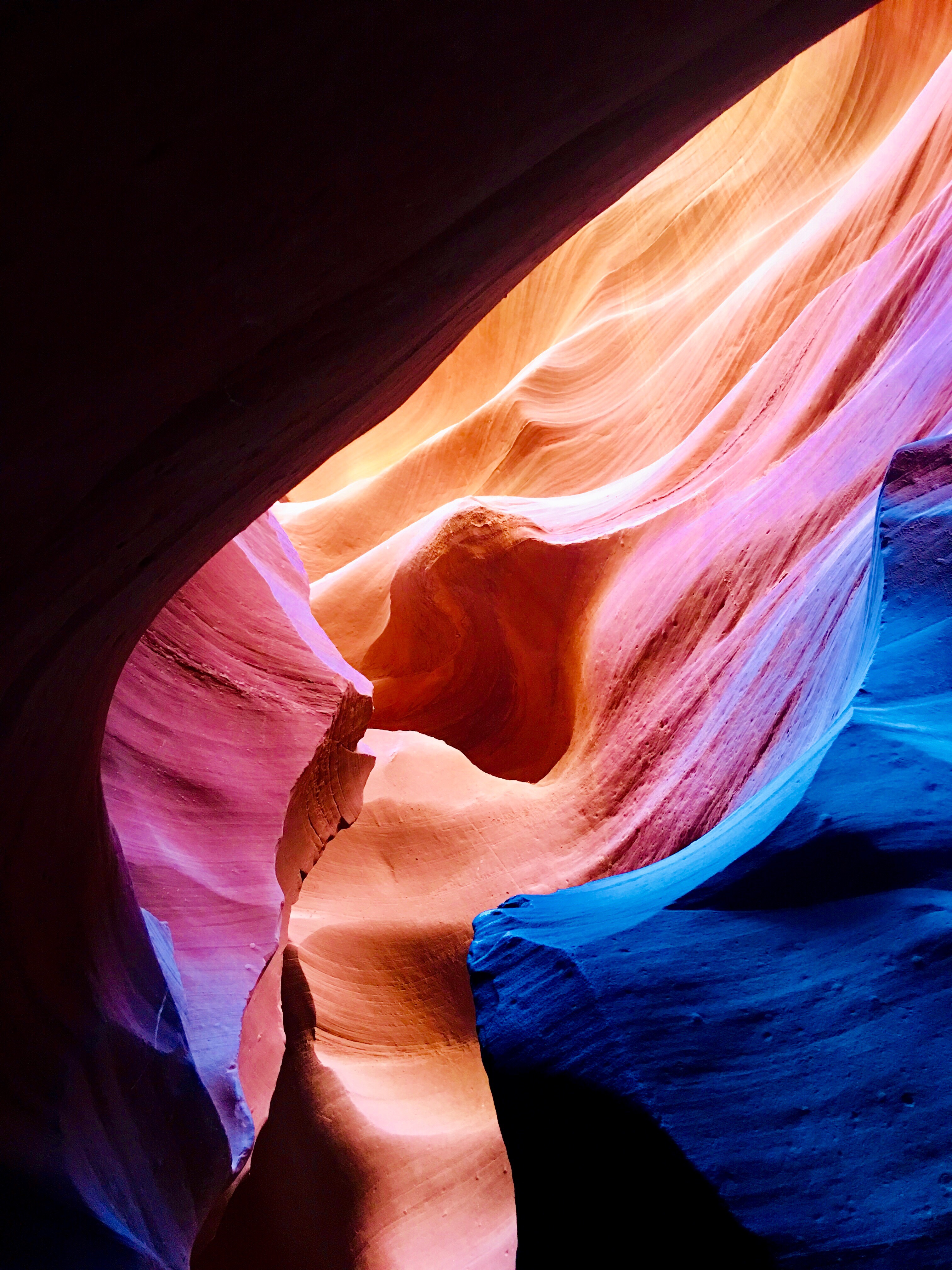
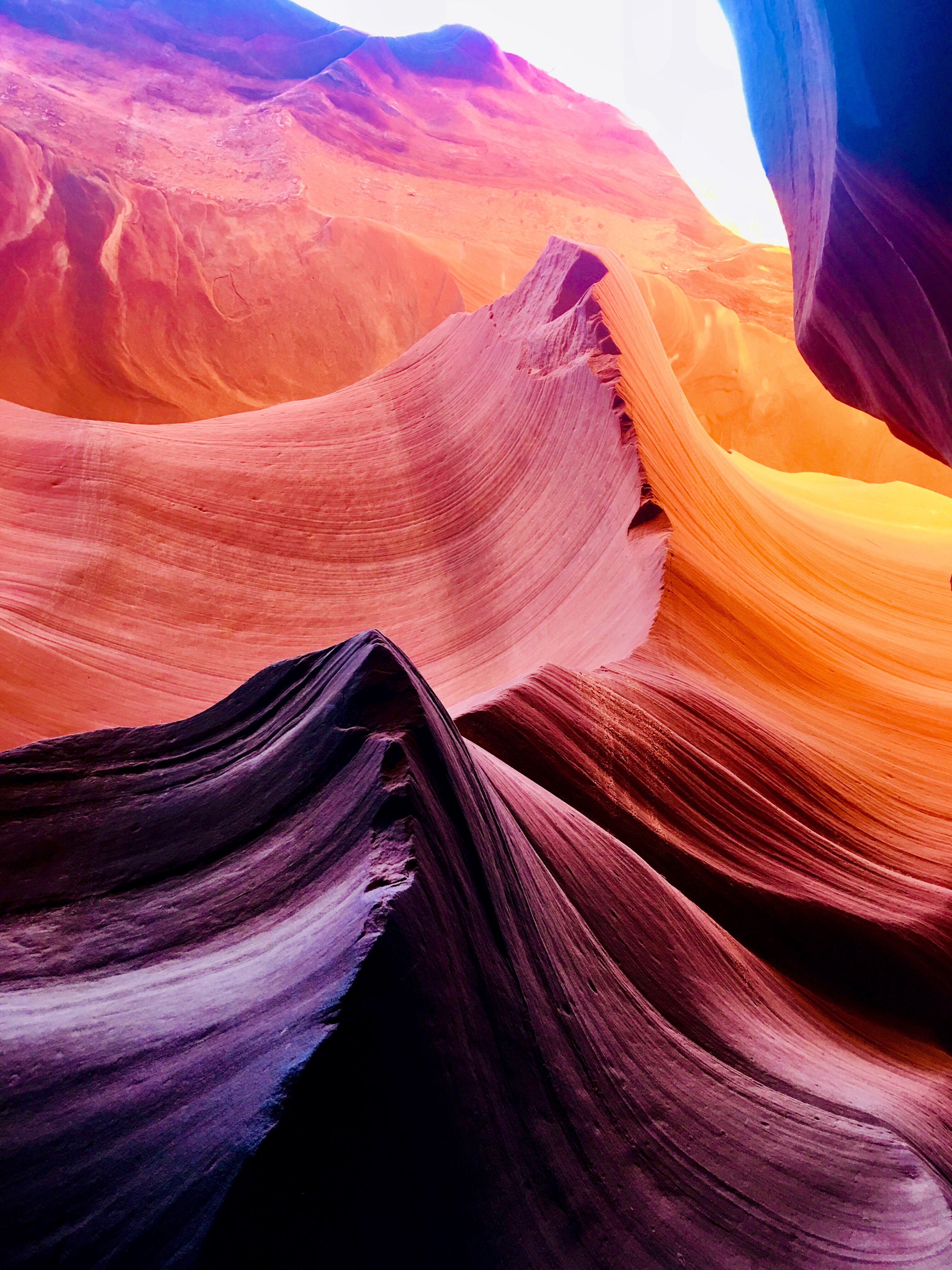
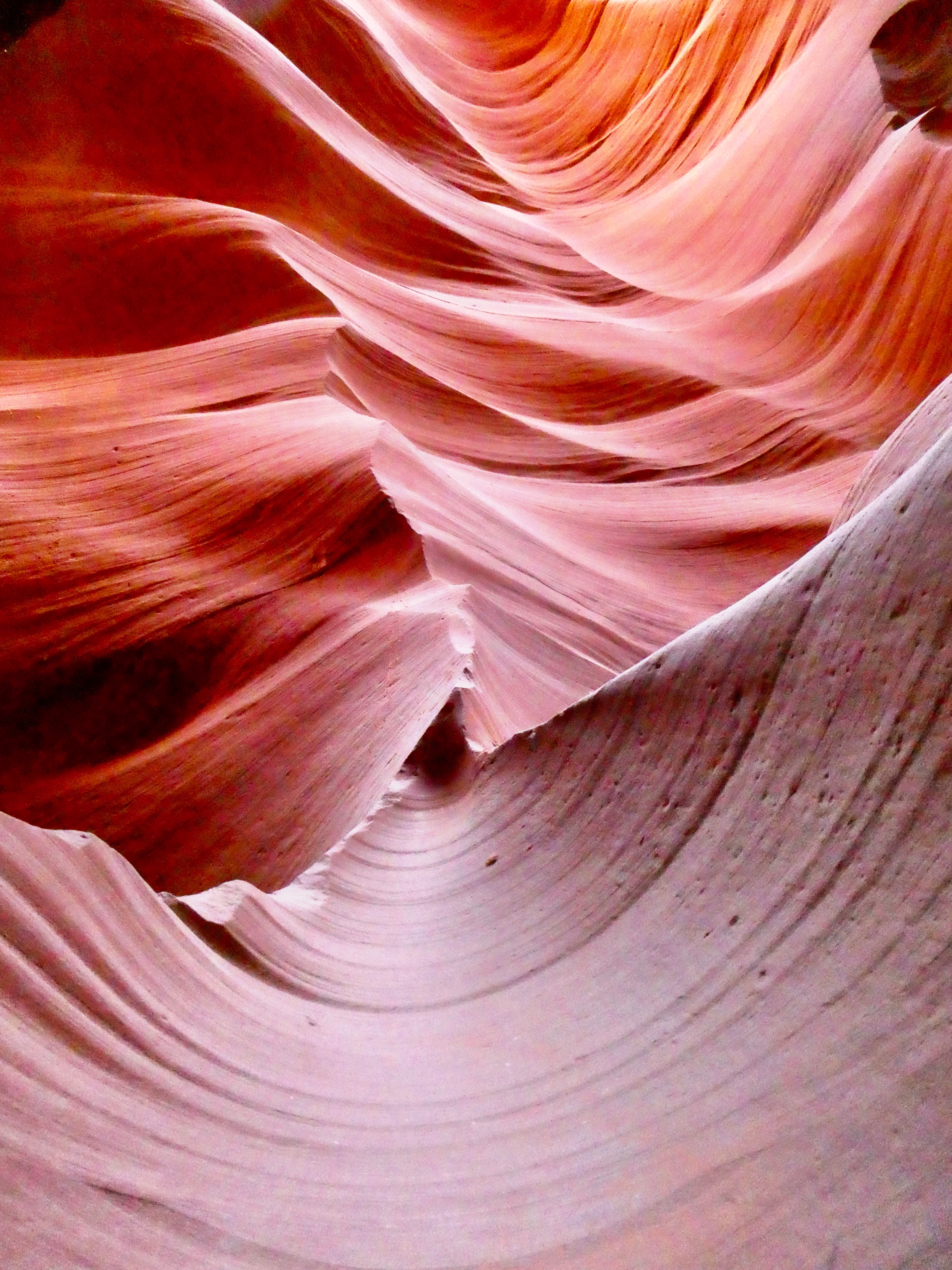
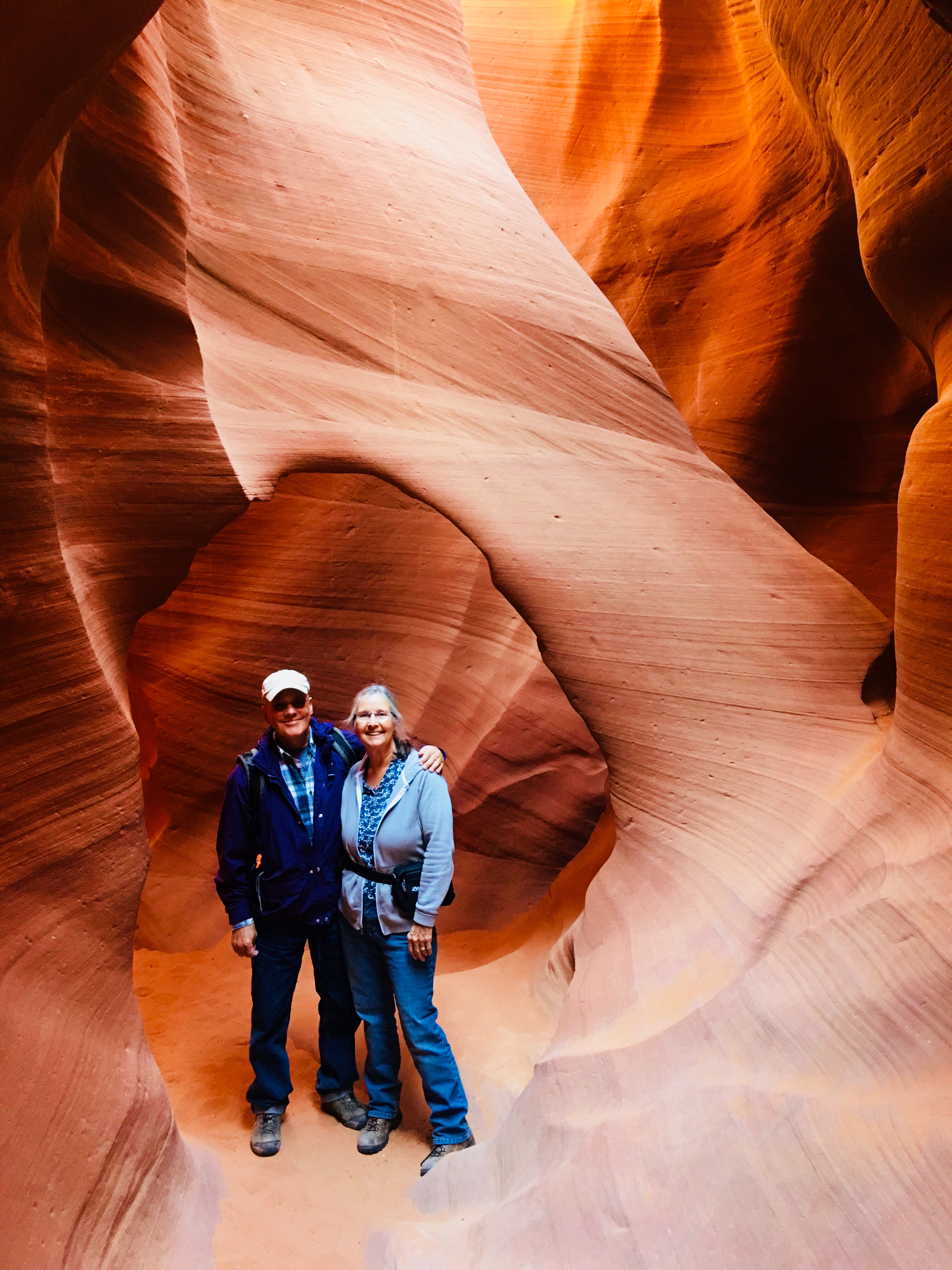
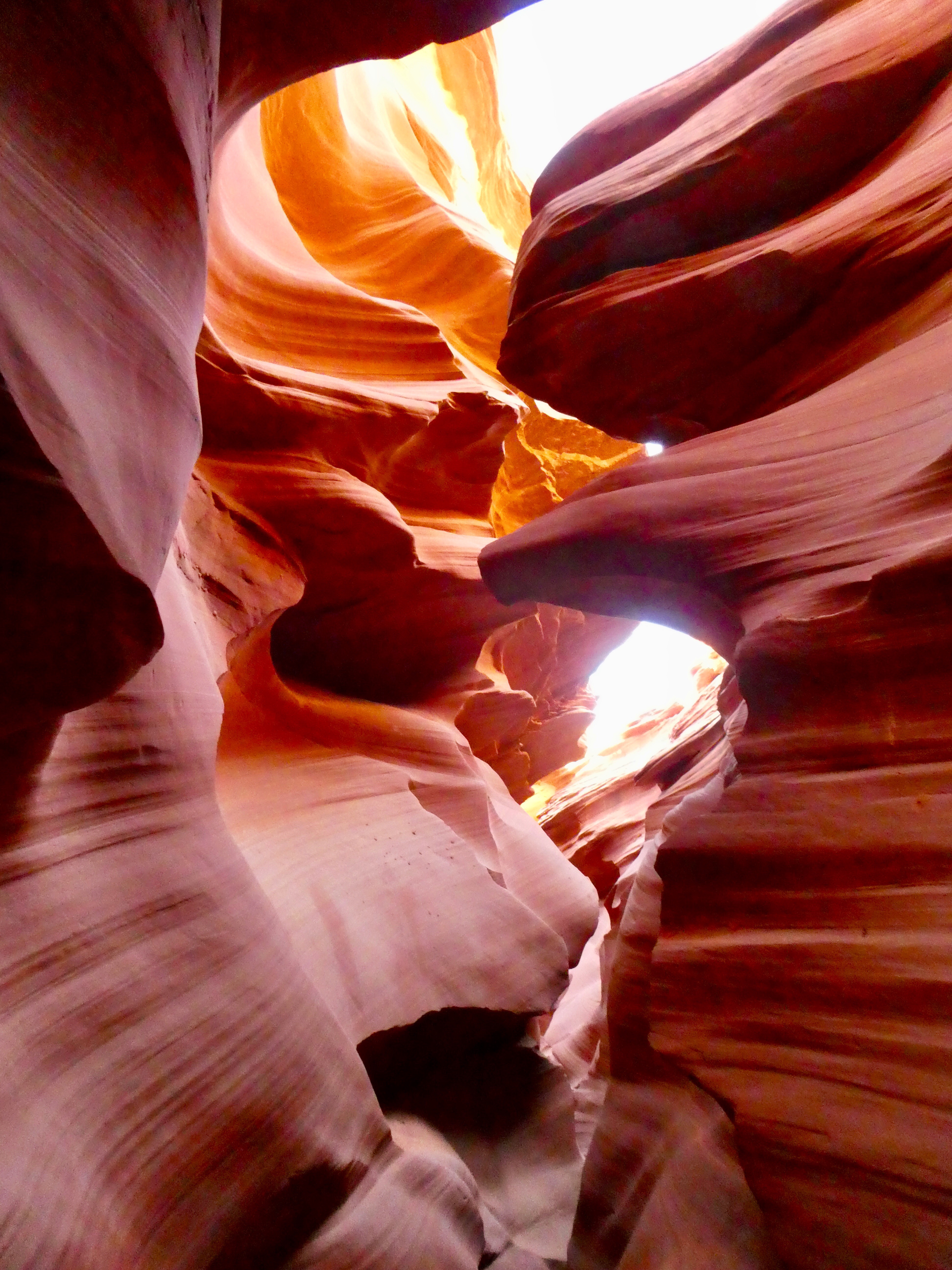
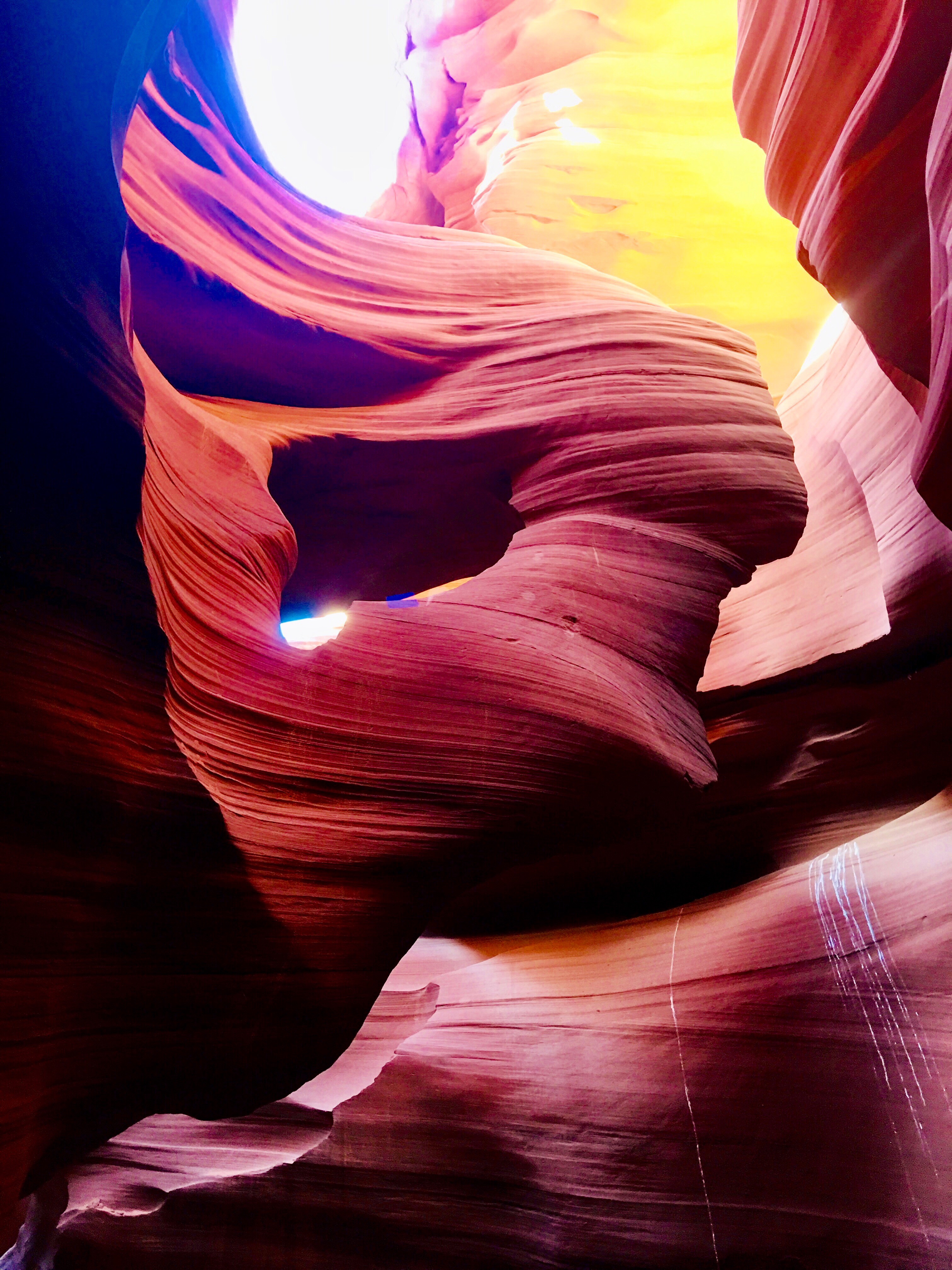
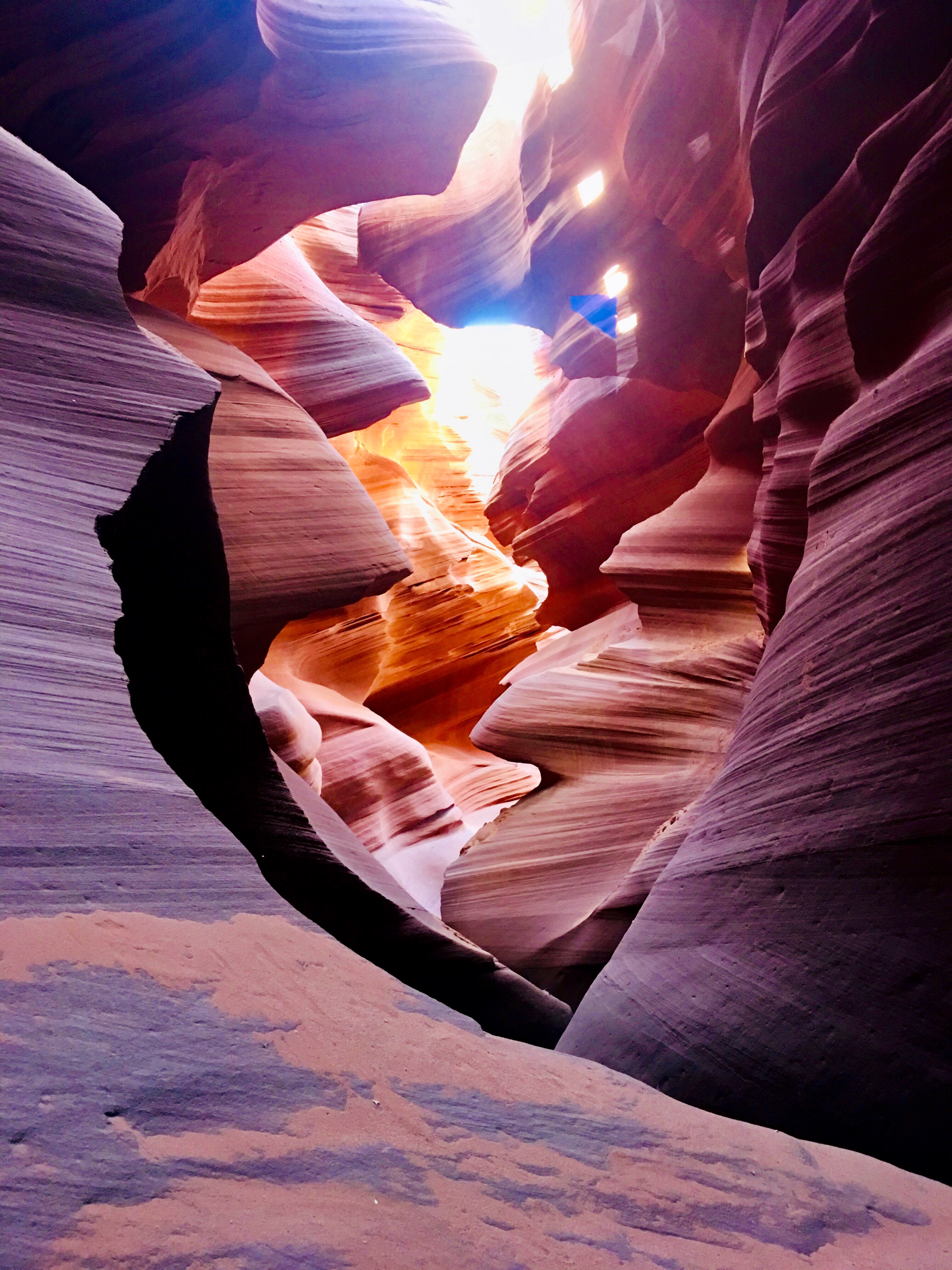
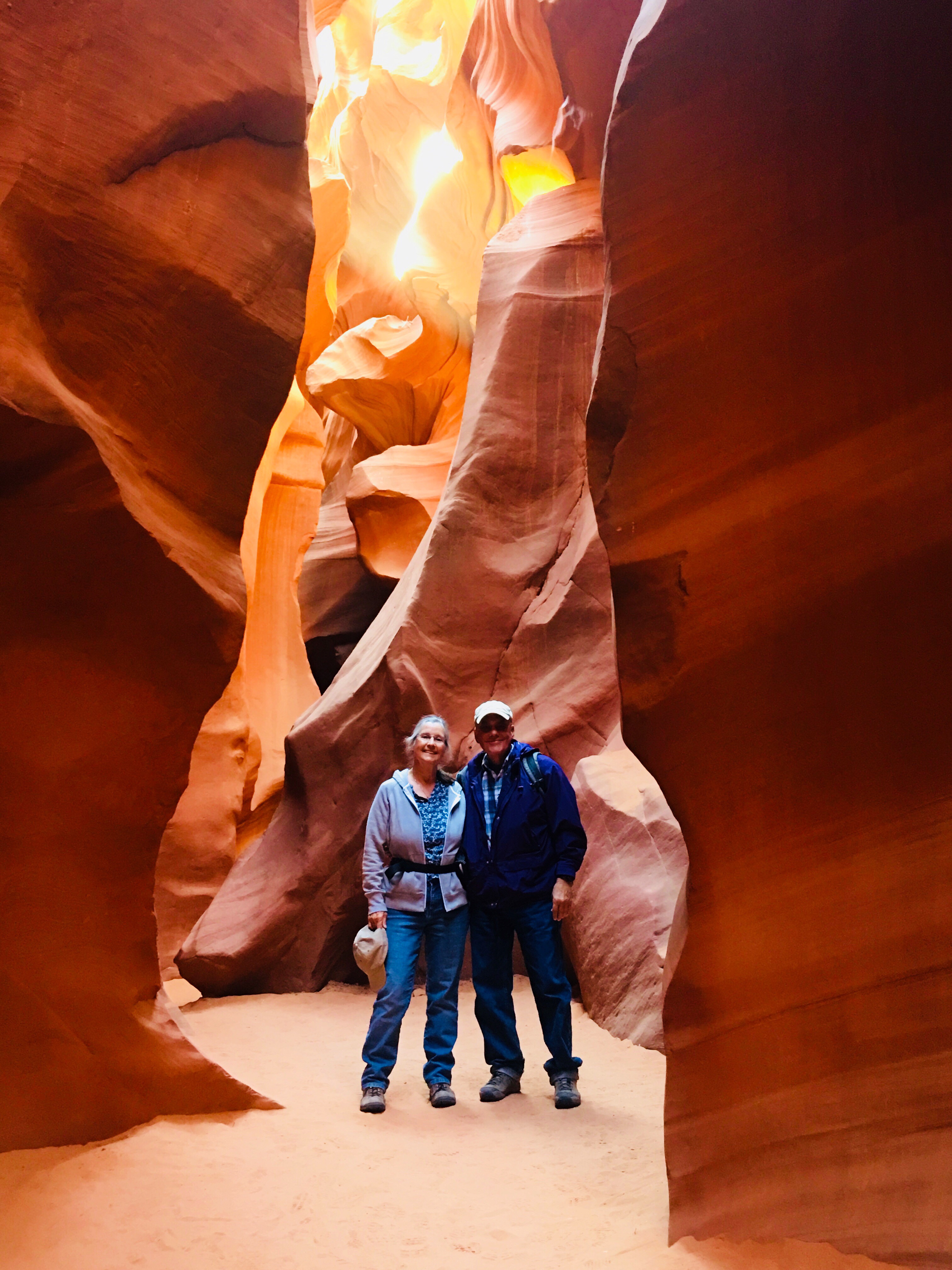
Antelope Canyon is located near Page on Navajo Nation land, just outside Glen Canyon National Recreation Area. Antelope is the most visited slot canyon in the Southwest, partly because it is easily accessible and by far the most publicized, and also since it is extremely beautiful, with just the right combination of depth, width, length, rock color and ambient light; many other slot canyons are deeper, narrower or longer, and some have rock that is even more colorful and sculptured, but here conditions are ideal.”
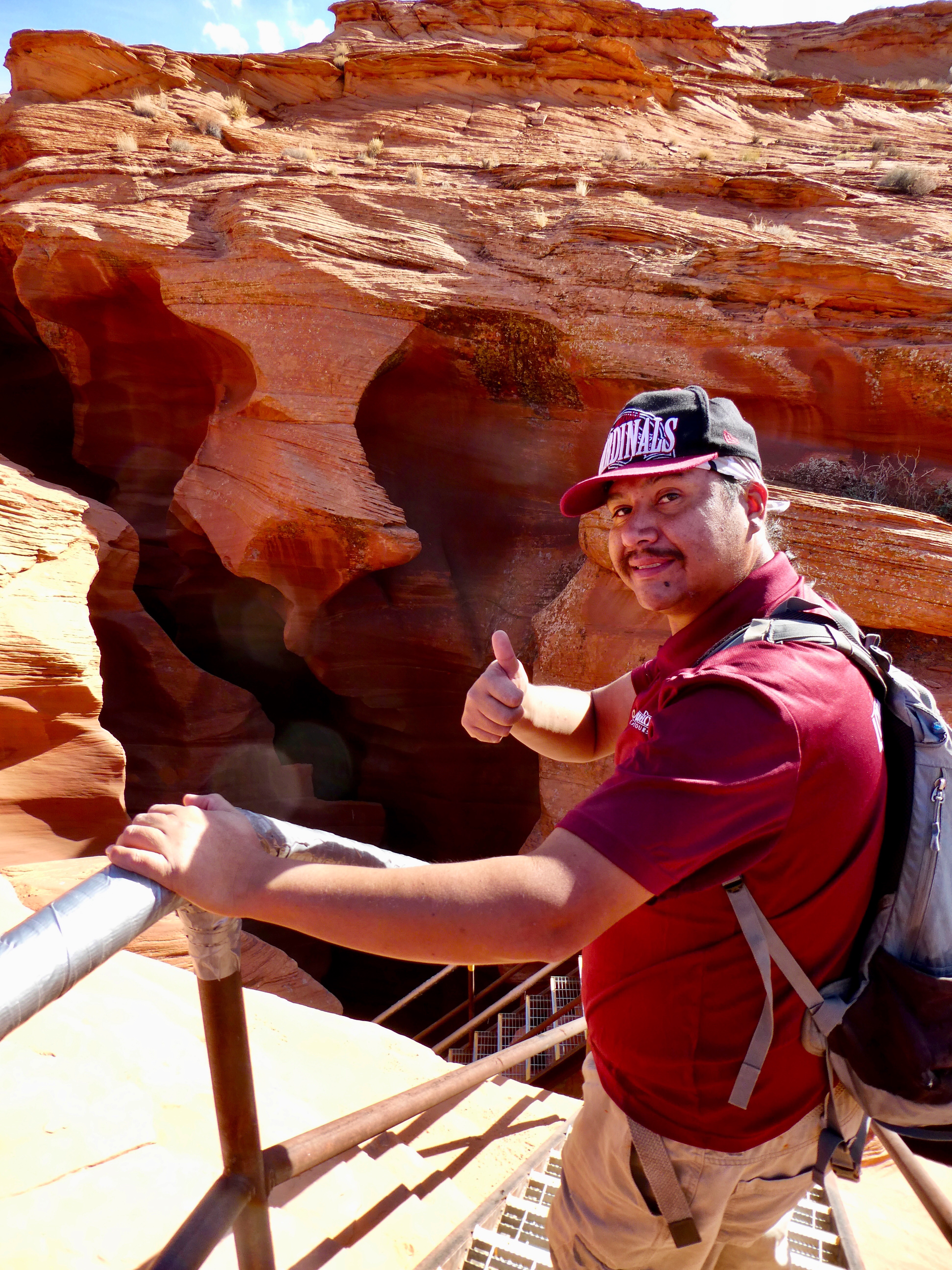
Our Hopi guide Mathew takes us down into the canyon
“Antelope Canyon was formed by erosion of Navajo Sandstone, primarily due to flash flooding and secondarily due to other sub-aerial processes. Rainwater, especially during monsoon season, runs into the extensive basin above the slot canyon sections, picking up speed and sand as it rushes into the narrow passageways. Over time the passageways eroded away, making the corridors deeper and smoothing hard edges in such a way as to form characteristic “flowing” shapes in the rock.”
Navajo National Monument
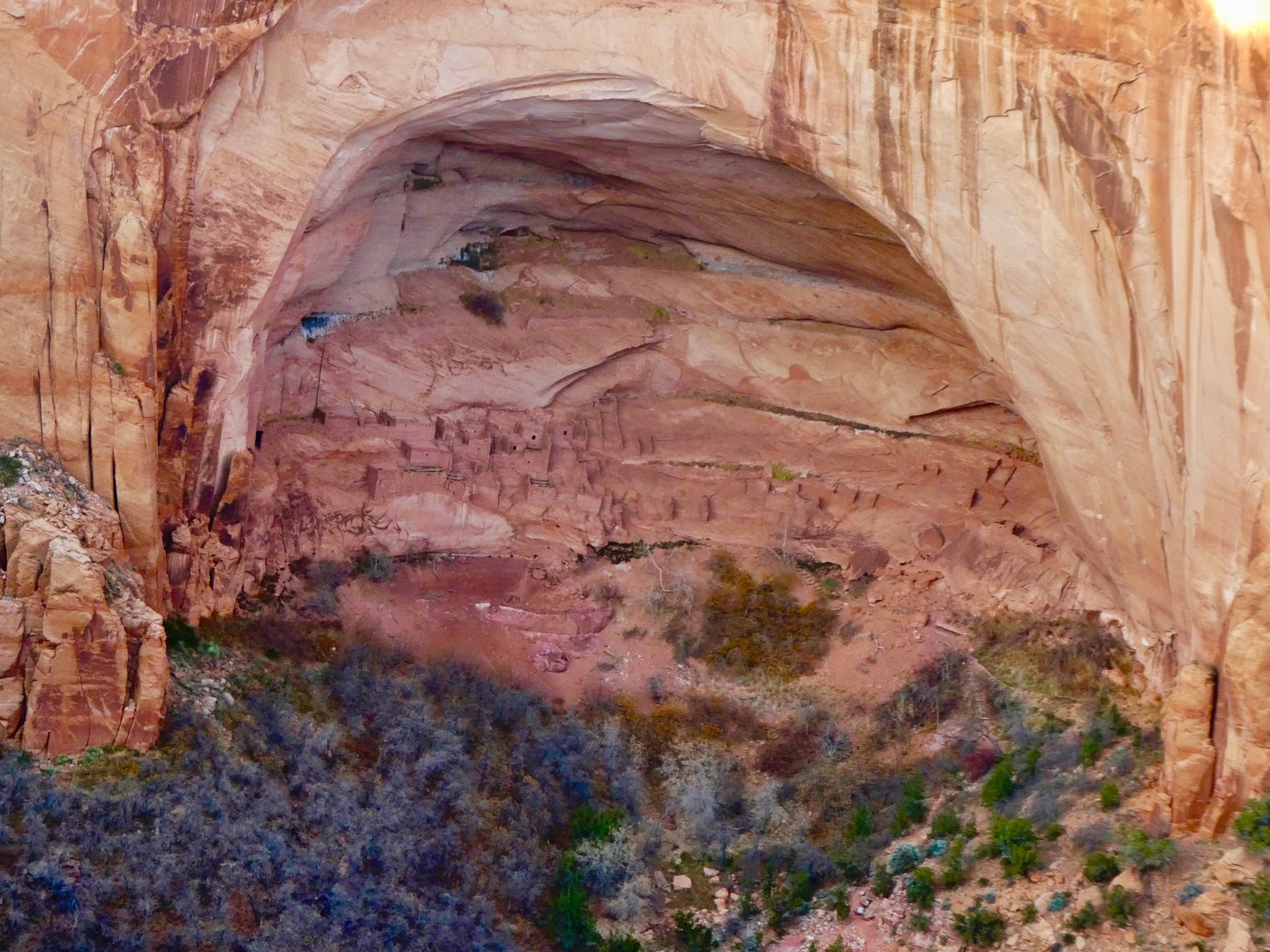
Navajo National Monument is a National Monumentlocated within the northwest portion of the Navajo Nation territory in northern Arizona, which was established to preserve three well-preserved cliff dwellings of the Ancestral Puebloan People: Broken Pottery (Kitsʼiil), Ledge House (Bitátʼahkin), and Inscription House (Tsʼah Biiʼ Kin). The monument is high on the Shonto plateau, overlooking the Tsegi Canyon system, west of Kayenta, Arizona. It features a visitor center with a museum, two short self-guided mesa top trails, two small campgrounds, and a picnic area. Rangers guide visitors on free tours of the Keet Seel and Betatakin cliff dwellings.“
After a short hike to view the Betatakin cliff dwelling, we settled into our lovely campsite for the evening. This time of year, the campground was nearly empty and is always free of charge!
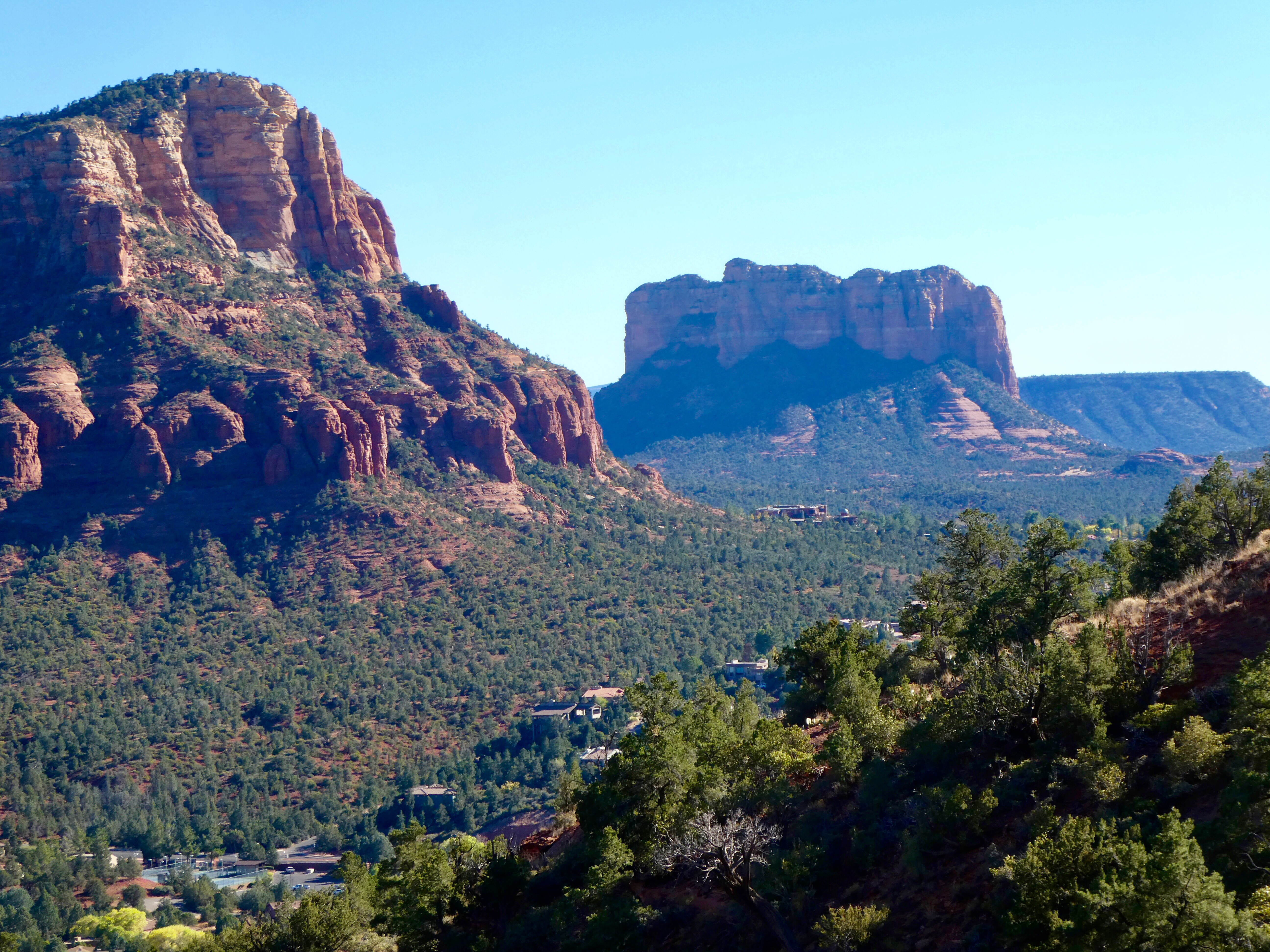
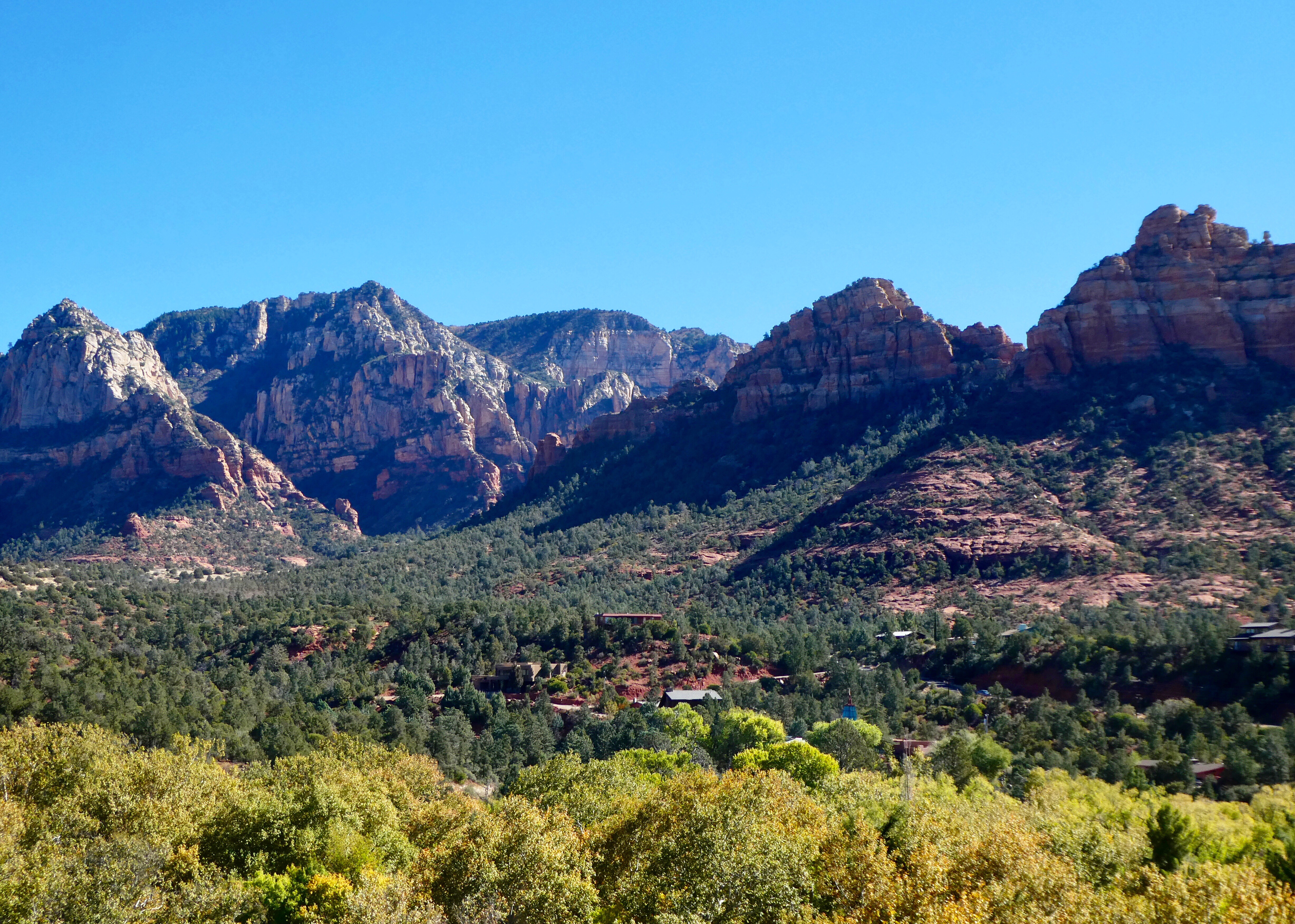
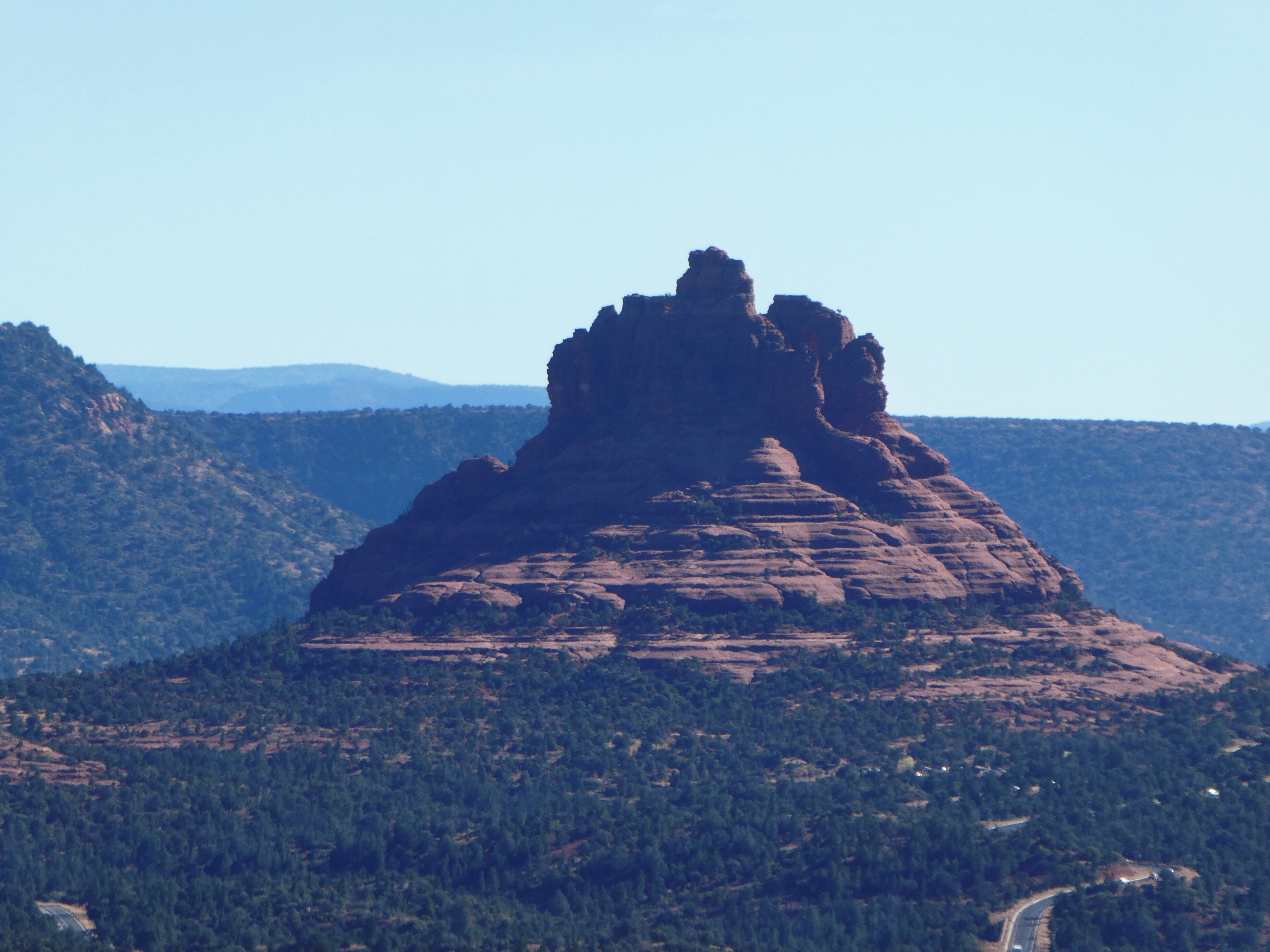
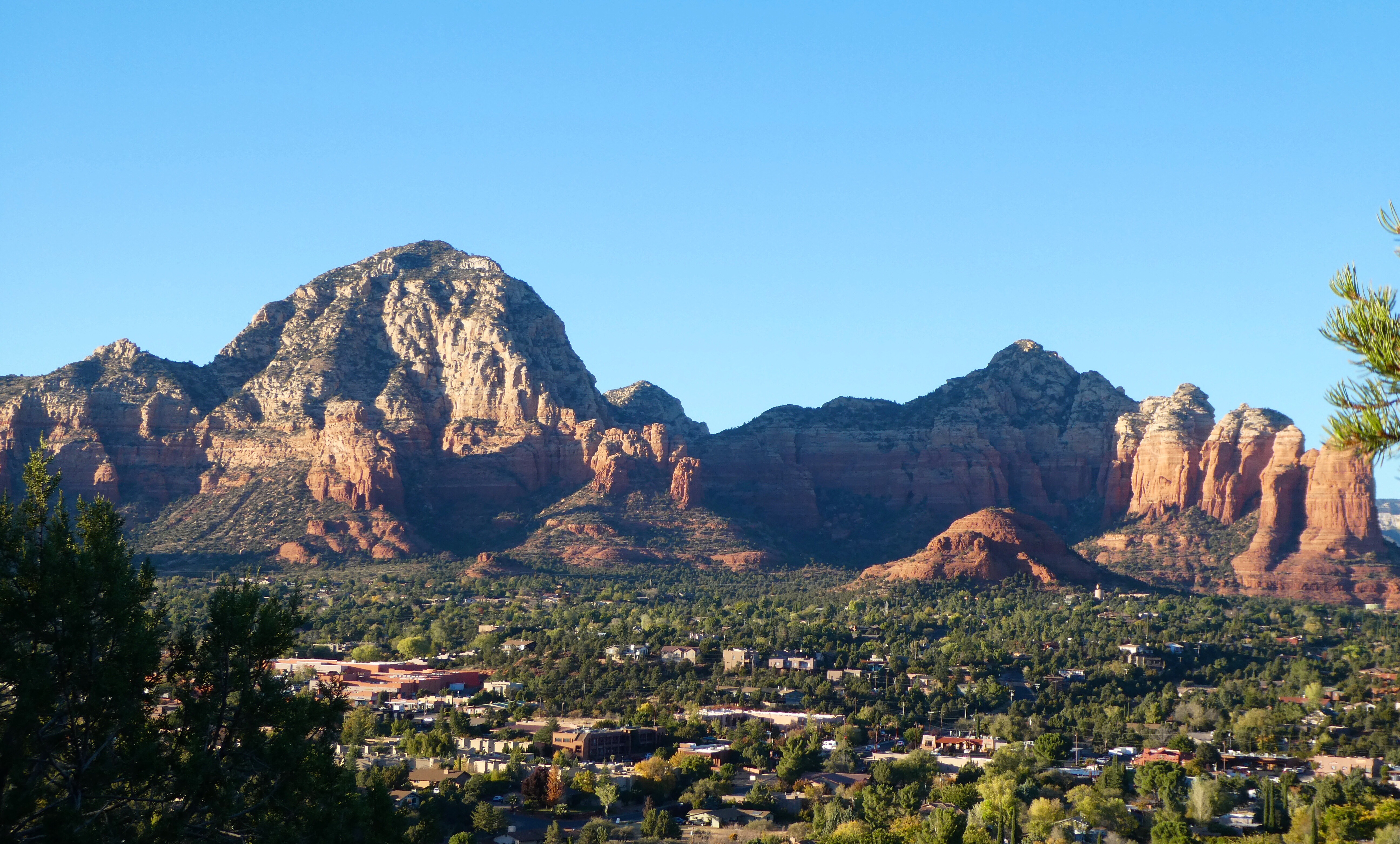
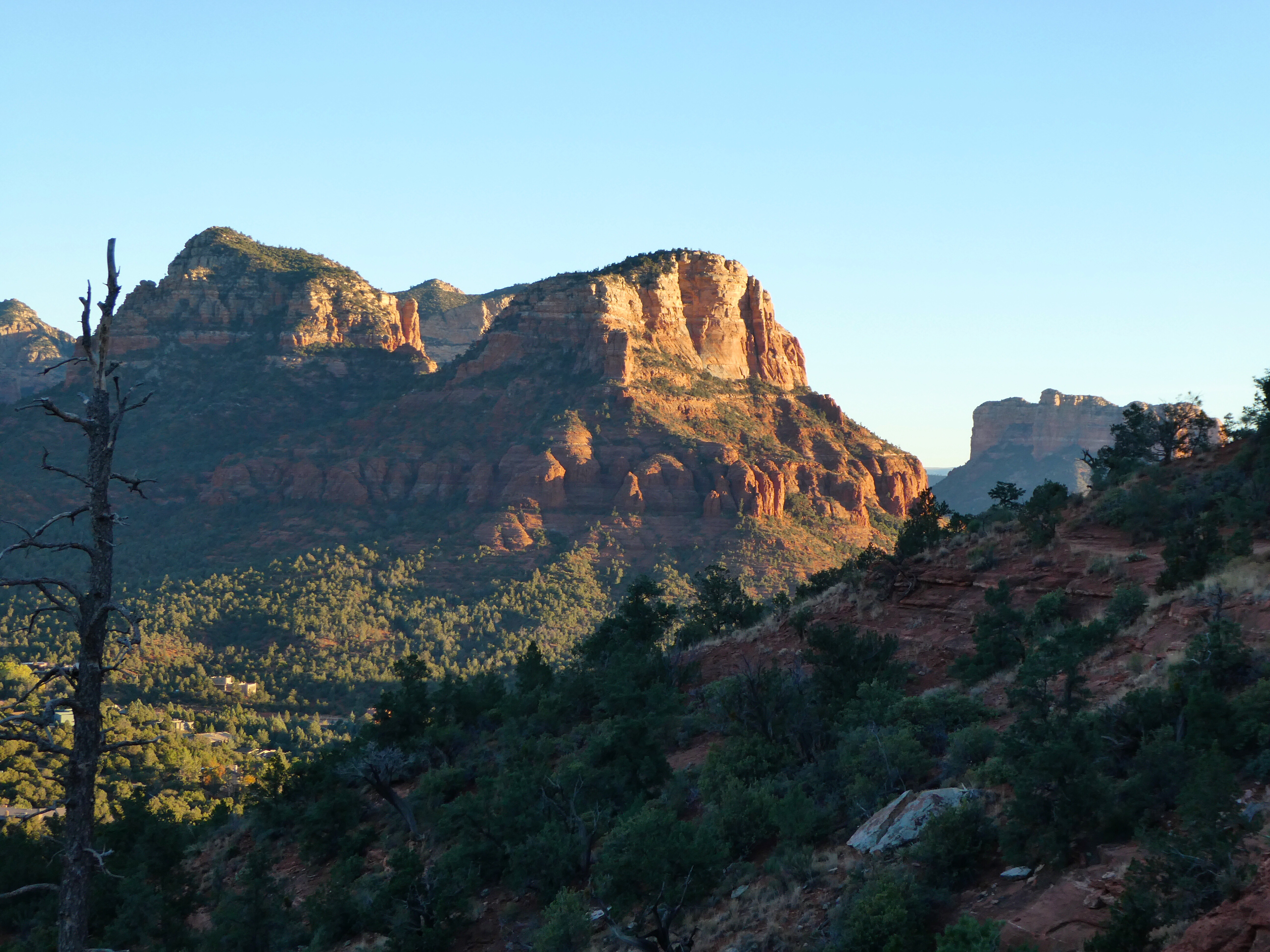
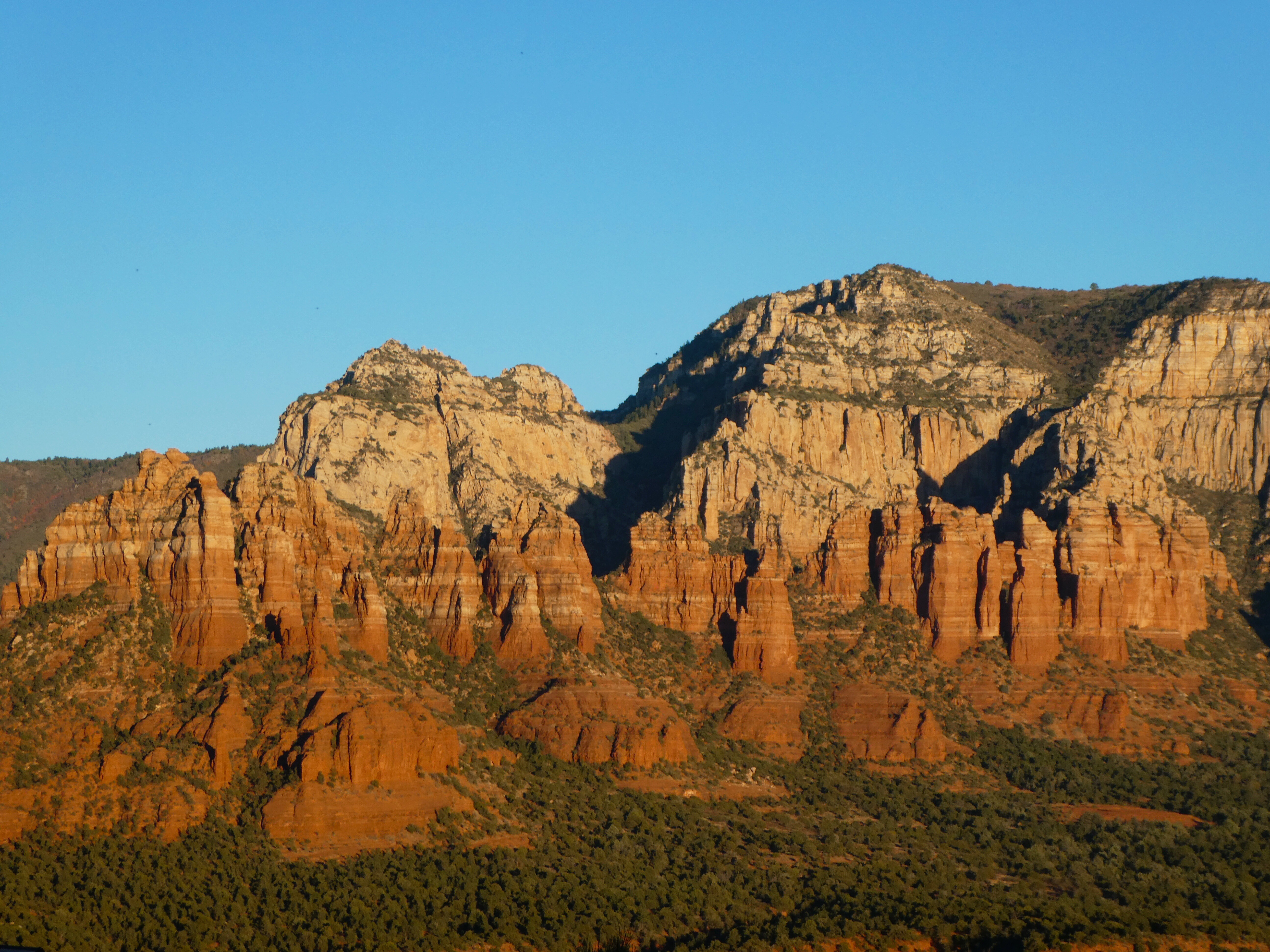
Sedona is an Arizona desert town near Flagstaff that’s surrounded by red-rock buttes, steep canyon walls and pine forests. It’s noted for its mild climate and vibrant arts community. Uptown Sedona is dense with New Age shops, spas and art galleries. On the town’s outskirts, numerous trailheads access Red Rock State Park, which offers bird-watching, hiking and picnicking spots.
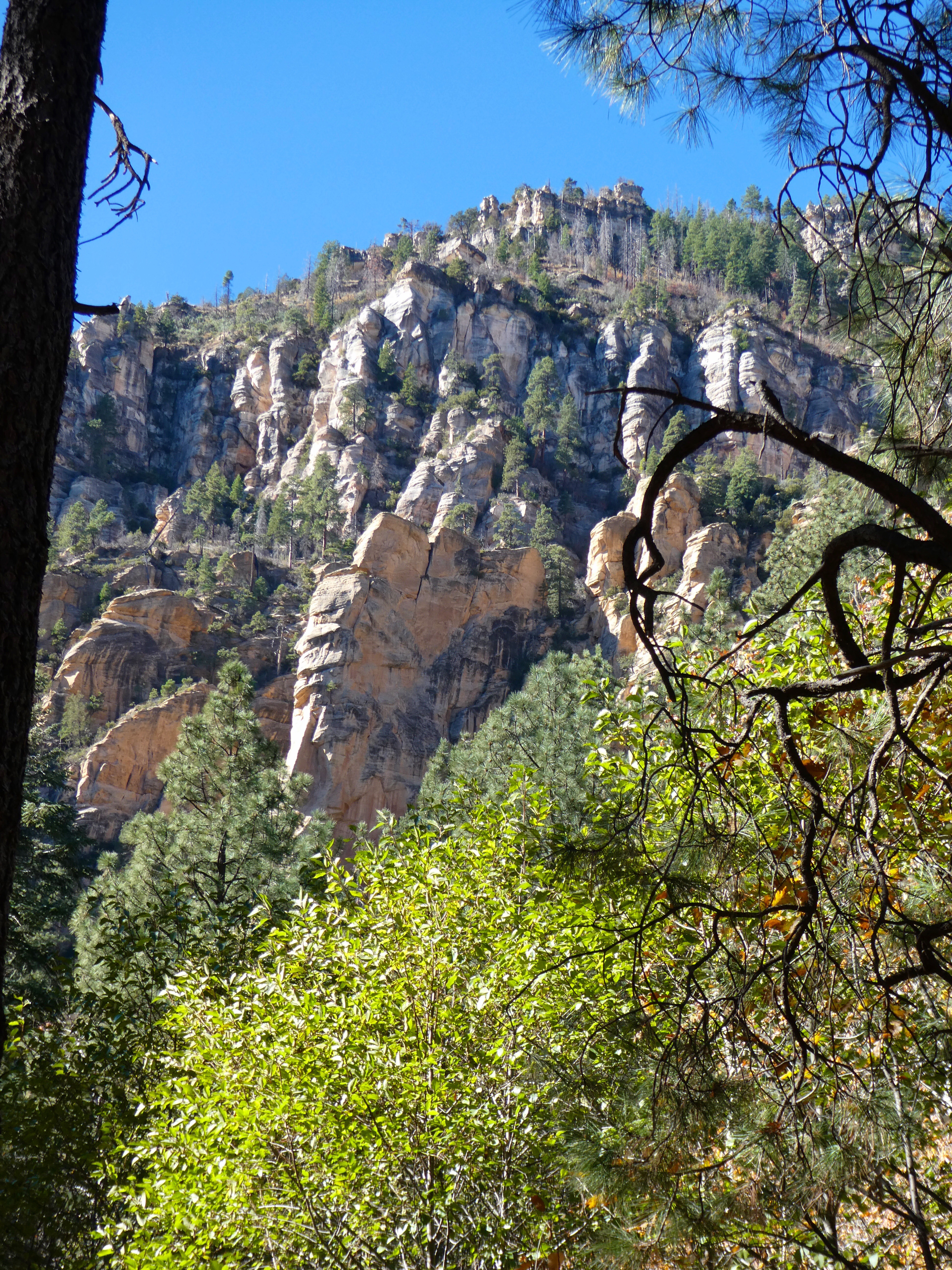
Dramatic sandstone formations such as Cathedral Rock and Bell Rock appeal to photographers and enlightenment-seekers, as does the modernist Chapel of the Holy Cross, built into rust-colored rocks. Oak Creek Canyon has trails for hiking and mountain biking, plus sites for camping and fishing. Part of the canyon is home to Slide Rock State Park, named for its natural water chutes, popular for swimming. Native American petroglyphs can be seen in the Coconino National Forest heritage sites V Bar V, Palatki and Honanki (the latter 2 also feature cliff dwellings).
Oak Creek Canyon
Airport Mesa Loop Trail
After visiting one of the four famous Sedona vortexes, we enjoyed a beautiful 4.5 mile sunset hike around Tabletop Mesa.
There is no other hike in the Sedona area that offers such awe-inspiring views as the Sedona Airport Mesa Loop Trail. It offers hikers a 360-degree panorama with views of almost every major red-rock landmark along the perimeter at an elevation of 4,500 feet.
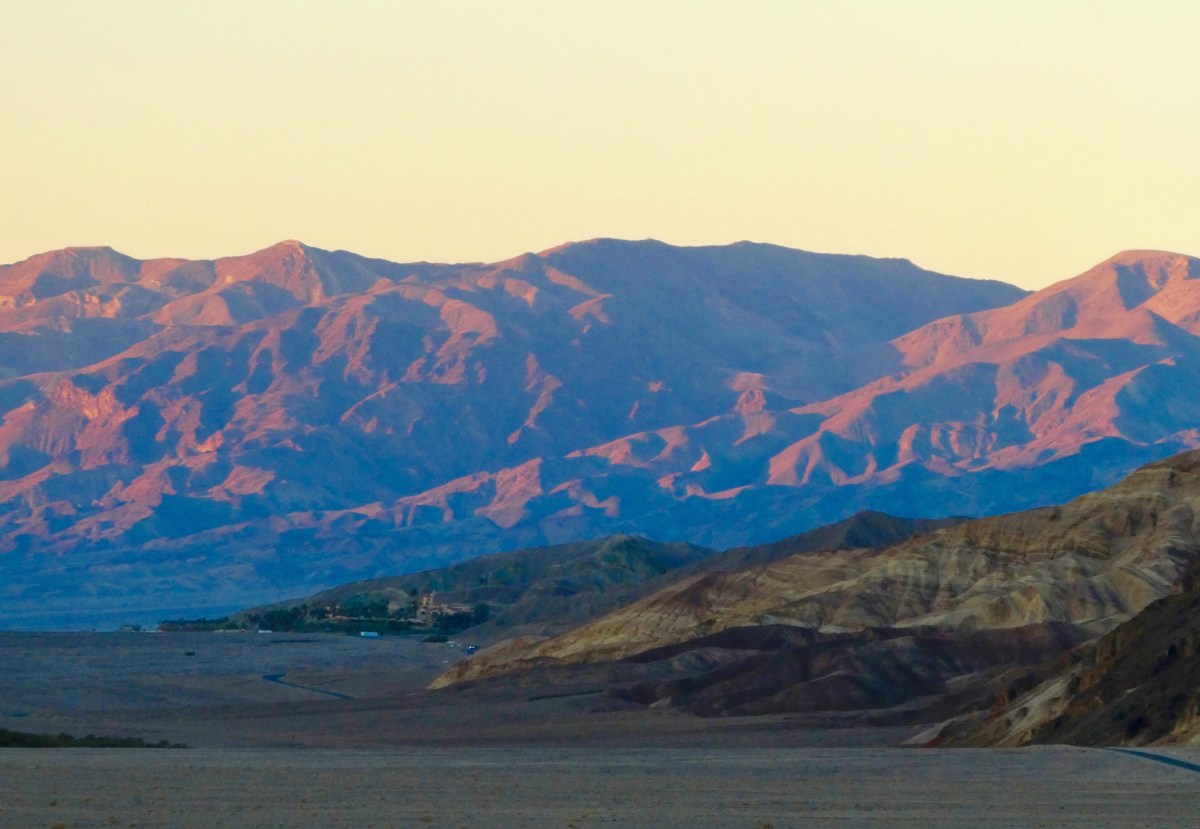
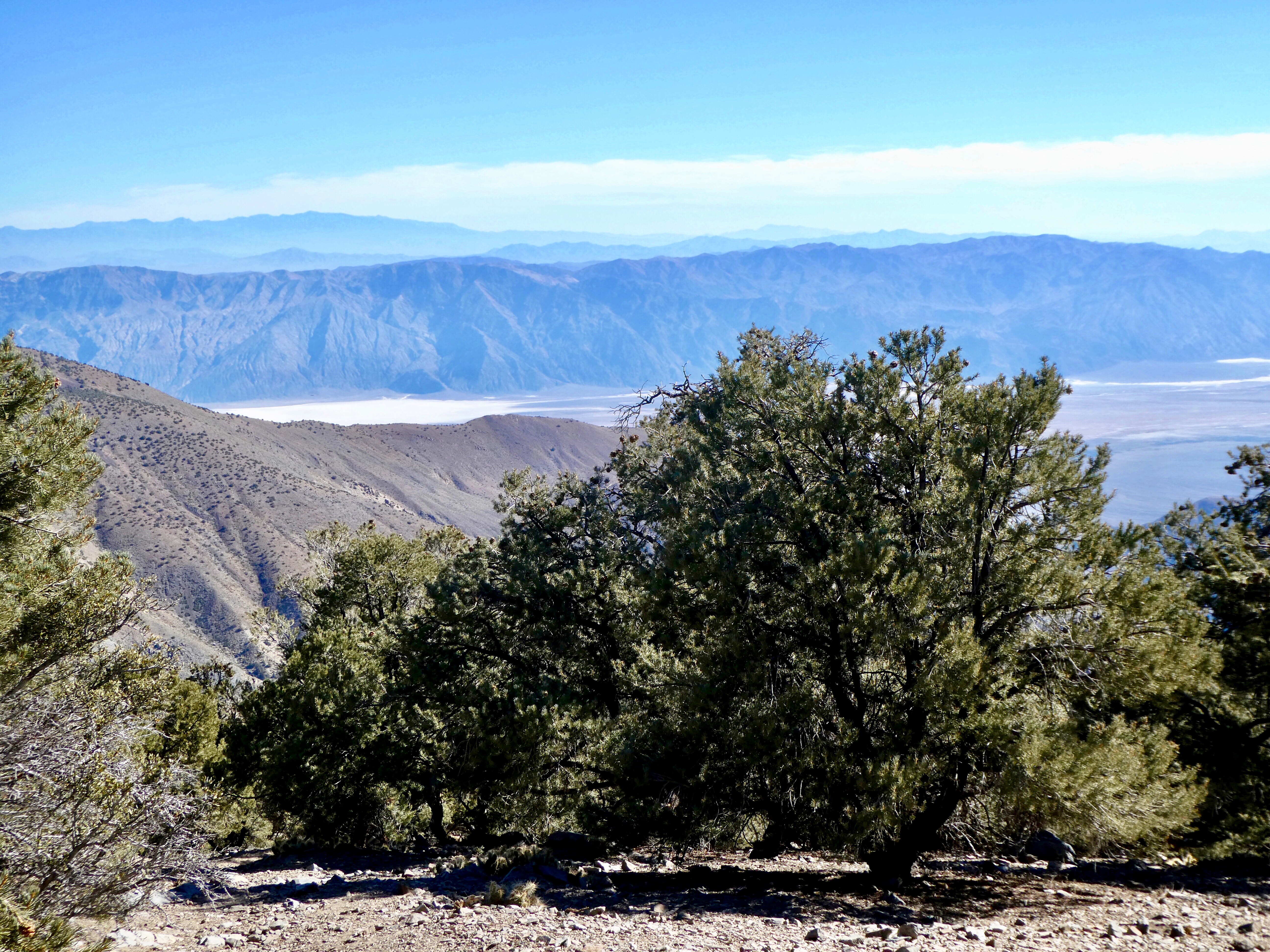
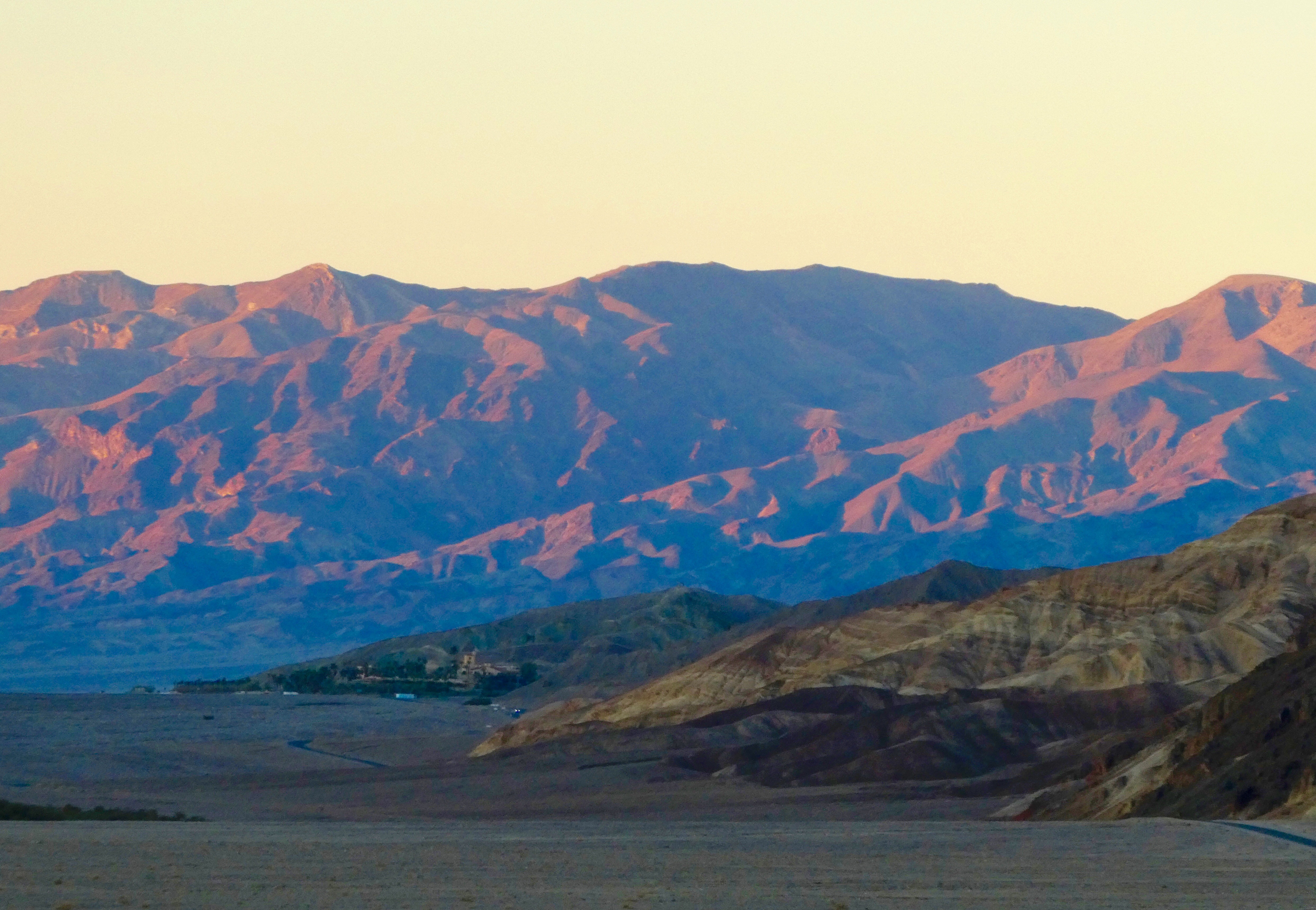
With 3 million acres of wilderness, Death Valley is the largest national park outside Alaska. Elevations in the park range from -282 feet below sea level at Bad Water (the lowest point in North America), to 11,049 feet at Telescope Peak. The park encompasses 3.3 million acres and normally enjoys summer temperatures in the 110’s and 120’s, but also experienced a record temperature of 134 degrees Fahrenheit. It is considered the hottest place on earth and the driest place in the United States.
Of the more than 900 plant species found, 19 are unique to this area.
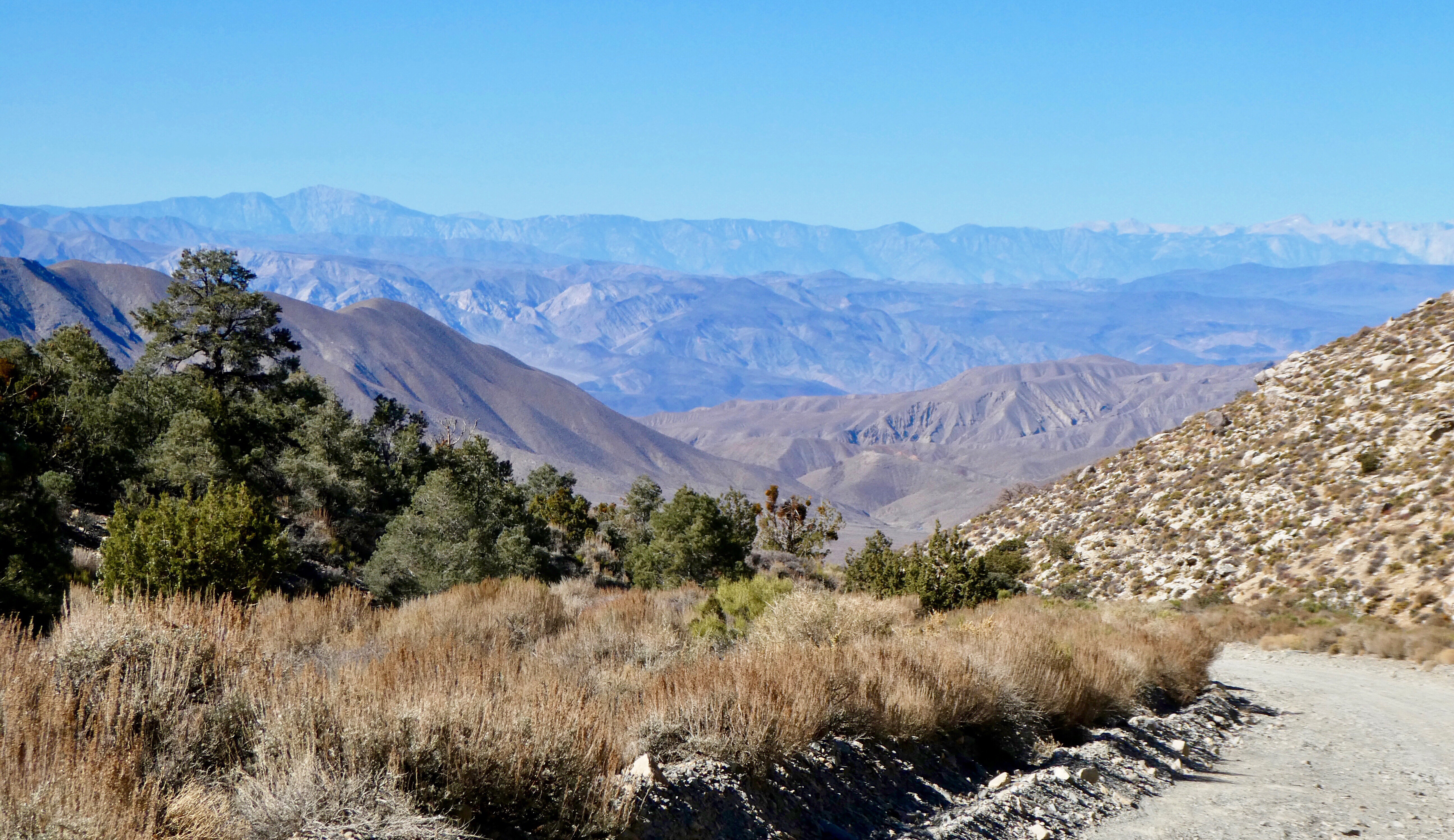
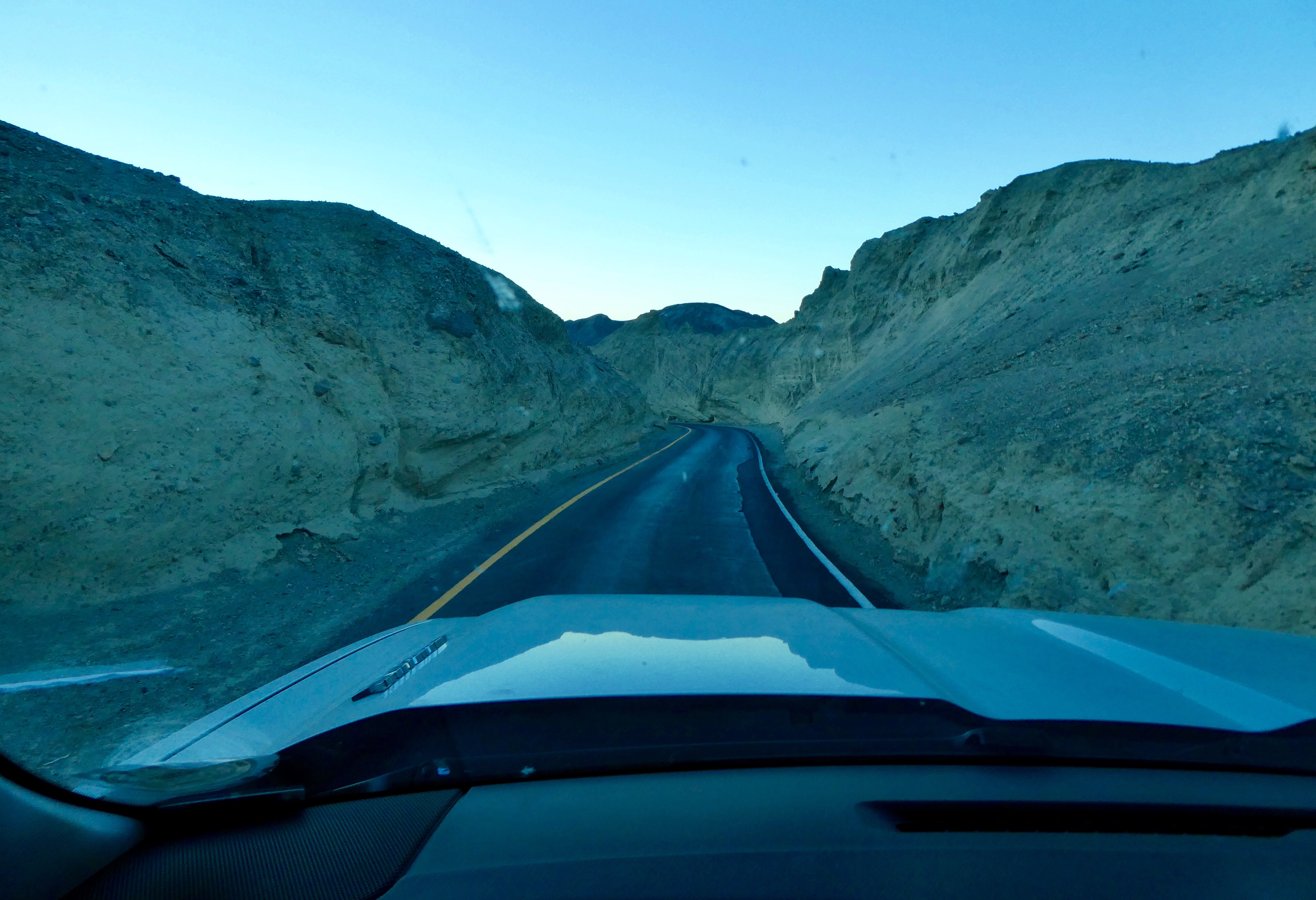
Driving in from the south as the sun sets, we make our way up a narrow winding road to the Wildrose Campground at 4,100 ft elevation. The mountains being much cooler than the surrounding desert, the temperature dropped quickly from 72 degrees, down to a low of 31 degrees in the early morning.
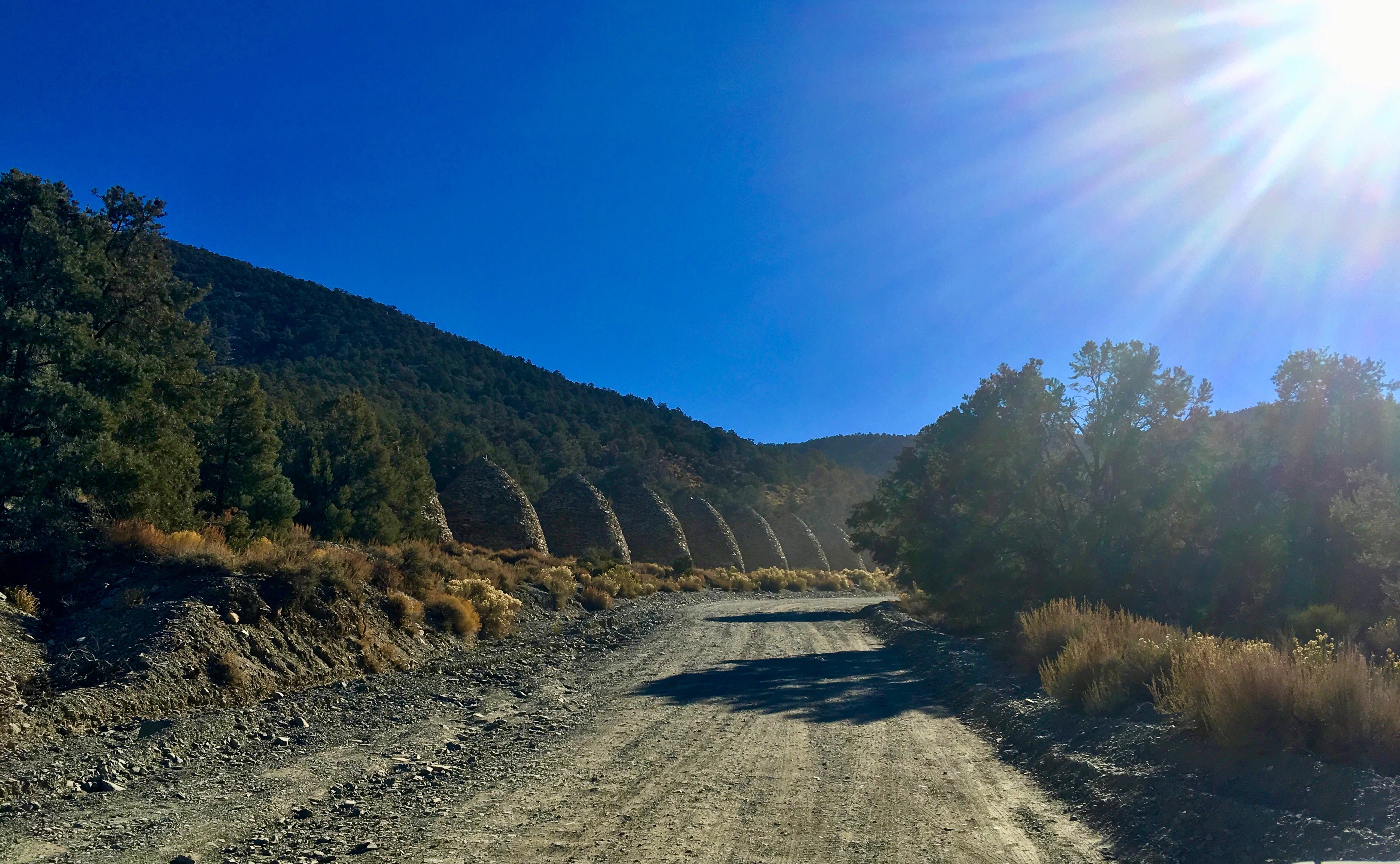
Up early at Wildrose Campground, we drove the dirt road up Wildrose Canyon toward the Charcoal Kilns and Mahogany Flats.
The 25’ high Charcoal Kilns were used to produce charcoal to smelt lead and silver from local ore mined beginning in 1877, and ceased operations shortly afterward.
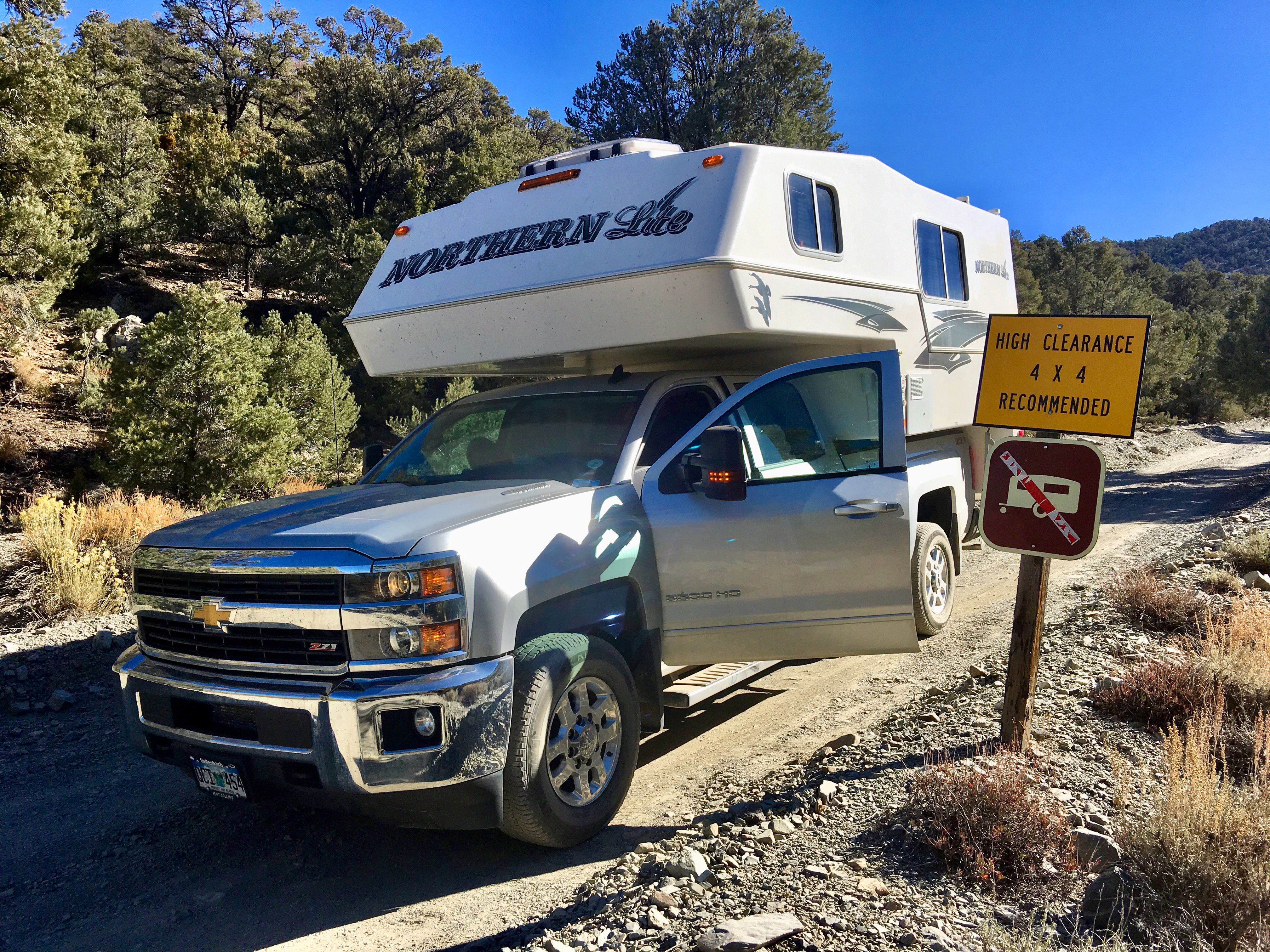
After the Kilns, the 4WD Road gets a bit rough, climbing to the Mahogany Flats Campground and the road’s end at 8,133 ft.
Returning the way we came, we head for the Visitor’s Center to view the exhibits and plan a sunset photo tour of the park.
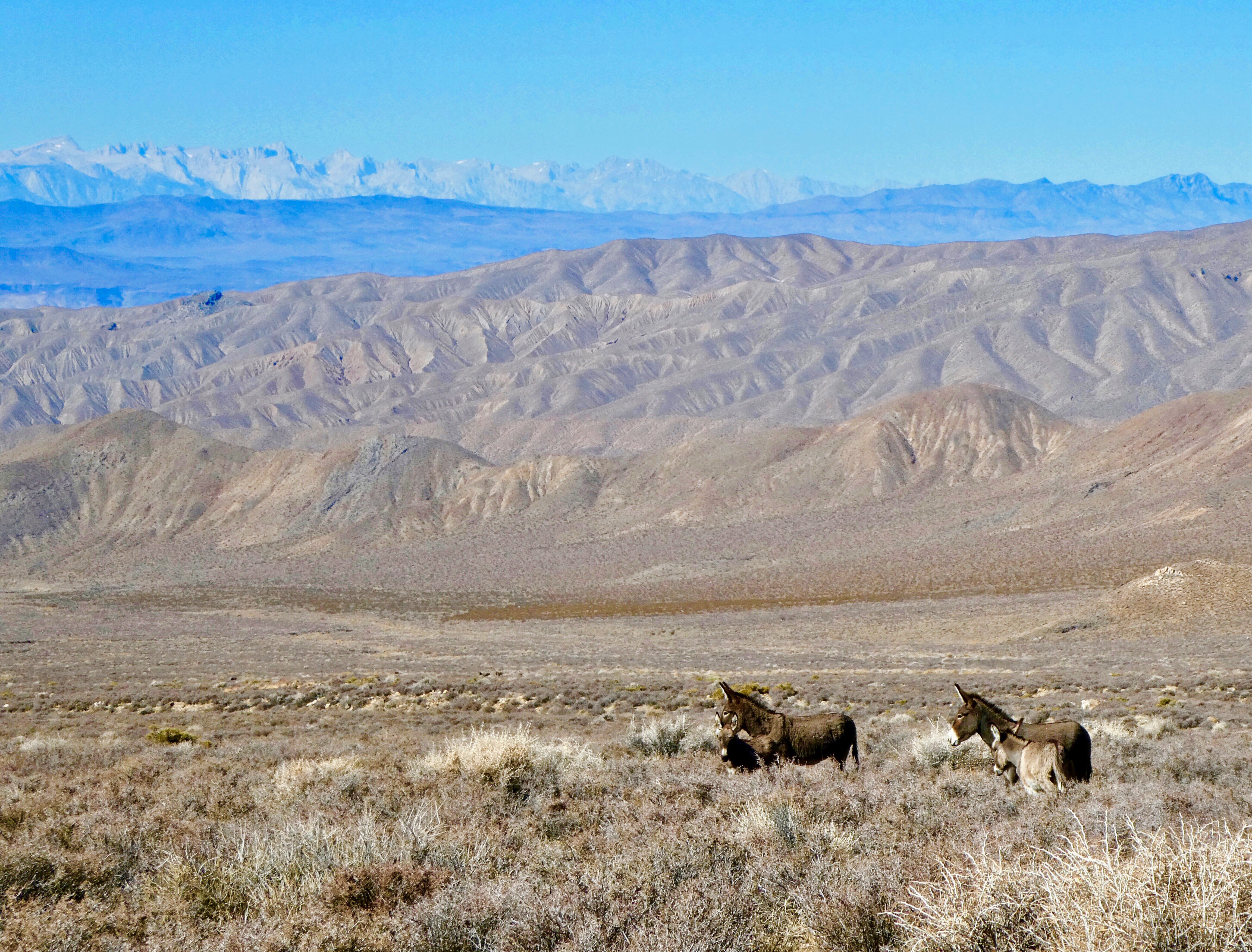
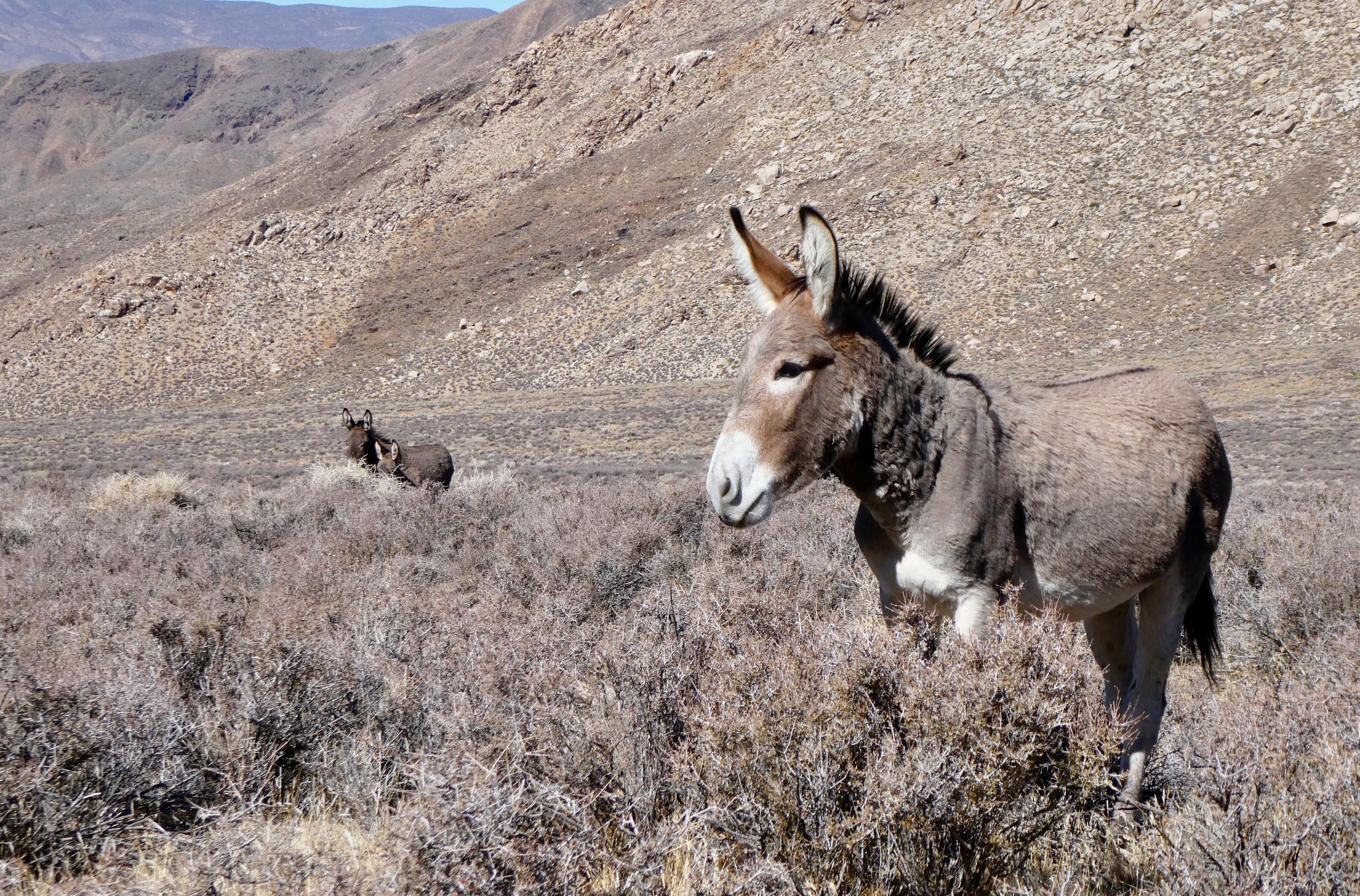
On the way, we encounter a small herd of feral donkeys, turned loose after mining operations ceased in the late 19th century.
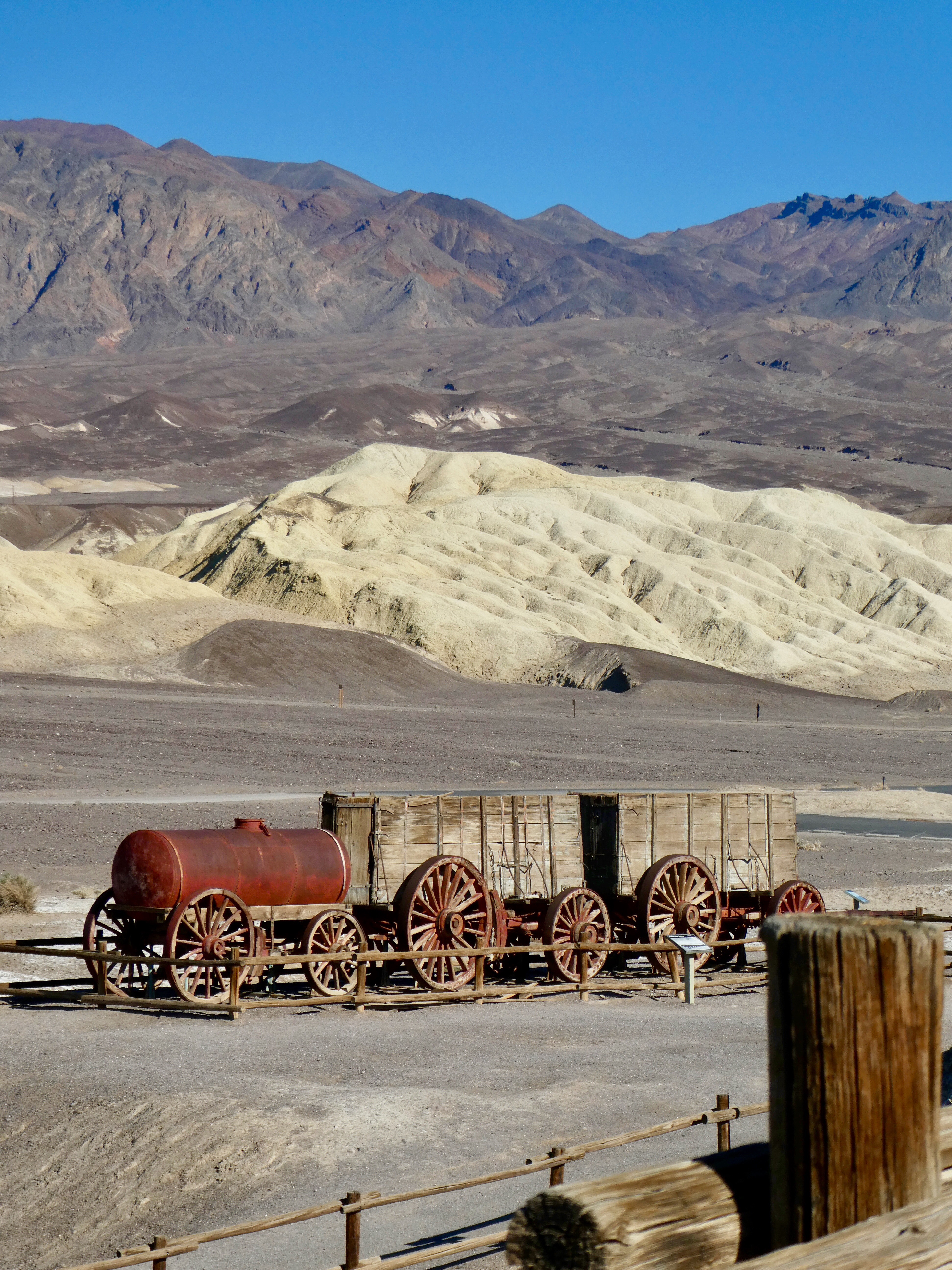
From the Visitor’s Center we set out for Bad Water Basin and Artists Drive before the sunset. On the way we pause at the Harmony Borax Works and an example of the “20 Mule Team” borax mining transportation and extraction methods.
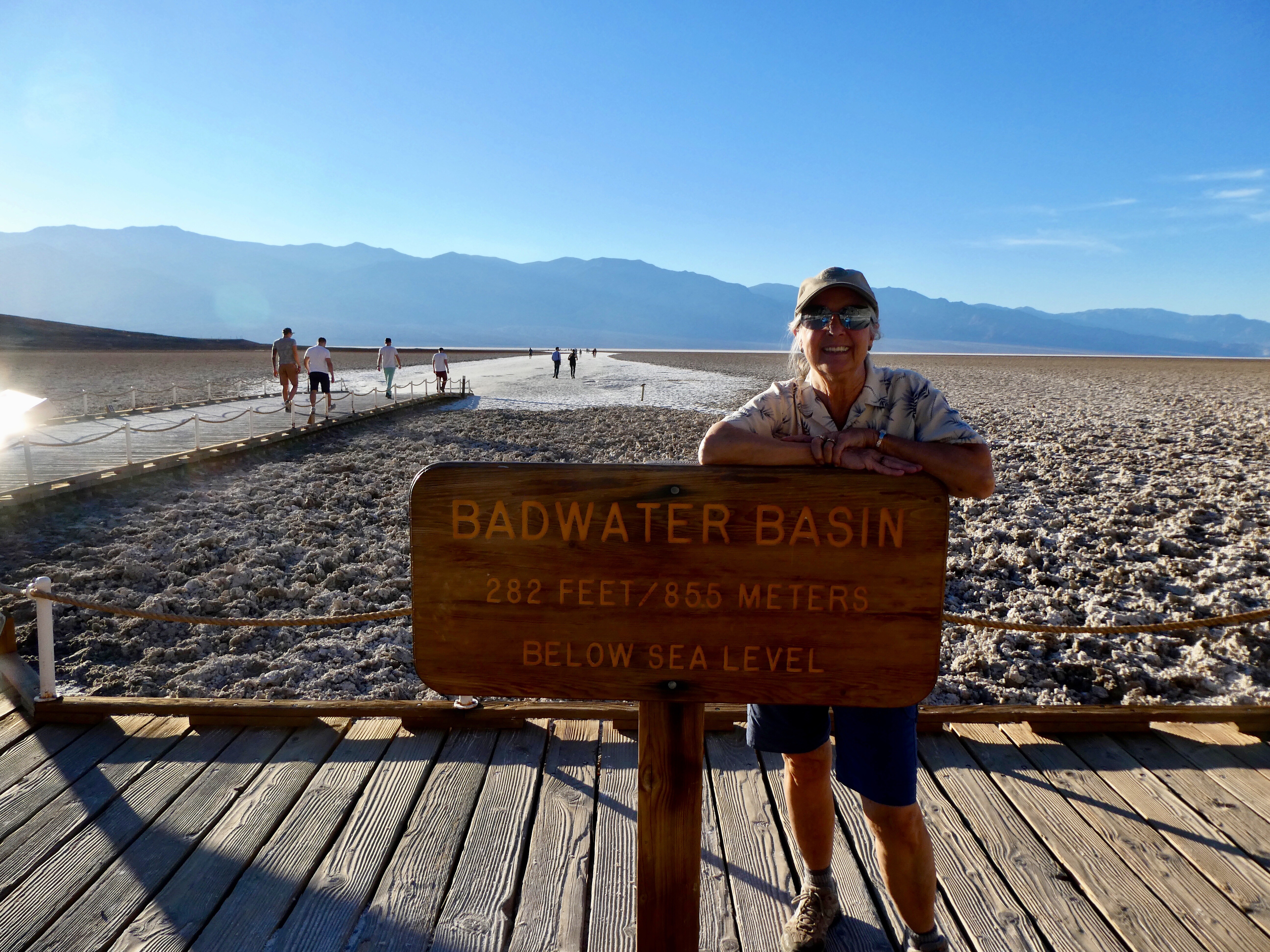
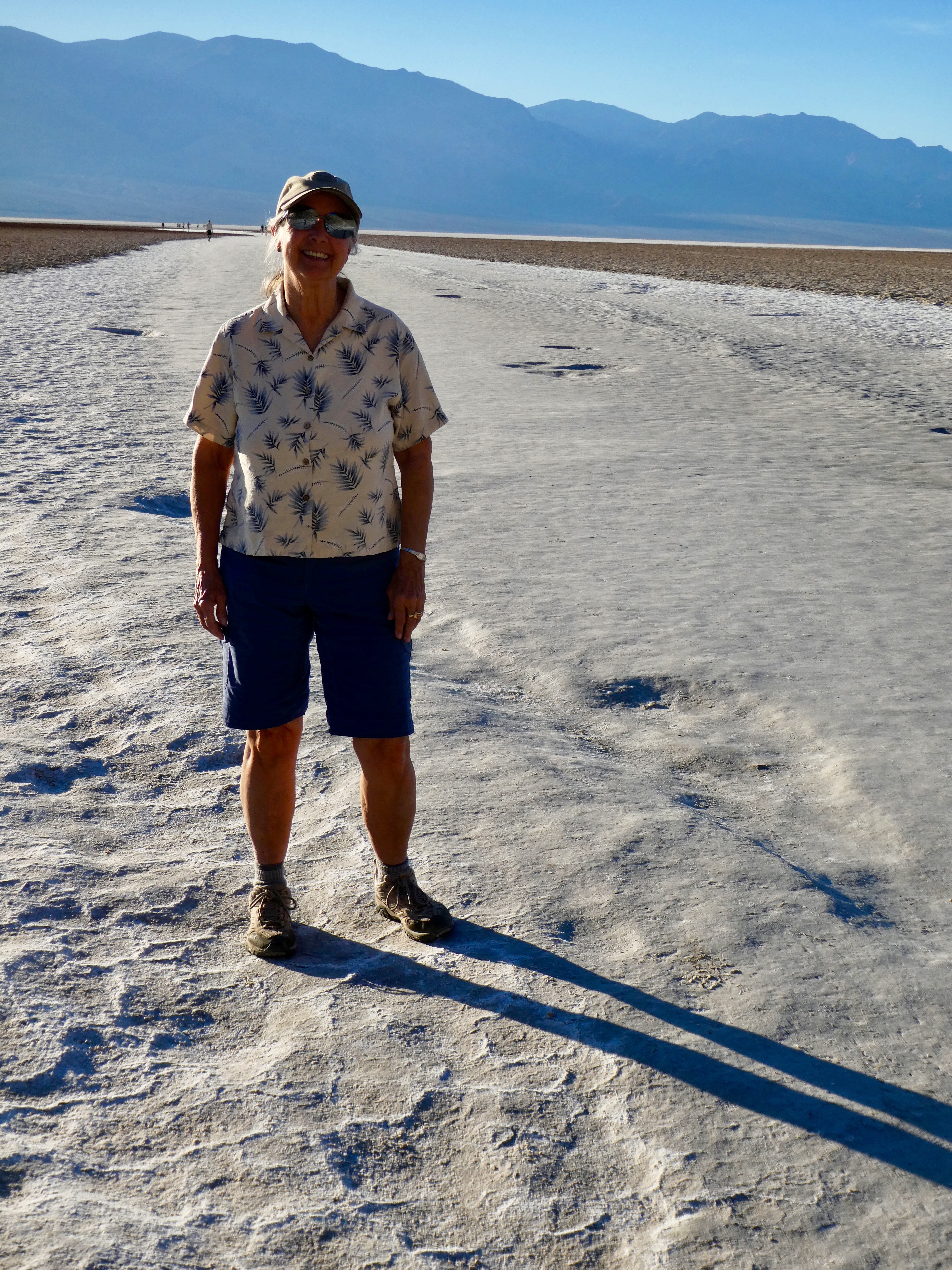
Next stop: Badwater Basin
Badwater Basin is an endorheic basin in Death Valley National Park, noted as the lowest point in North America, with a depth of 282 ft (86 m) below sea level. Mount Whitney, the highest point in the contiguous 48 United States, is only 84.6 miles (136 km) to the northwest.
The site itself consists of a small spring-fed pool of “bad water” next to the road in a sink; the accumulated salts of the surrounding basin make it undrinkable, thus giving it the name.
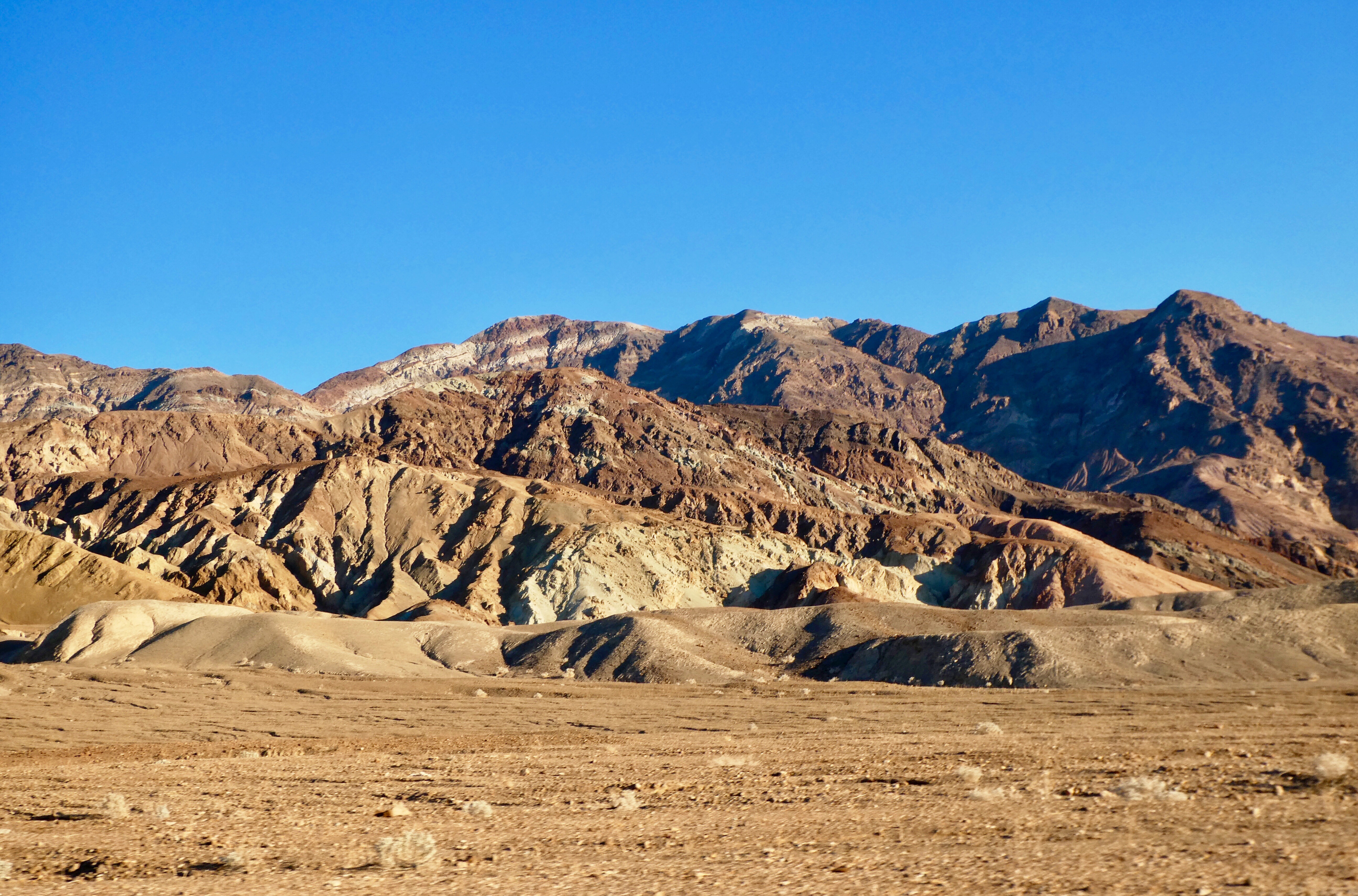
From Bad Water we quickly travel to Artists Drive to attempt to capture the beautiful mineral colors in the hot light of sunset.
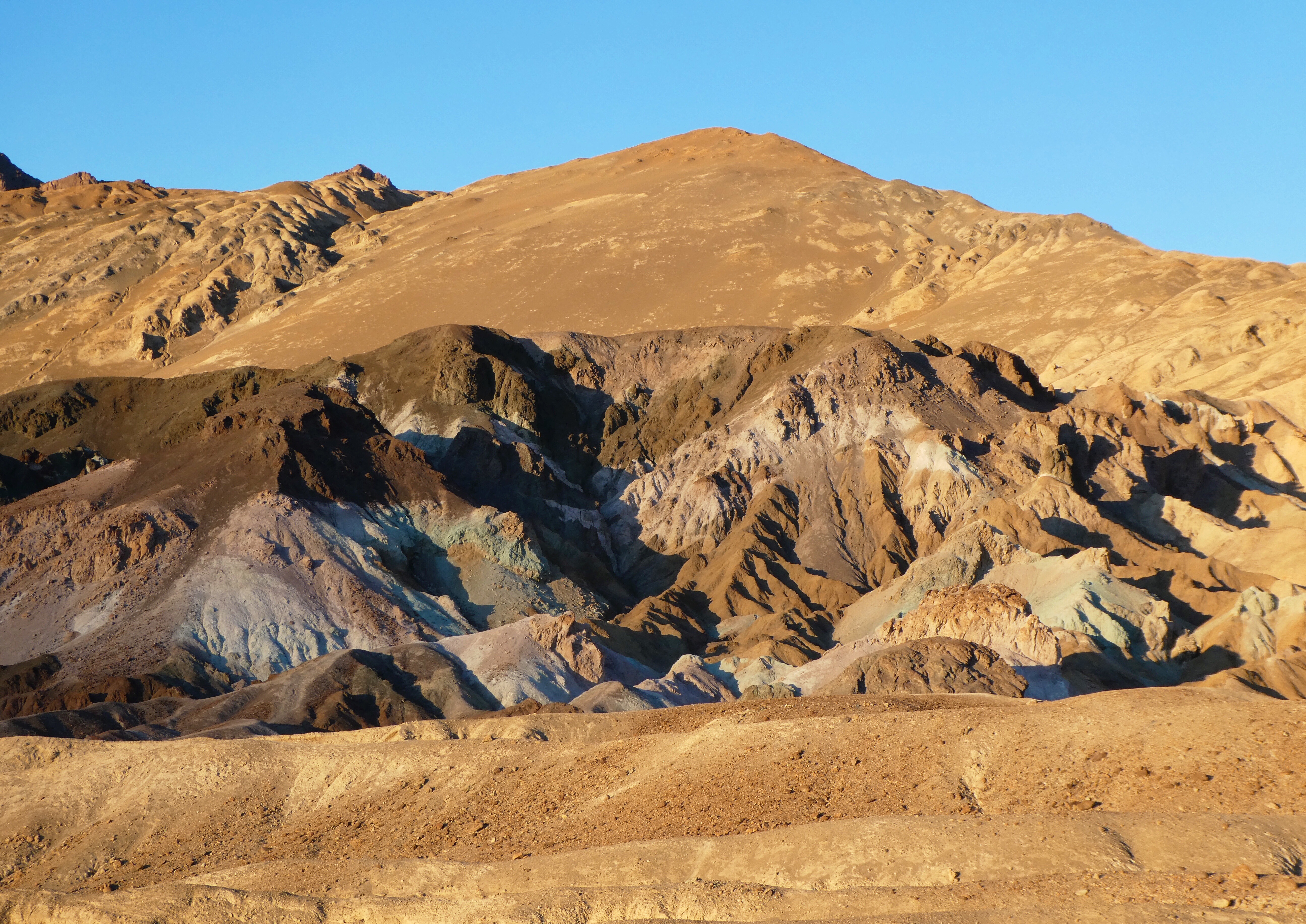
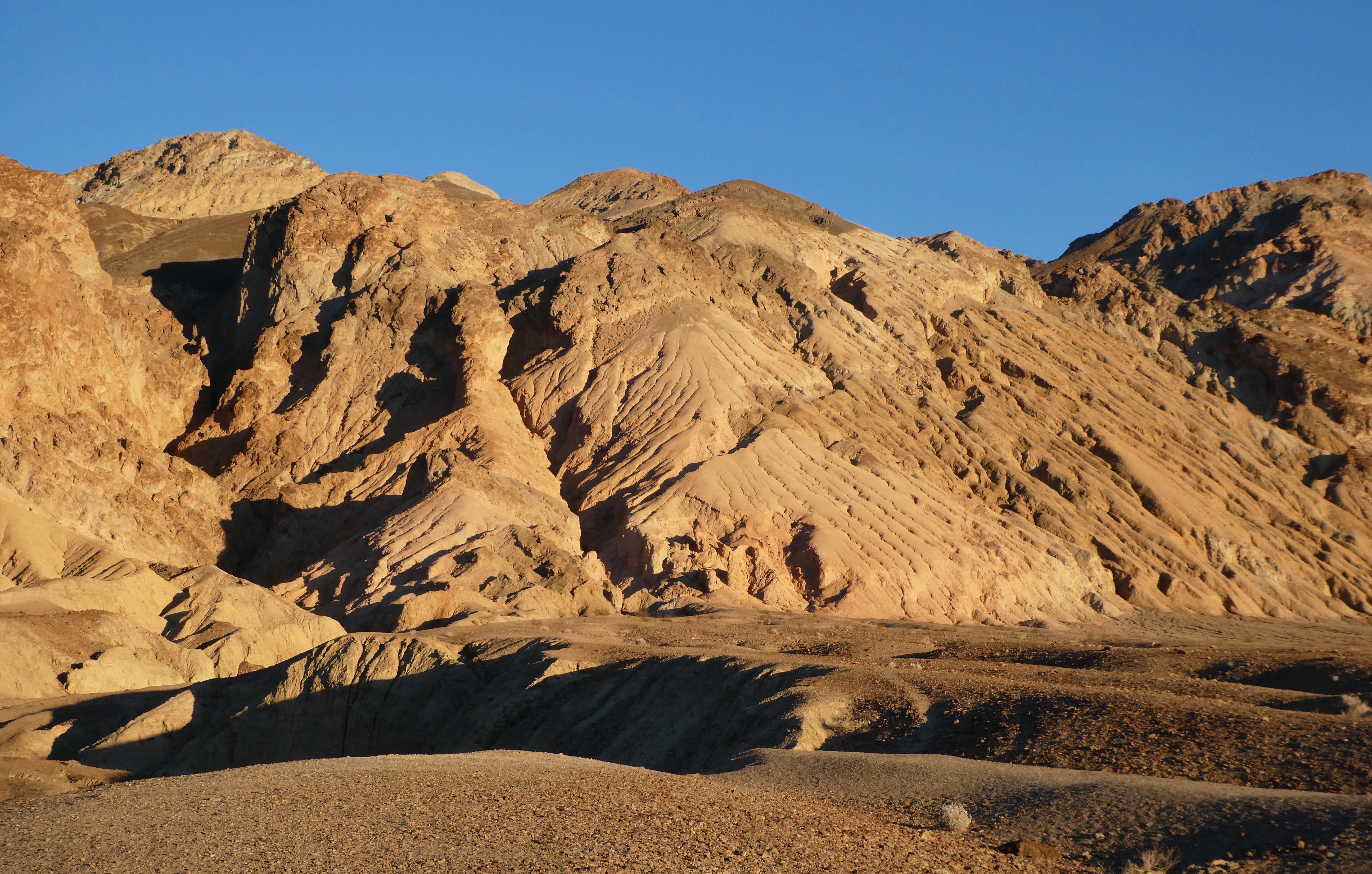
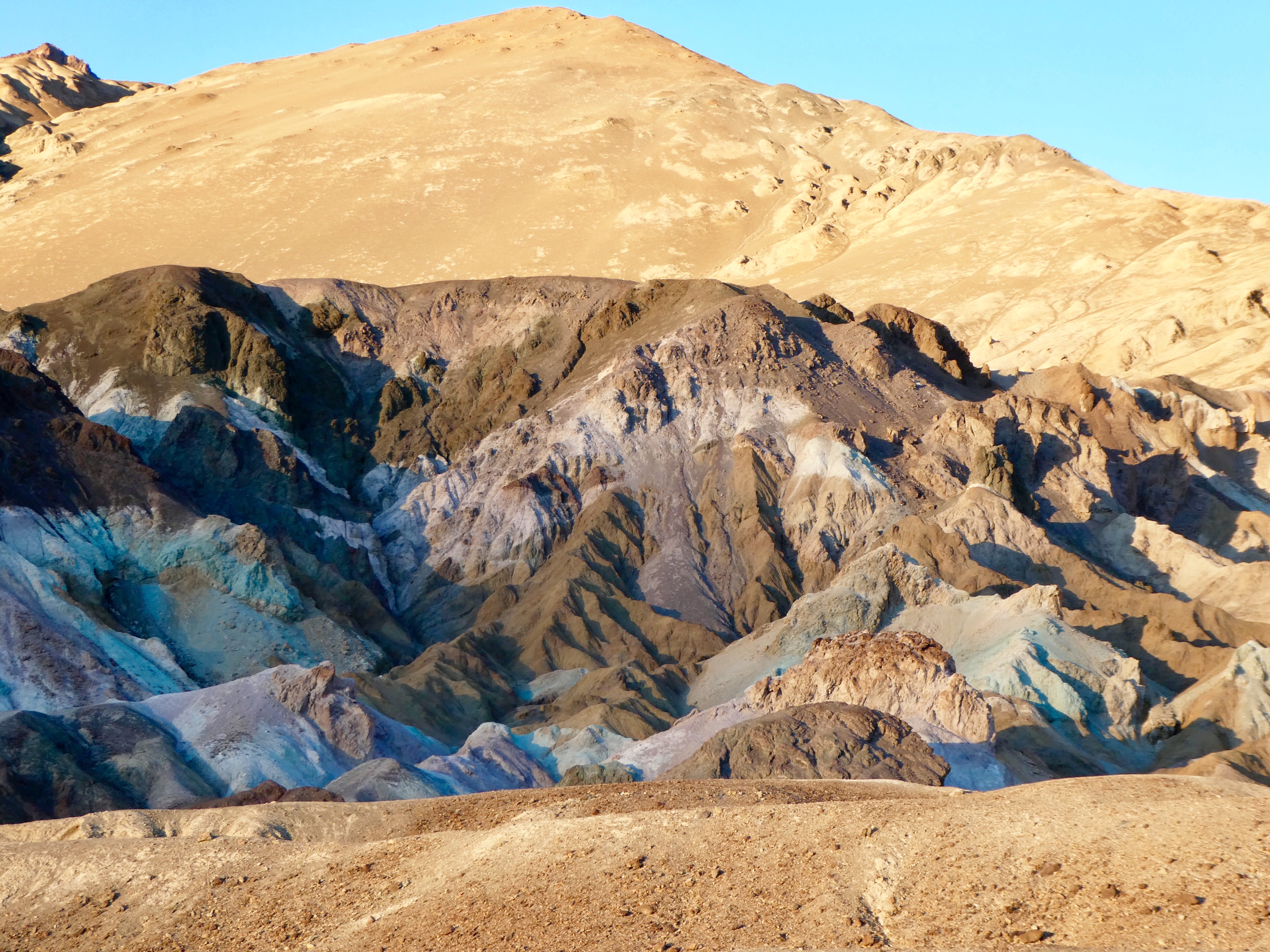
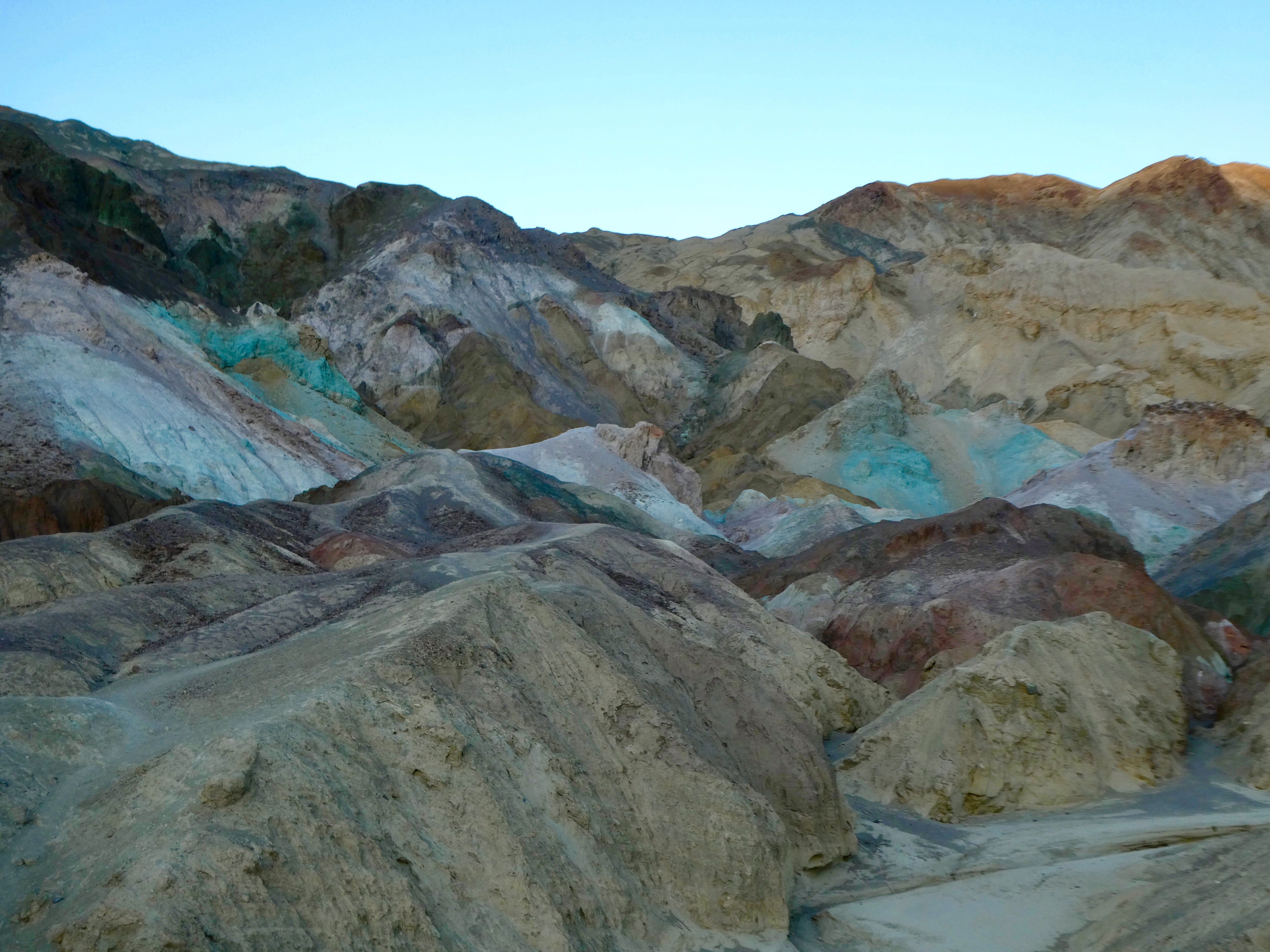
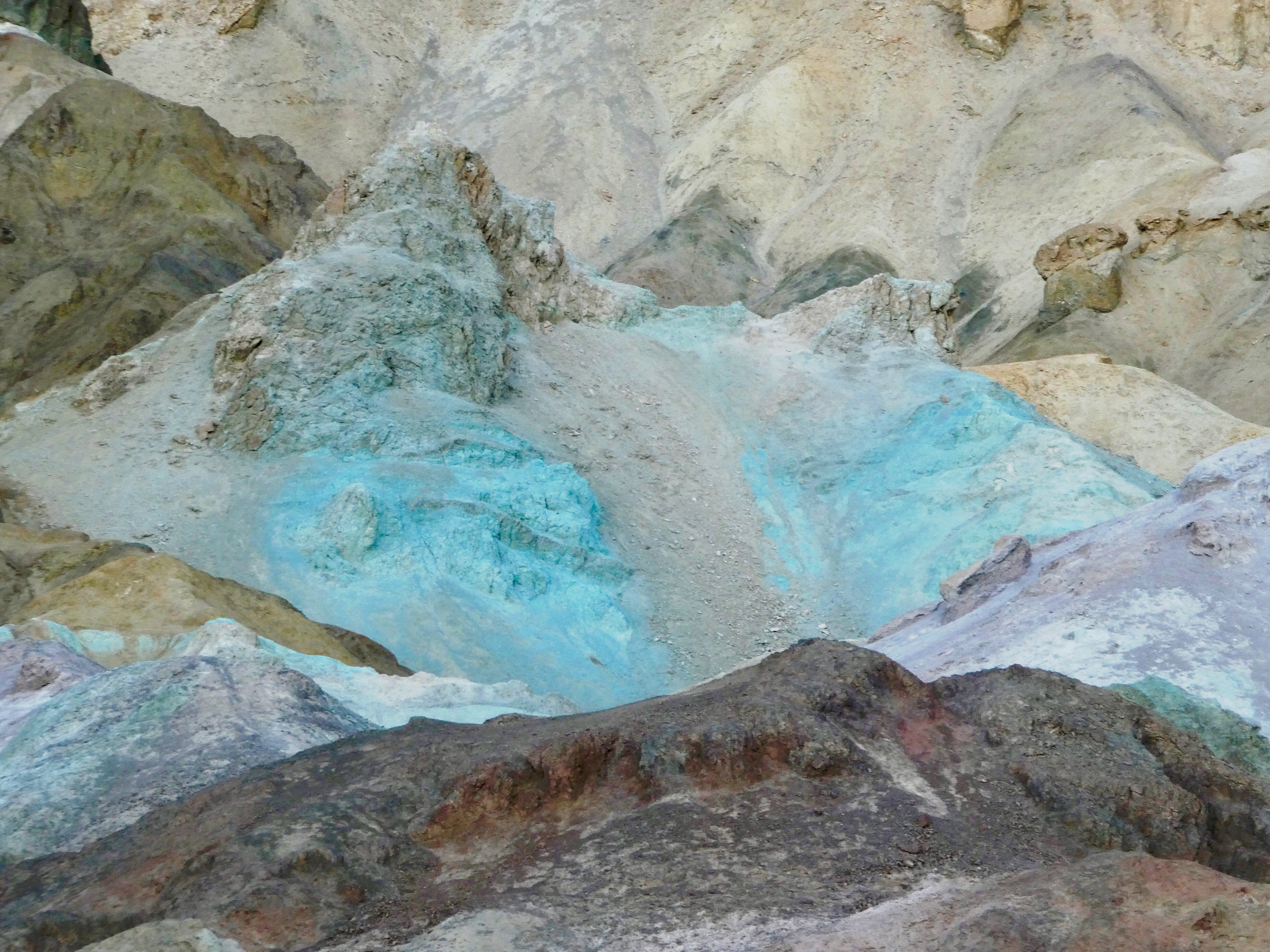
Artist’s Drive rises up to the top of an alluvial fan fed by a deep canyon cut into the Black Mountains. Artist’s Palette is an area on the face of the Black Mountains noted for a variety of rock colors. These colors are caused by the oxidation of different metals (iron compounds produce red, pink and yellow, decomposition of tuff-derived mica produces green, and manganese produces purple).
Called the Artist Drive Formation, the rock unit provides evidence for one of the Death Valley area’s most violently explosive volcanic periods. The Miocene-aged formation is made up of cemented gravel, playa deposits, and volcanic debris, perhaps 5,000 feet (1500 m) thick. Chemical weathering and hydrothermal alteration cause the oxidation and other chemical reactions that produce the variety of colors displayed in the Artist Drive Formation and nearby exposures of the Furnace Creek Formation.
Artists Palette
Artists Drive is a very narrow one-way road restricted to vehicles less than 25 feet in length.
Alas, dusk put an end to our photographic endeavors, but a sunset dinner back at our campsite provided more than adequate recompense.
There is so much to experience in Death Valley and we have barely scratched the surface. We will undoubtedly return!
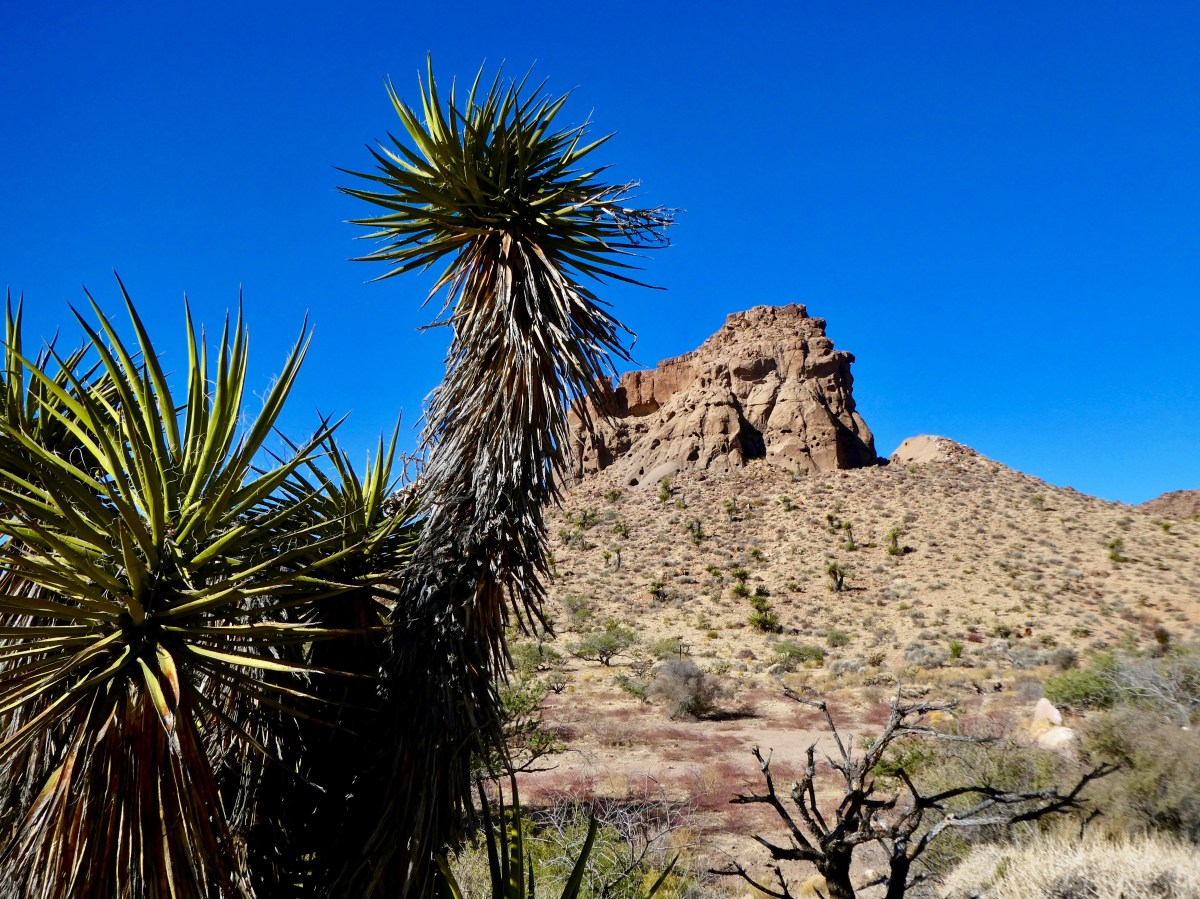
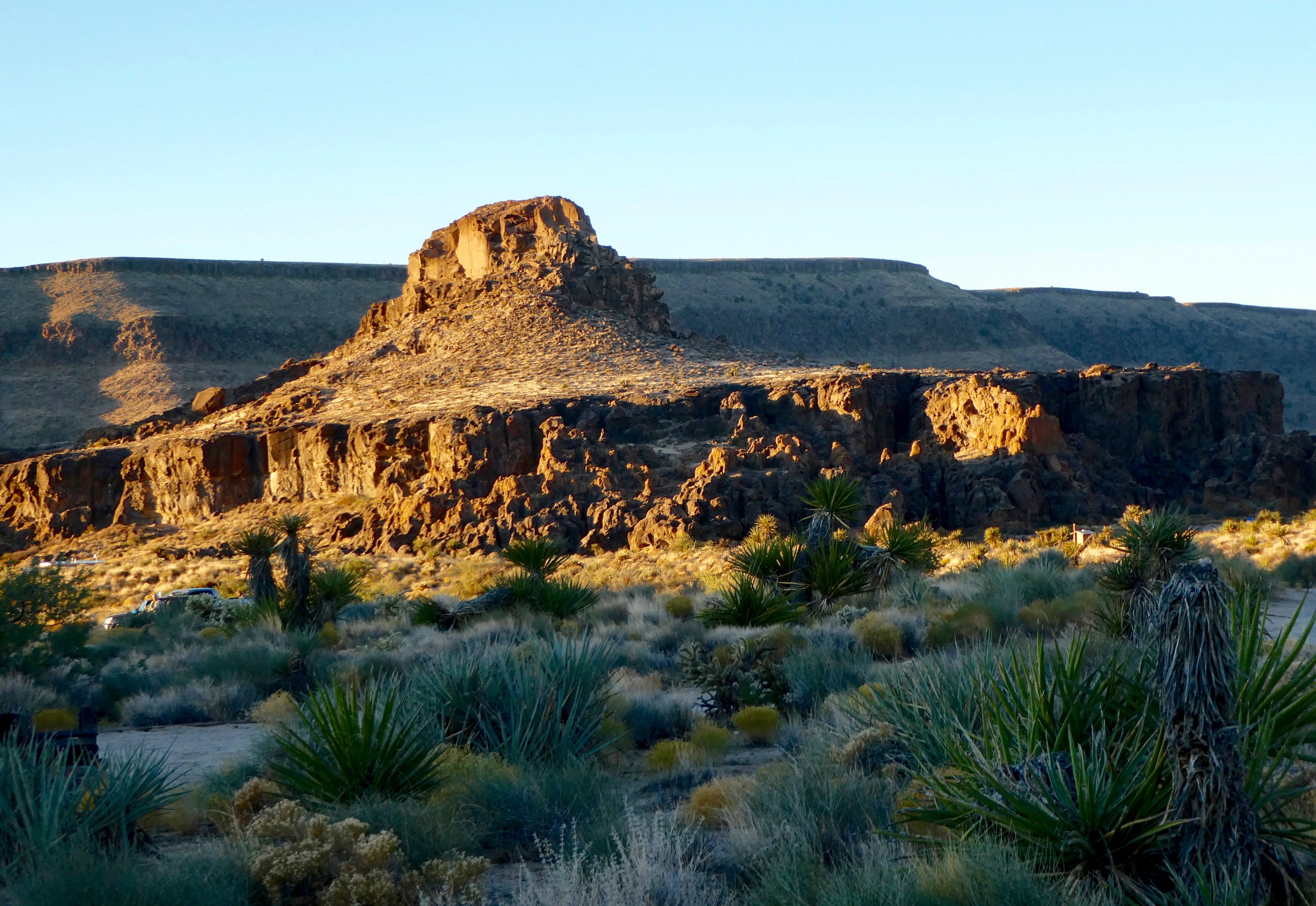
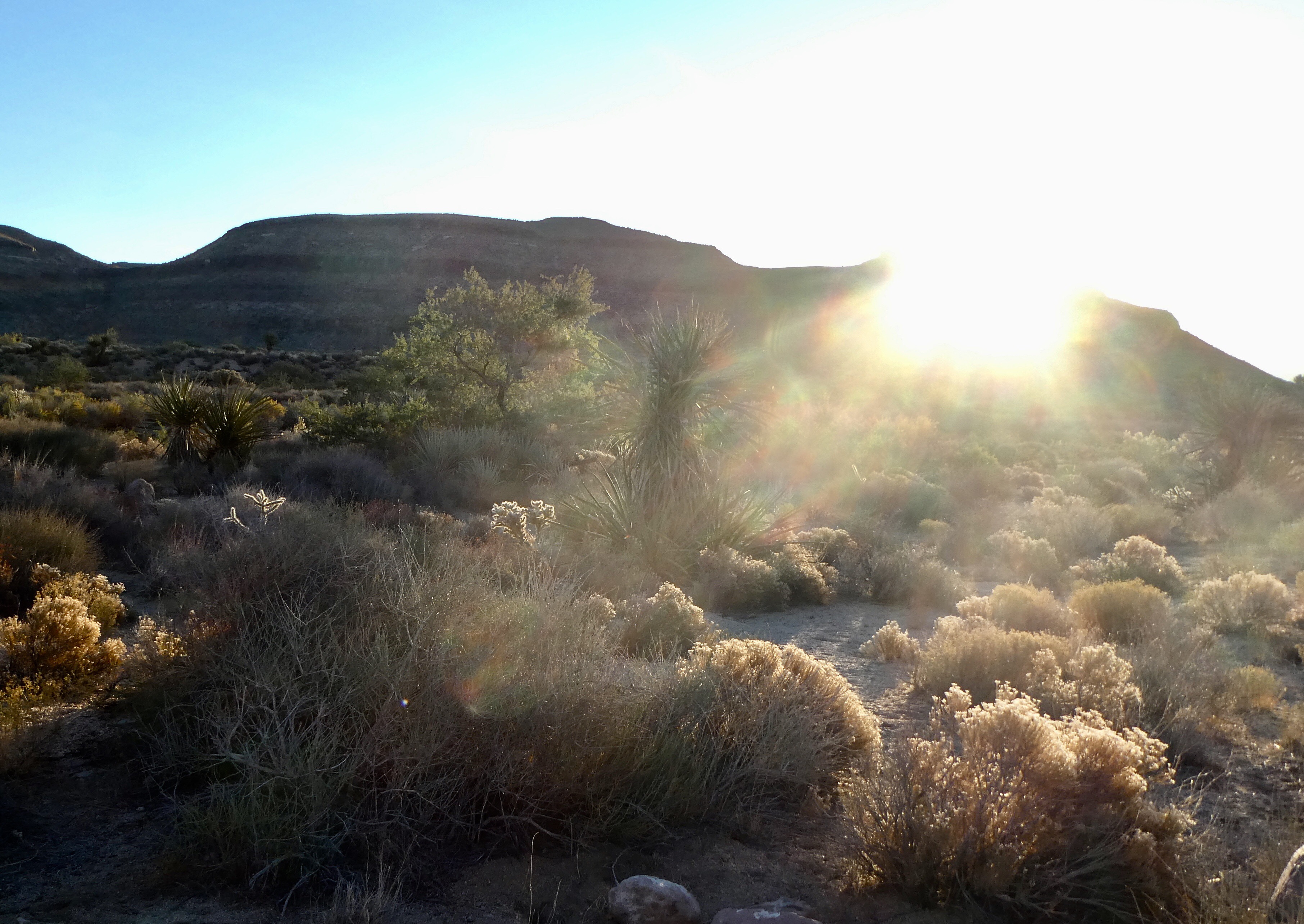
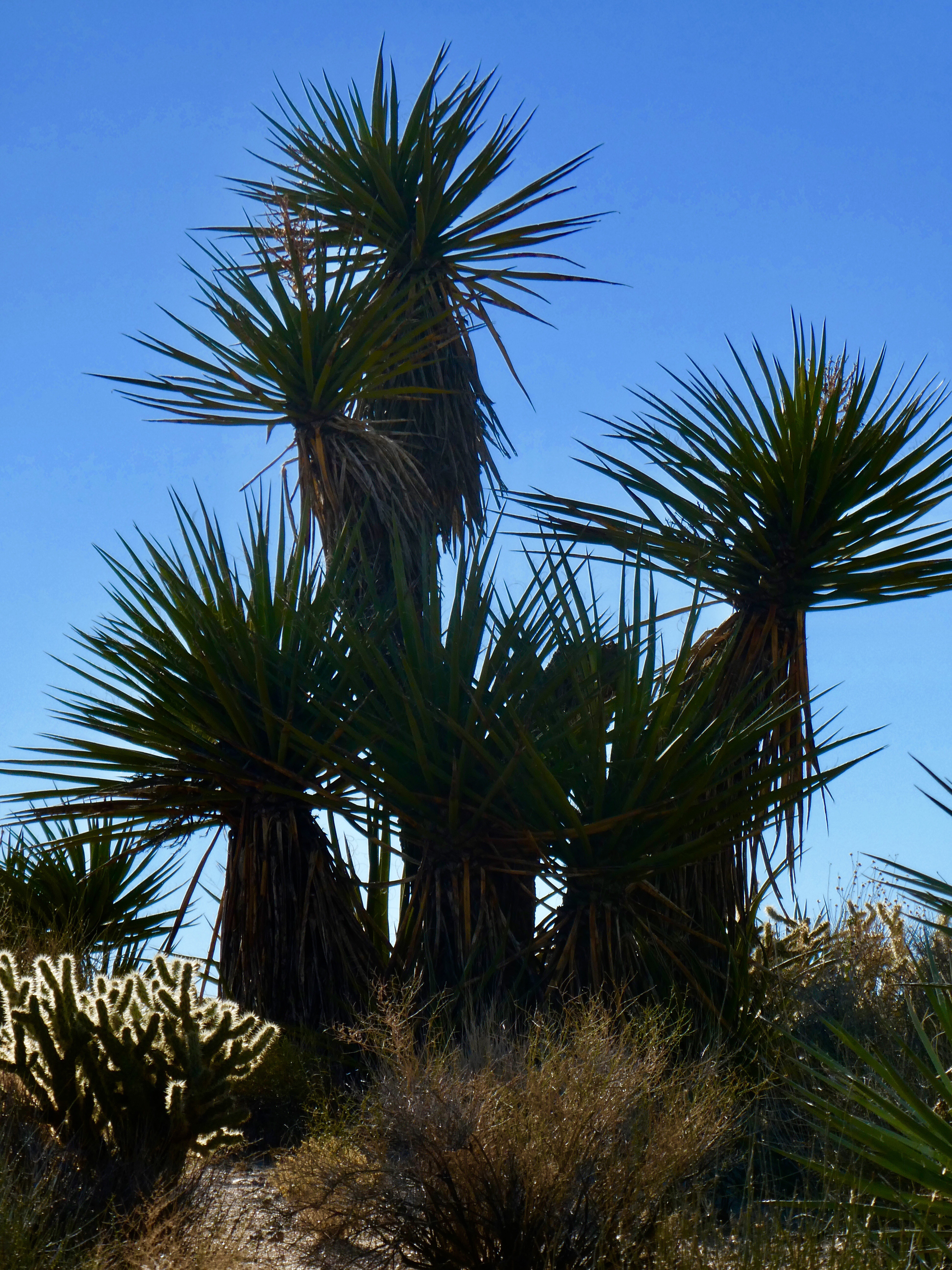
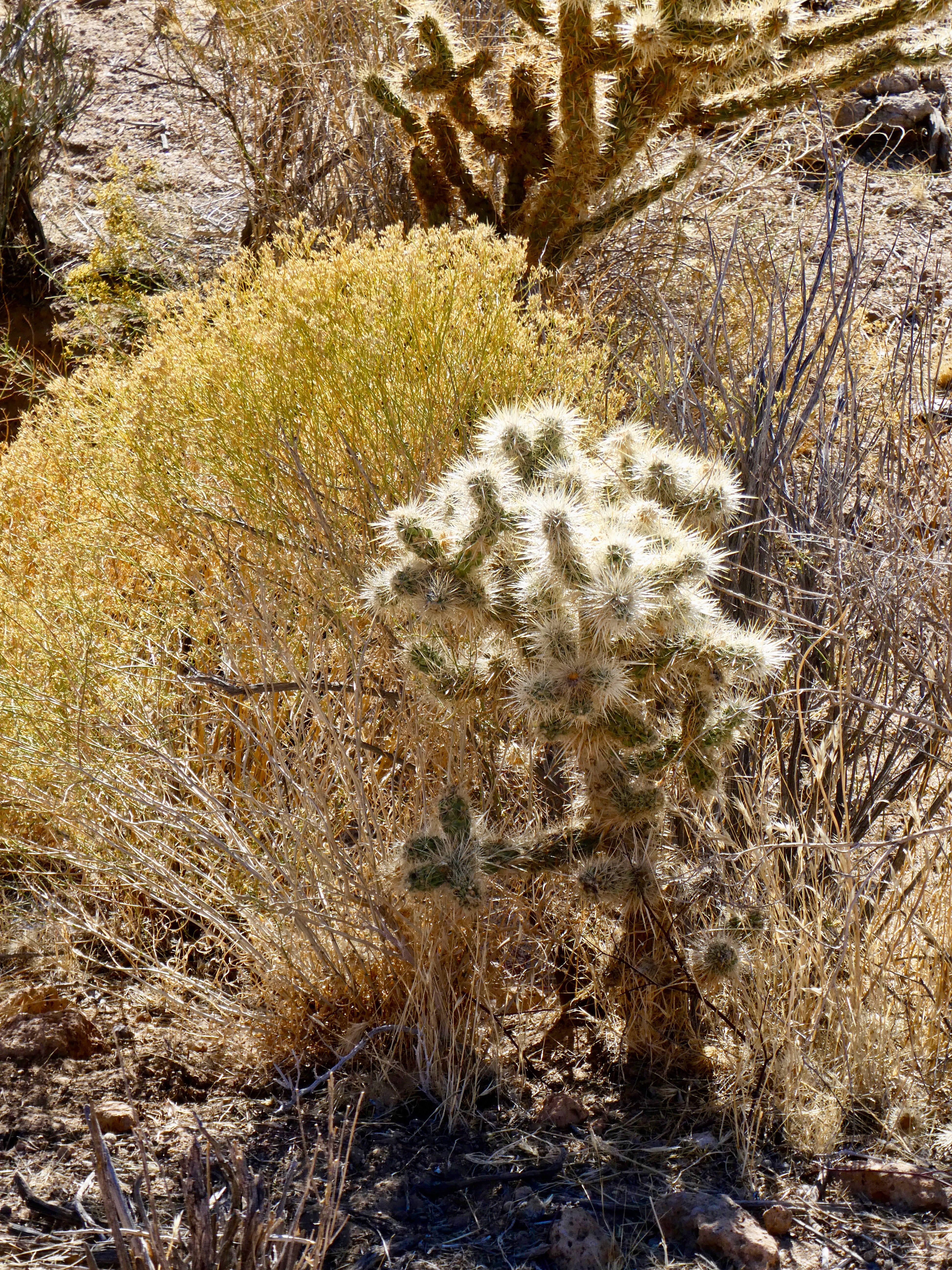
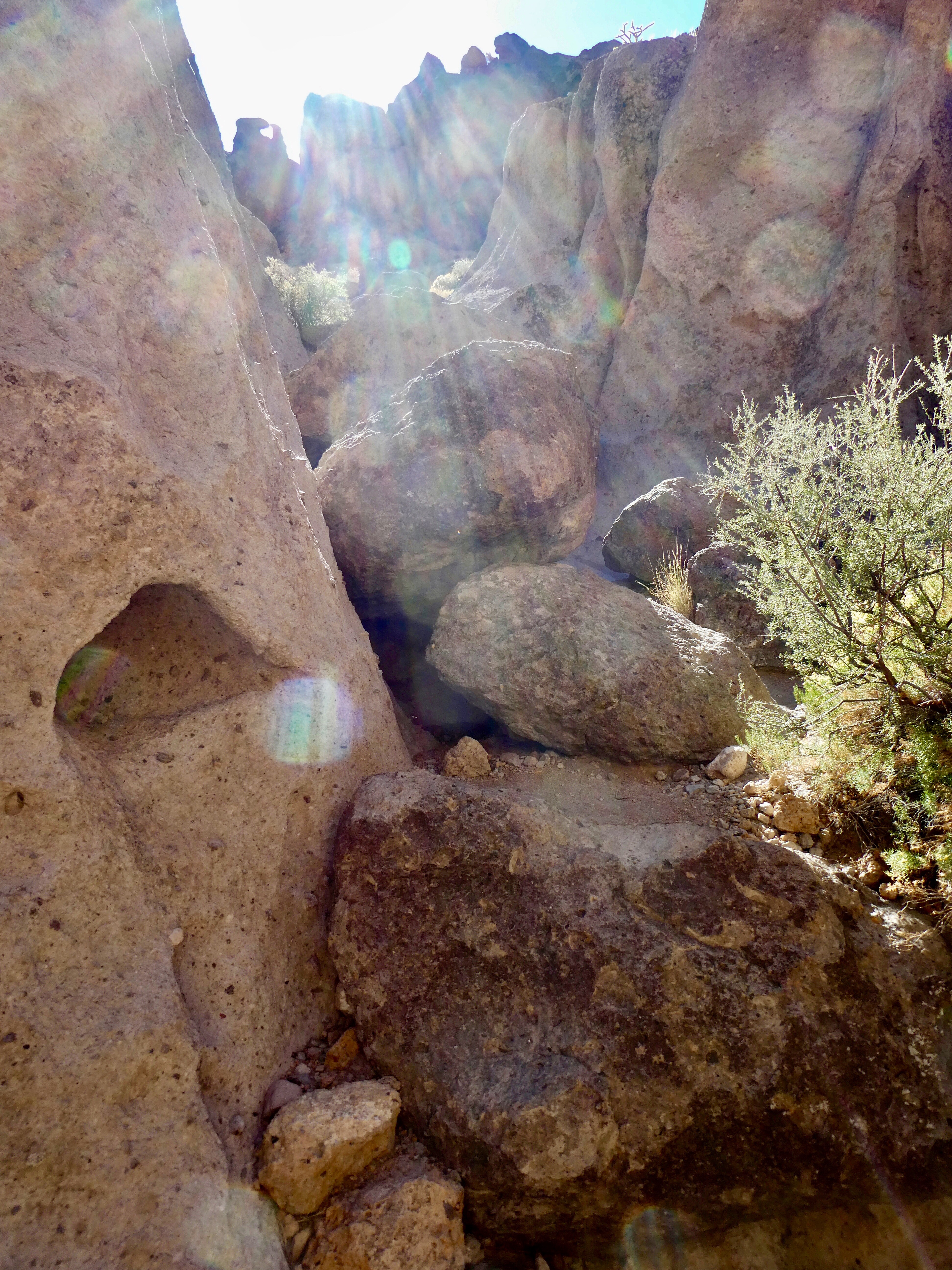
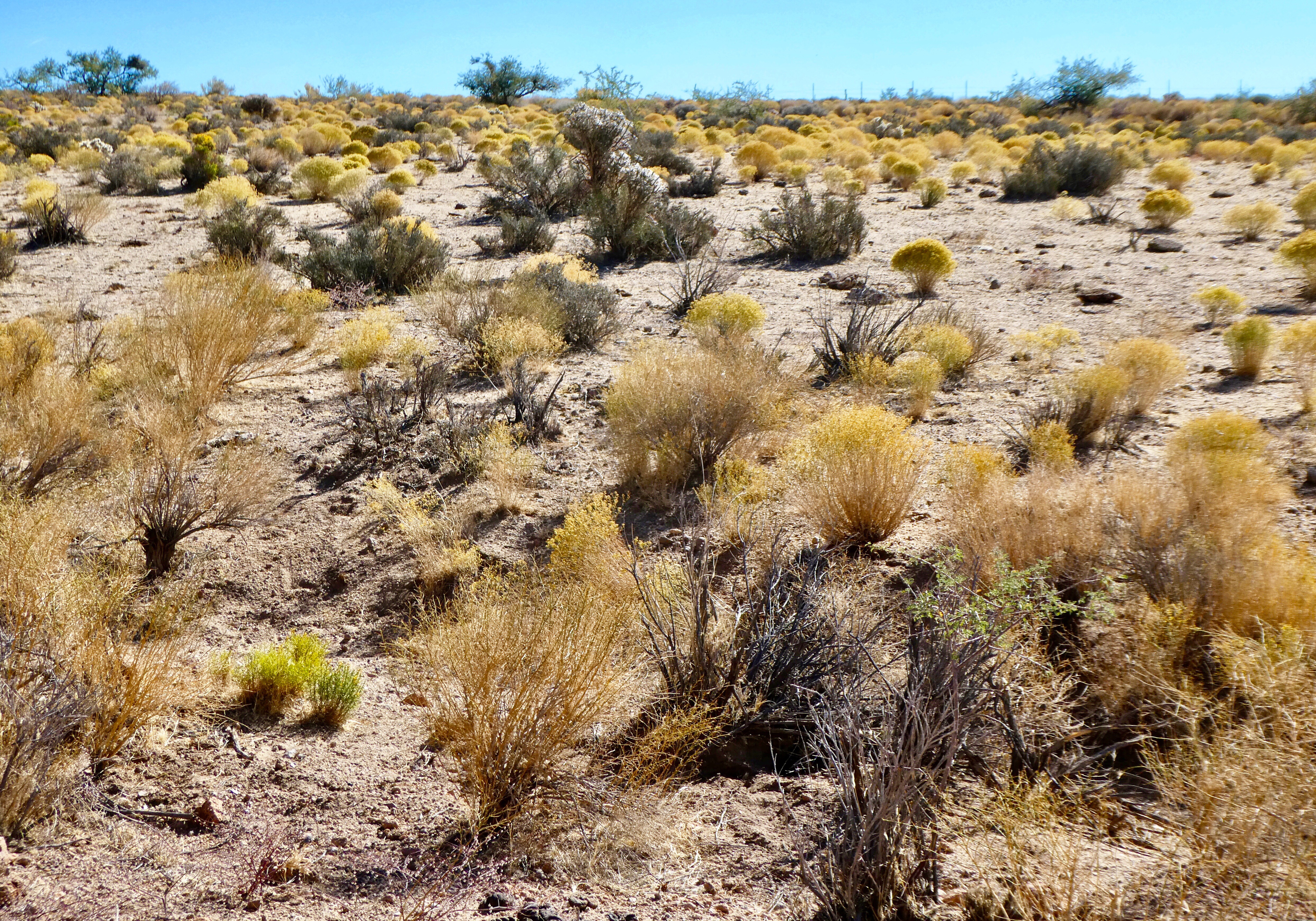
Driving in from the from Las Vegas, Nevada to the north, the road turns from paved to dirt and then to very rough dirt. Not awful, but the Park Service does advise 4WD vehicles only. The desert dusk scenery is lovely and I am the only vehicle on this 40 mile stretch of road. I find plenty of open campsites at Hole-in-The-Wall Campground and settle in for the night.
The Mojave National Preserve encompasses 1.6 million acres, including portions of the Mojave, Great Basin and Sonoran Deserts About half of the Park is congressionallly designated wilderness.
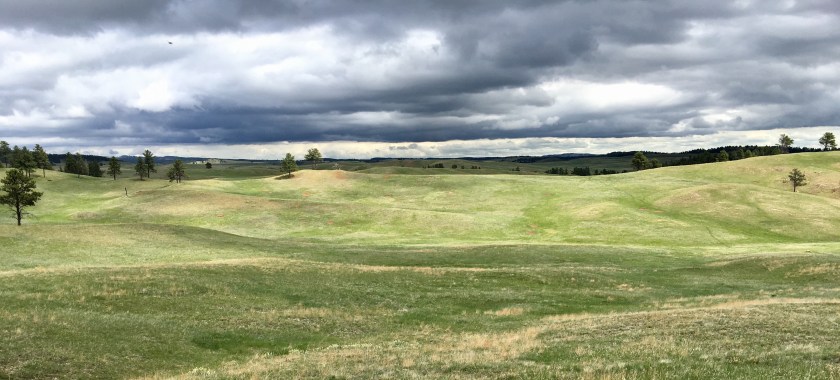
Driving from the south into the Black Hills of South Dakota, we pass through the town of Hot Springs which was founded as a frontier health spa to capitalize on springs of warm mineral waters rising in Fall River Canyon. The town is set in a sandstone canyon with lovely turn-of-the-century style sandstone buildings. Six major thermal springs which emerge from the ground within the town of Hot Springs converge in a single canyon.
Wind Cave National Park
Wind Cave National Park is in the southwestern corner of South Dakota. It’s known for the vast, underground Wind Cave, with chambers like the Post Office and the Elks Room. Many of the cave’s walls are rich in honeycomb-shaped calcite formations known as boxwork. The park’s prairie and pine forests are home to bison, elk and pronghorn antelopes.
American Indians of the area have known about the opening to Wind Cave and the winds that move in and out of it for centuries. It is a sacred place for many tribes. In 1881 Jesse and Tom Bingham were also attracted to the cave by the whistling noise of the air coming out of the cave. As the story goes, wind was blowing out of the cave entrance with such force that it blew off Tom’s hat. A few days later when Jesse returned to show this phenomenon to some friends, he was surprised to find the wind had switched directions and his hat was sucked into the cave. Today, we understand that the movement of the wind is related to the difference in atmospheric pressure between the cave and the surface.
Wind Cave boxwork formation
After touring Wind Cave, we returned to our campsite, and prepared a lovely dinner, featuring Ray’s grilling skills.
Chef Ray expertly grills a marinated tri-tip steak
Custer State Park
Waking to a gentle rain, we drove north to Custer State Park Visitor Center.
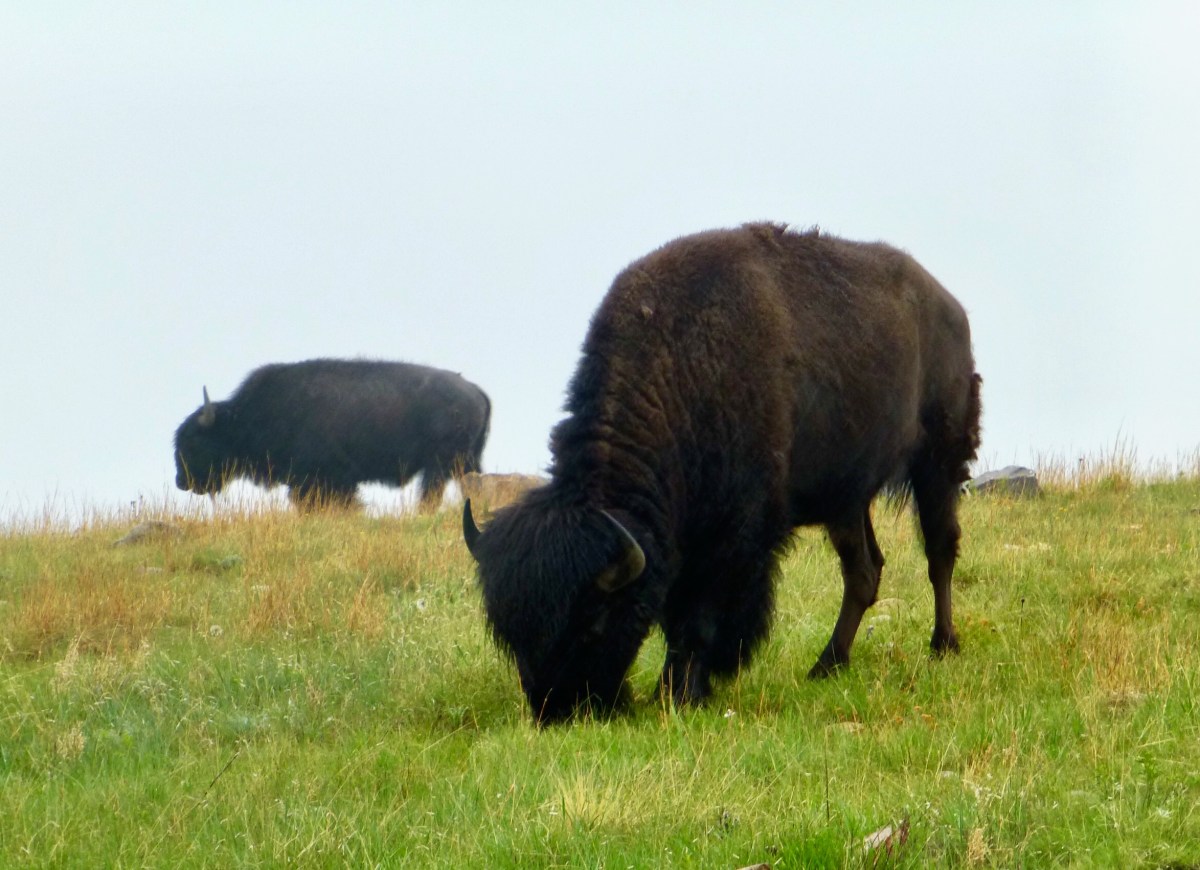
Custer State Park is a state park and wildlife reserve in the Black Hills of southwestern South Dakota, USA. The park covers an area of over 71,000 acres (287 km2) of hilly terrain and is home to a famous herd of 1500 free roaming bison.Elk, coyotes, mule deer, white tailed deer, mountain goats, prairie dogs, bighorn sheep, river otters, pronghorn, cougars, and feral burros also inhabit the park. The park is famous for its scenery, its scenic drives (Needles Highway and the wildlife loop), with views of the bison herd and prairie dog towns.
We encountered lots of Bison, even very near the road. A large herd grazed a few hundred yards away. Newborn calves ran and chased each other, running in and out among the adults.
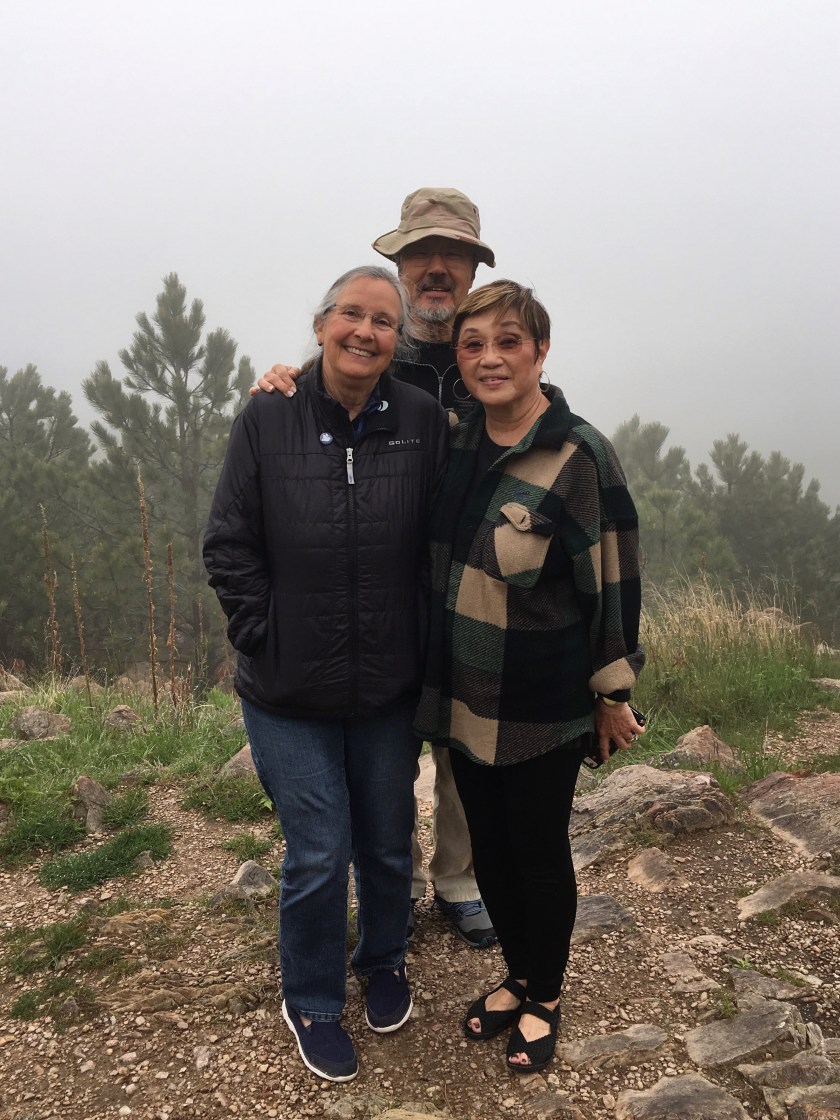
As the clouds close in, the weather remains damp and chilly
Custer State Park has many absolutely beautiful campgrounds including at Sylvan and Stockade Lake. Sylvan was not yet open for the season, so we found campsites in the large, hilly, forested campsites above Stockade Lake.
Badlands National Park
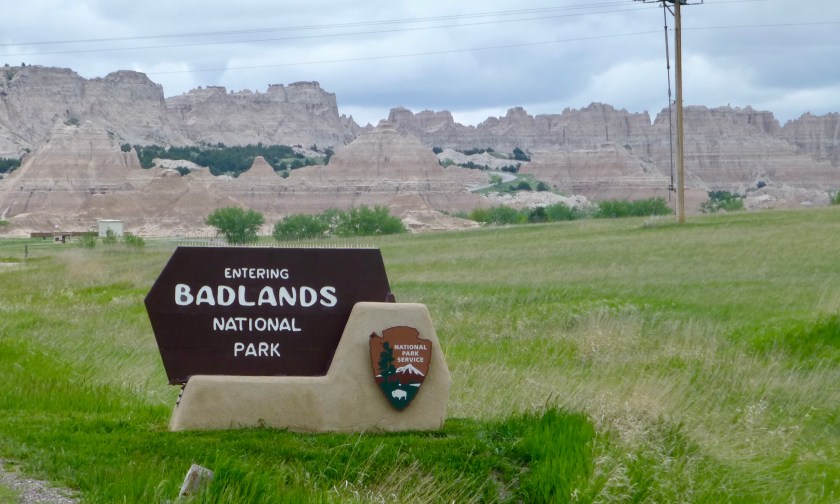
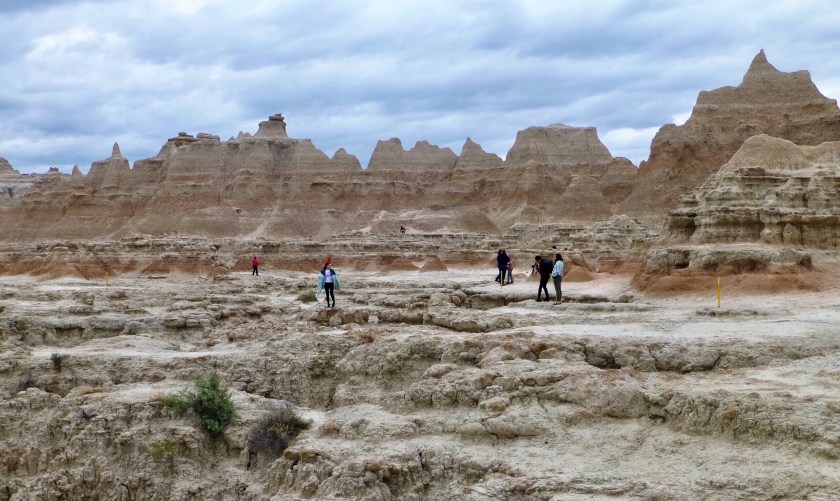
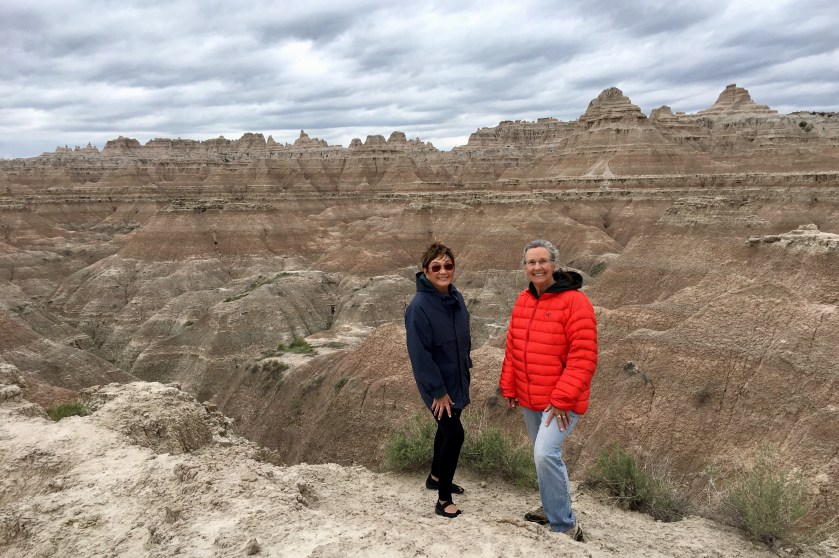
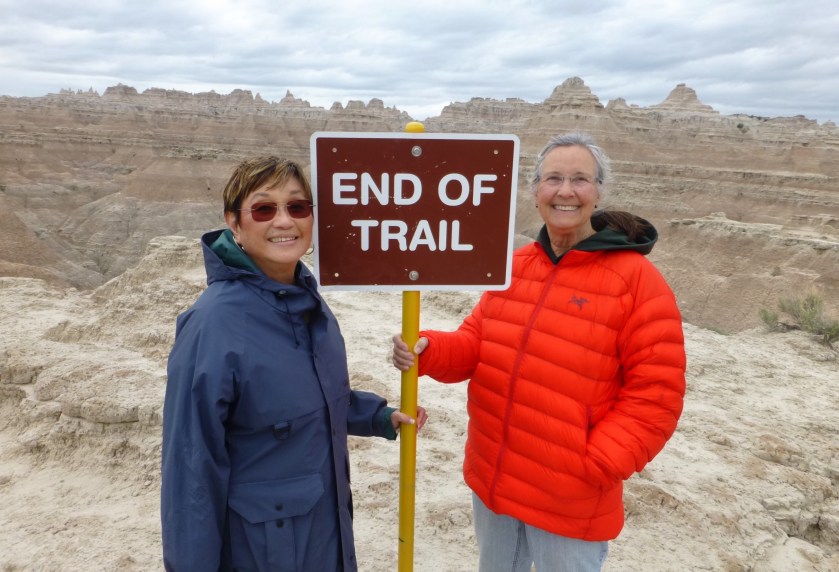
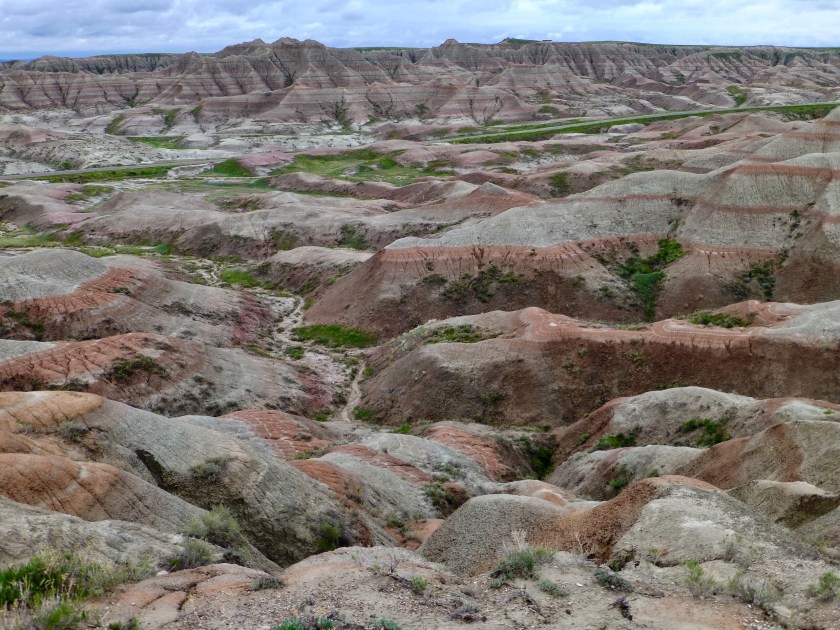
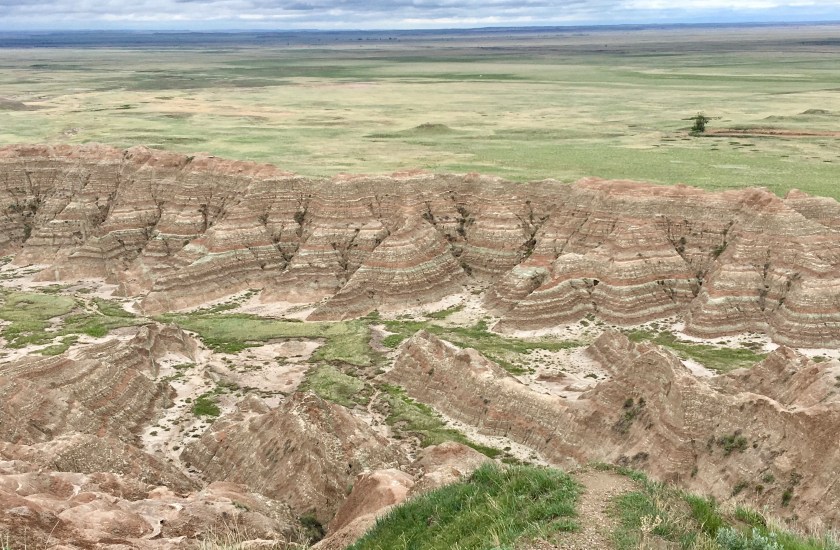
In the morning, we drove southeast to Badlands National Park. The weather remained cloudy and cold, but at least there was no rain. We found campsites at Cedar Pass Campground with views of the Badlands cliffs, stopped at visitor center for maps and orientation and then drove north along the Badlands Loop Road, where we stopped to hike the Cliff Shelf Nature Trail, Window Trail and Door Trails with amazing views of the Badlands formations.
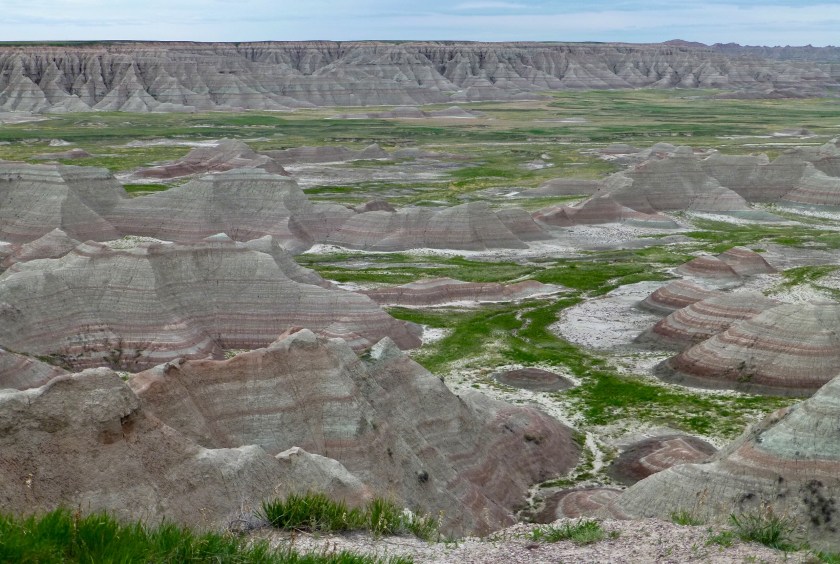
Badlands National Park is in South Dakota. Its dramatic landscapes span layered rock formations, steep canyons and towering spires. Bison, bighorn sheep and prairie dogs inhabit its sprawling grasslands. The Badlands Loop Road (Highway 240) winds past scenic lookouts. Several trails begin near the Ben Reifel Visitor Center. The Fossil Exhibit Trail is a boardwalk with displays on fossils uncovered in the park.
The view near our campground
Short hikes, affording excellent views.
After our lovely hikes, we drove back for dinner and a walk around the campground. To our wonder and amazement we found a coin operated hot shower building in the other campground loop! Well in need of cleansing, we all took advantage of this luxurious amenity, then off to bed
We had light rain and cool temperatures all night. Our plan was to head northwest on the Badlands Loop scenic road, stopping along the way at the lovely overlook pullouts and camp tonight in Sage Campground, having very primitive facilities, but also welcome isolation from other campers.
Highlights of our day included the unexpectedly beautiful, soils deposited near Homestead Overlook.
Colorful soils near Homestead Overlook
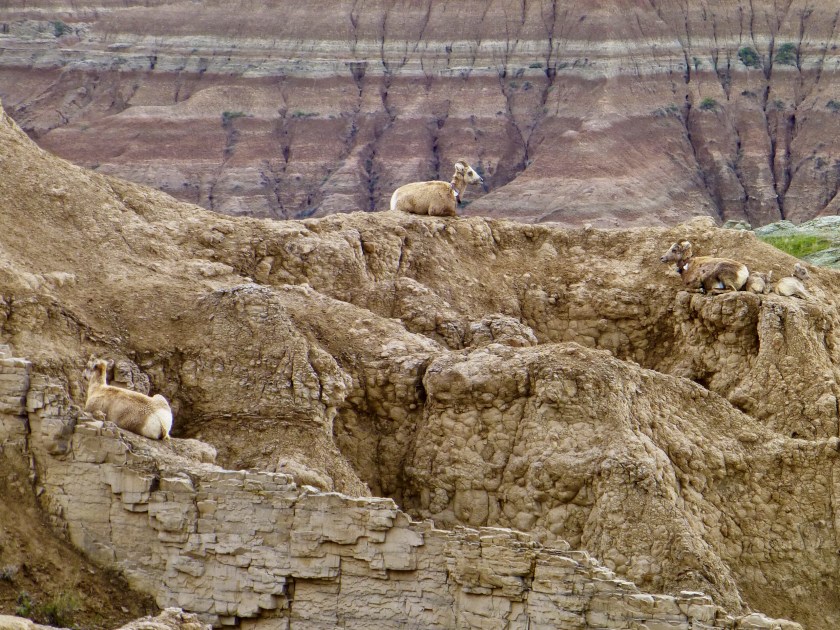
Another highlight was a herd of Bighorn Sheep ewes and lambs, at Pinnacles Overlook.
Collared eweEwe twoCan you find all five sheep? Three adult ewes and two newborn lambs off to the right.
As it turned out, the shortest road to Sage Campground was closed due to very muddy conditions due to the constant rain. And since snow was forecast for the evening, we decided to press on the Devils Tower.
Just after turning off the interstate, the sun came out, temperatures soared into the mid 60’s and the spring scenery along the winding country road became more and more beautiful. Soon lovely views of Devil’s Tower appeared on the horizon. We found space at tree-shaded Belle Fourche Campground and enjoyed dinner, a cloudless sunset and a small campfire with beautiful view of Devil’s Tower.
The sun sets on Devil’s Tower
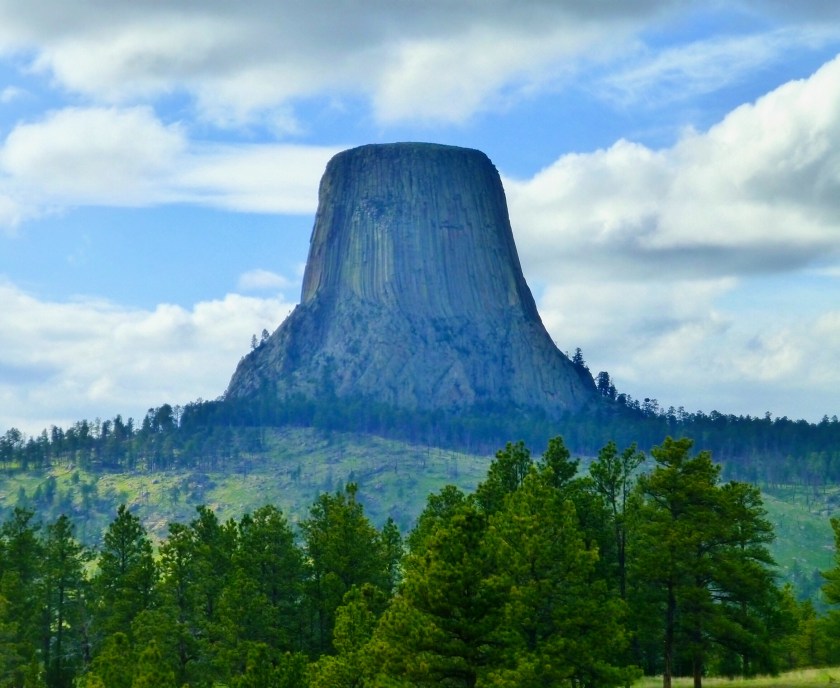
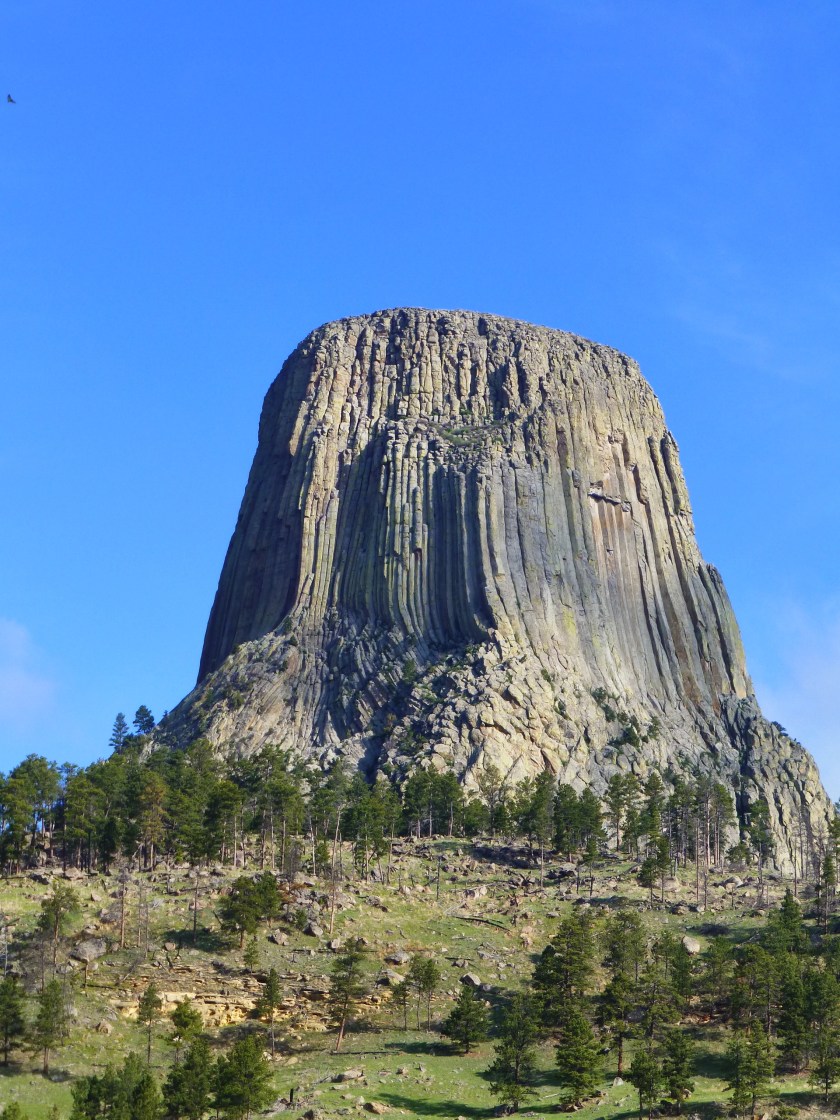
Devil’s Tower National Monument
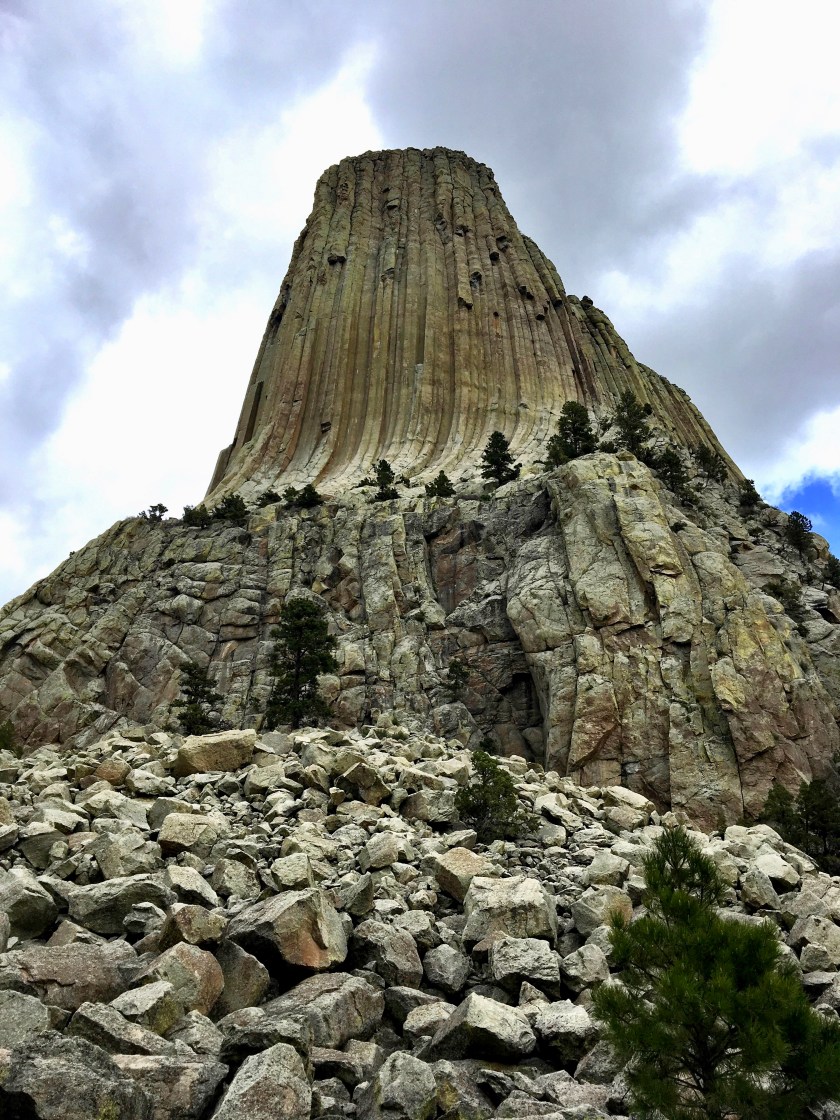
Devils Tower (also called Bear Lodge Butte) is a laccolithic butte composed of igneous rock in the Bear Lodge Mountains (part of the Black Hills) near Hulett, northeastern Wyoming, above the Belle Fourche River. It rises dramatically 1,267 feet (386 m) above the Belle Fourche River, standing 867 feet (265 m) from summit to base. The summit is 5,112 feet (1,559 m) above sea level, and is a mecca for rock climbers.
In recent years, climbing Devils Tower National Monument has increased in popularity. The first known ascent of Devils Tower by any method occurred on July 4, 1893, and is accredited to William Rogers and Willard Ripley, local ranchers in the area. They completed this first ascent after constructing a ladder of wooden pegs driven into cracks in the rock face. A few of these wooden pegs are still intact and are visible on the tower when hiking along the 1.3-mile (2.1 km) Tower Trail at Devils Tower National Monument.
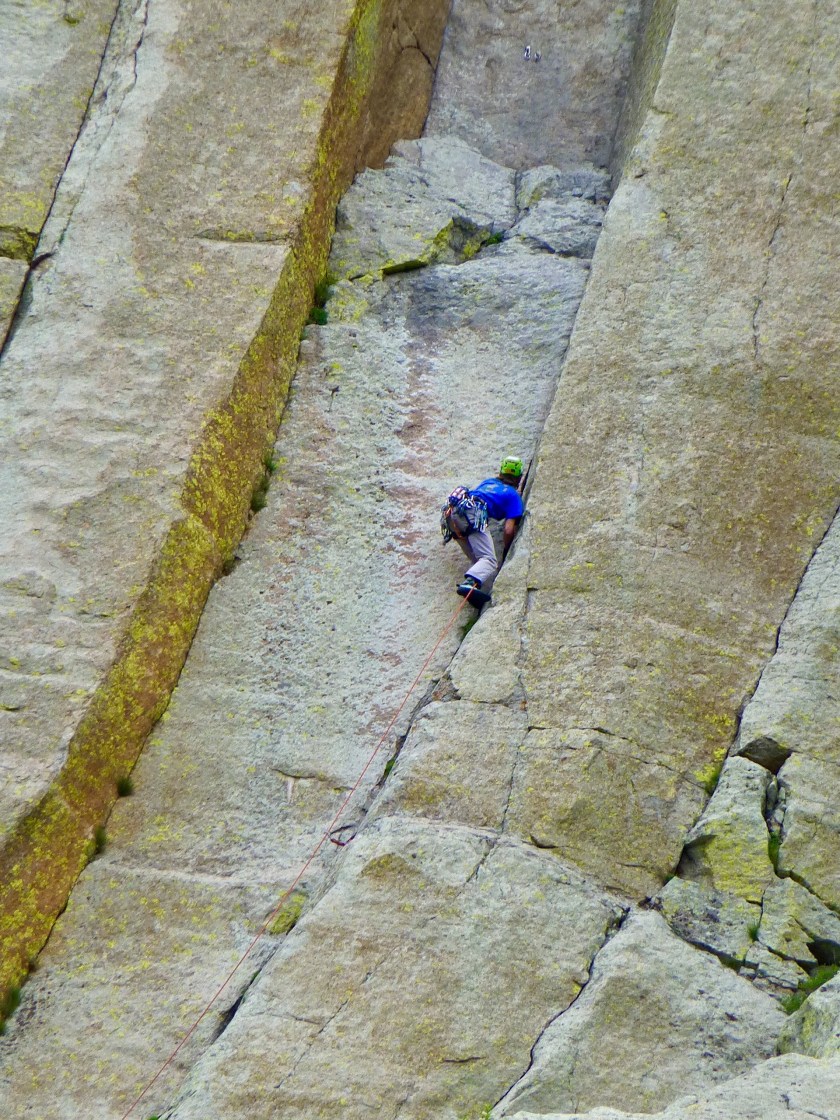
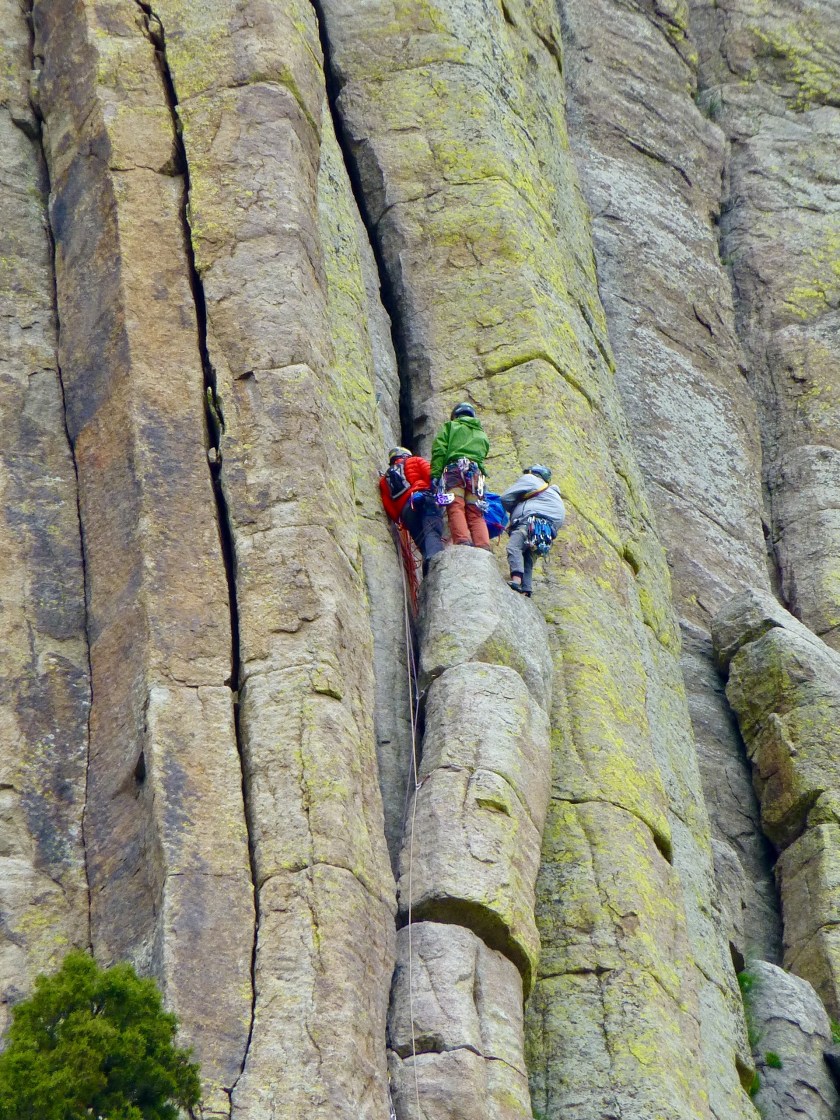
Today, hundreds of climbers scale the sheer rock walls of Devils Tower each summer. There are many established and documented climbing routes covering every side of the tower, ascending the various vertical cracks and columns of the rock. The difficulty of these routes range from relatively easy to some of the hardest in the world.
The Tower is sacred to several Plains tribes, including the Lakota, Cheyenne and Kiowa. Because of this, many Indian leaders objected to climbers ascending the monument, considering this to be a desecration. The climbers argued that they had a right to climb the Tower, since it is on federal land. A compromise was eventually reached with a voluntary climbing ban during the month of June when the tribes are conducting ceremonies around the monument. Climbers are asked, but not required, to stay off the Tower in June. According to the PBS documentary In the Light of Reverence, approximately 85% of climbers honor the ban and voluntarily choose not to climb the Tower during the month of June.
We woke to a much appreciated sunny morning, featuring nice views of the rising sun illuminating Devil’s Tower. Sally got up at 6 a.m. to capture some nice photographs.
Devil’s tower at sunrise from our campsite
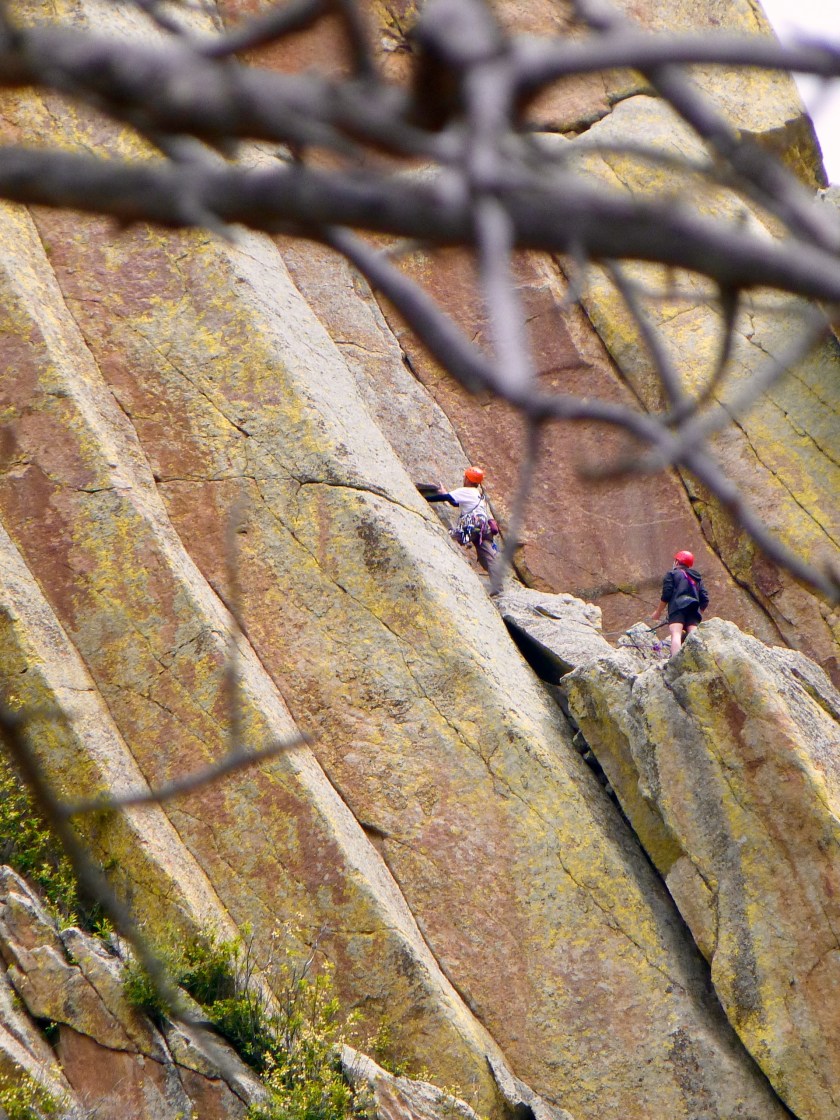
After breakfast we drove to the visitor center, the took the 1.3 mile hike around the tower, seeing lots of rock climbers scaling it. The quickest recorded ascent of the 900 ft tower is 18 minutes! Most ascents & descents take 6-10 hours.
Devil’s Tower as seen from the Tower TrailA climber two-thirds of the way up. Most ascents take 6-10 hours for the round trip.
Late in the day, we watched the climbers with our binoculars, rappele back down. The descent was much quicker!
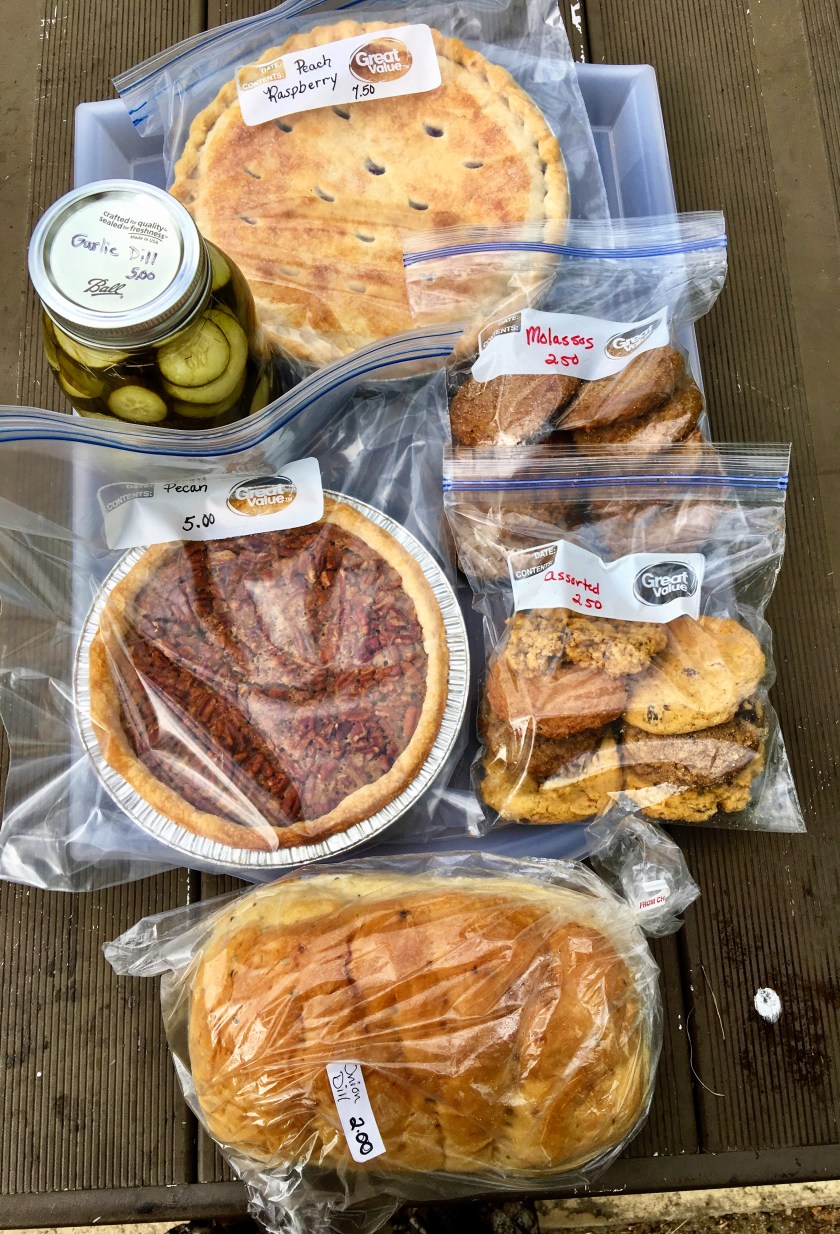
After hiking (circumnavigating) Devil’s Tower, we returned to camp, ate lunch and drove to the one grocery store in Hulett, Wyoming to replenish our stocks of sparkling water and milk. A very sweet Amish girl was selling baked items outside the store. She said that her group had come from Iowa five years ago and she greatly preferred Wyoming for its less humid environment and milder winters. She sold eggs, unhomogenized milk, cute rabbits, an assortment of pies, cookies, bread, pickles, canned vegetables, jams and lots of other items.
Feasting tonight!
We purchased a raspberry/ peach and pecan pie, molasses and mixed bags of cookies, a loaf of bread and a jar of garlic dill pickles. I was totally unable to resist!
Buffalo Wyoming and Tensleep Canyon
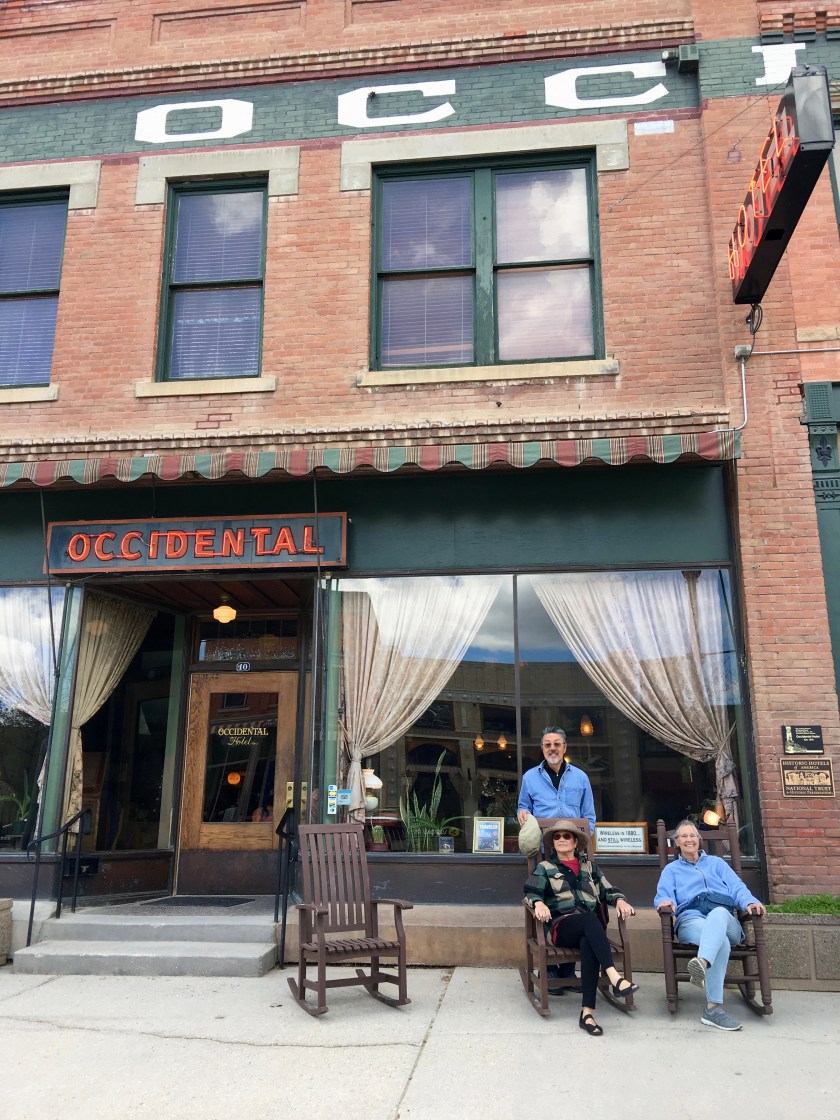
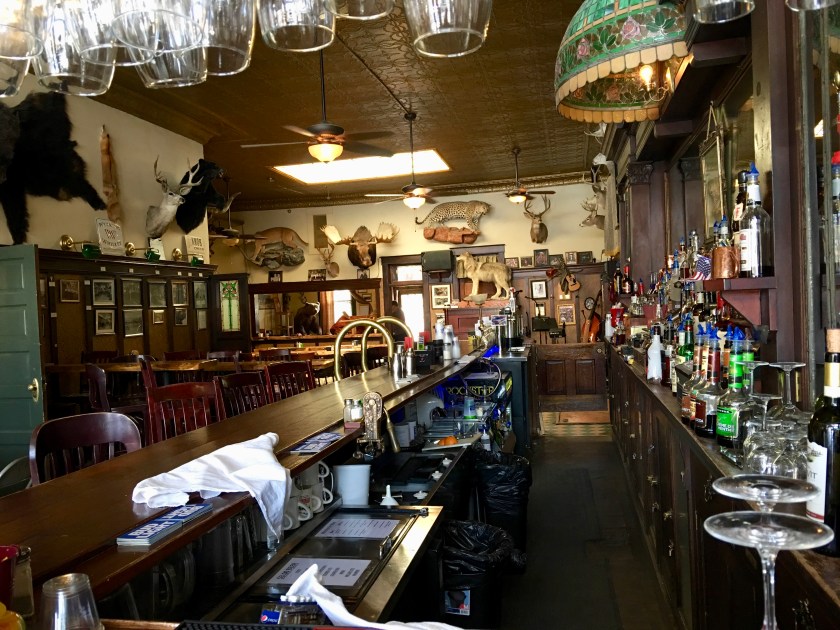
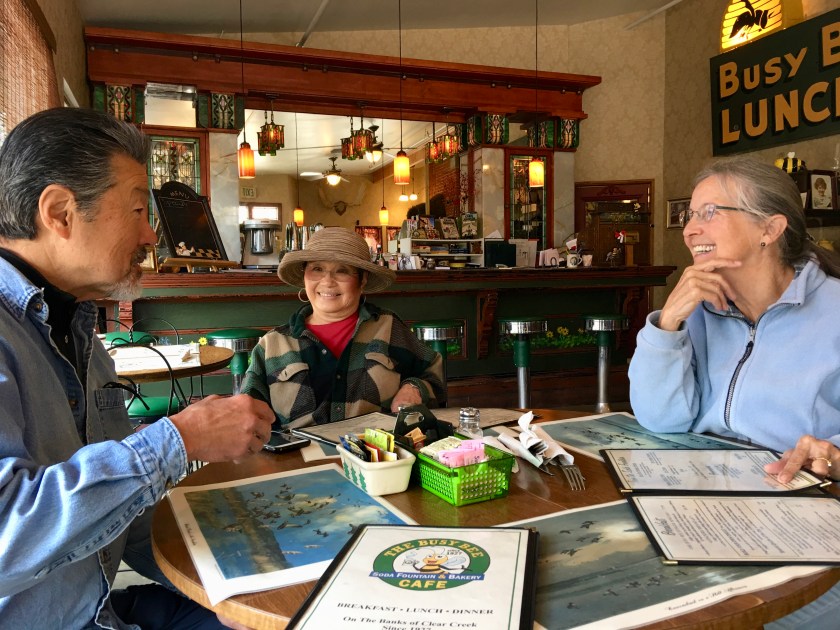
The next morning, we drove from Devil’s Tower to Buffalo, Wyoming. The sun came out, and we walked the main street of the town, toured the 1880’s Occidental Hotel, and ate lunch at the “Busy Bee” restaurant.
Relaxing at the Occidental Hotel, built 1880.The Occidental saloon, featuring many mounted game animals.Lunch at the Busy Bee. Built in 1927 on Clear Creek, it features an old-fashioned soda fountain. The mirrored backsplash is over 100 years old.
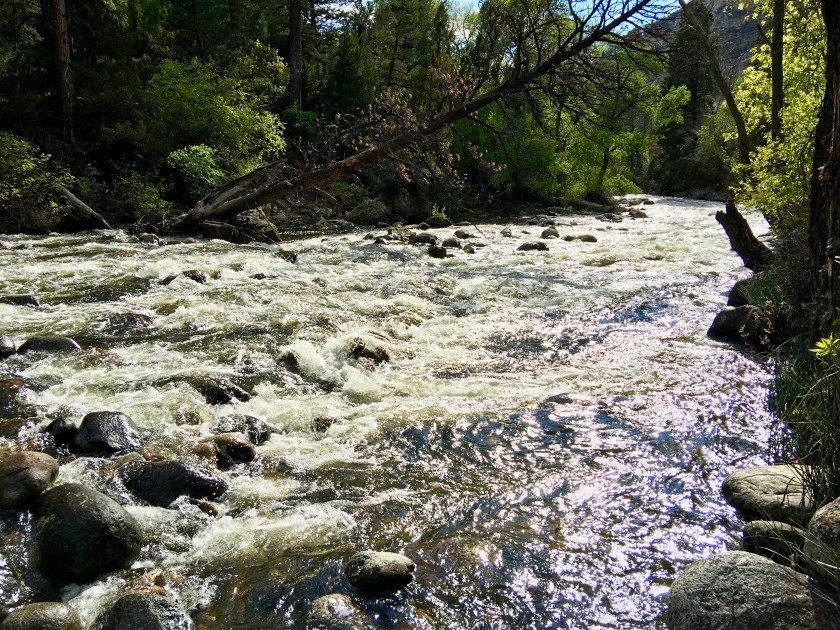
We had expected to stay at one of the many campgrounds in the Bighorn National Forest, but most were still closed this early in the season. Encountering snow at Powder River Pass, we dropped down into beautiful Tensleep Canyon and found the last two campsites at Leigh Creek campground which is on Tensleep Creek. Surrounded by pretty rock cliffs and on the lovely creek, the forested sites were dotted with early spring wildflowers. Most campsites were filled with rock climbers, who love to scale the canyon walls.
Hippies and hunters and cowboys and climbers—these strange bedfellows mingle in relative harmony in north-central Wyoming’s Ten Sleep. Rich in history, this ranching town was the halfway point—or ten “sleeps”—between two major Sioux Indian camps. Ten Sleep was an American Indian rest stop, so-called because it was 10 days’ travel, or “10 sleeps,” from Fort Laramie (southeast) and the Indian Agency on the Stillwater River in Montana (northwest). There are numerous archeological sites throughout the area, with frequent discoveries of artifacts such as arrowheads, pictographs and petroglyphs.
Tensleep Creek, Tensleep Canyon
We had a lovely dinner outside in the sunlight, and slept really well, listening to the sound of the rushing creek.
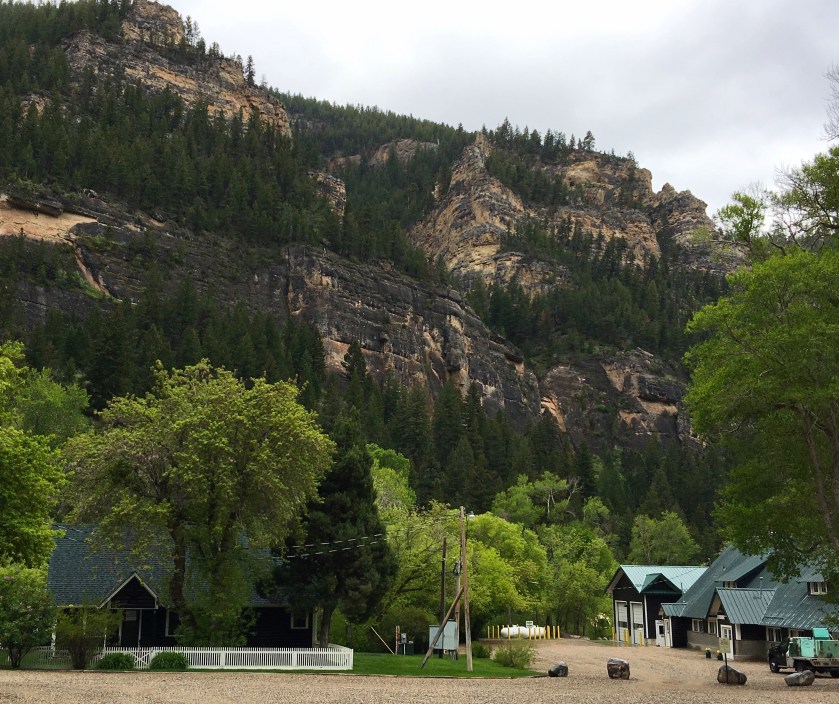
The morning dawned cloudy, cold and rainy, so we decided to make the seven hour drive home, first stopping for a tour of the Wyoming Game and Fish, Tensleep Fish Hatchery. The operations were nicely documented and the staff was friendly and helpful – a much appreciated learning experience.
The fish hatchery and staff quarters in lovely Tensleep canyonShirley’s reflection in a trout production tank
My friends Ray and Shirley had only been home a few weeks, but were getting restless to get their camper back on the road. They invited me to tag along on a five-day excursion to explore the lovely parks located near Moab, Utah. It has been years since we were last here.
Driving south on Utah highway 128 following the Colorado River. A beautiful, curvy drive with wonderful vistas of the buttes ahead and lots of campsites along the river. Unfortunately they all appear to be full.
Beautiful Utah Highway 128 following the Colorado river
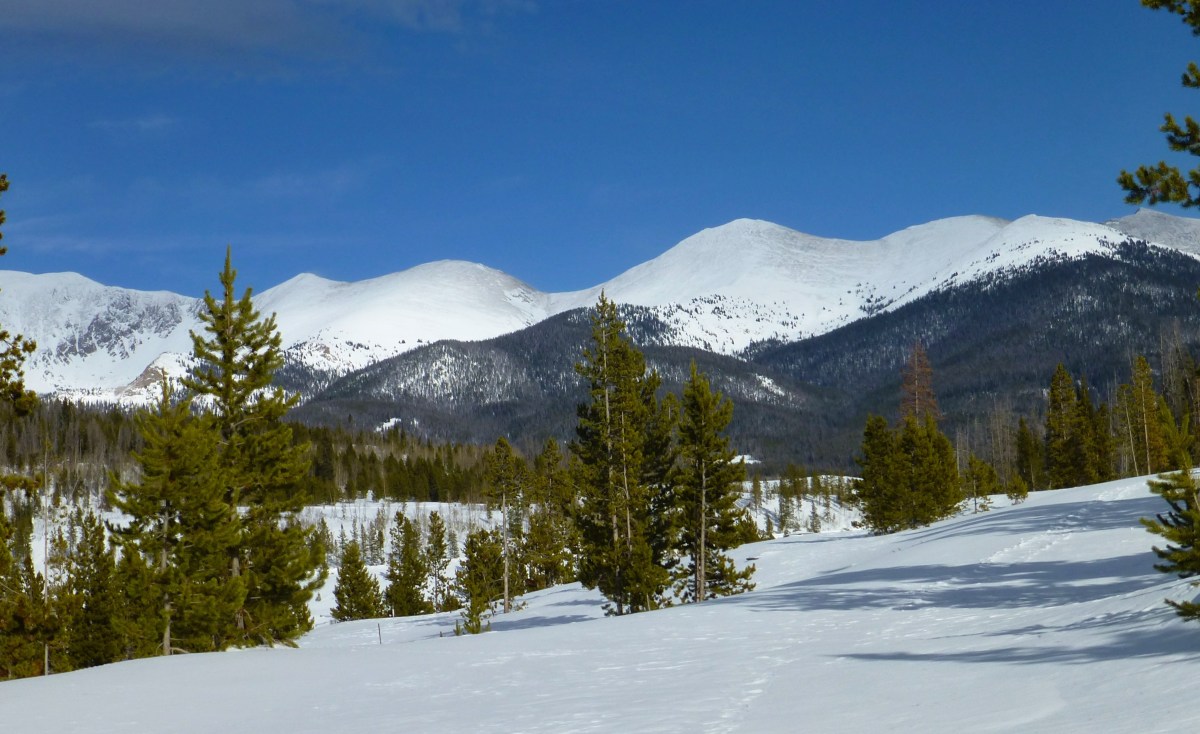
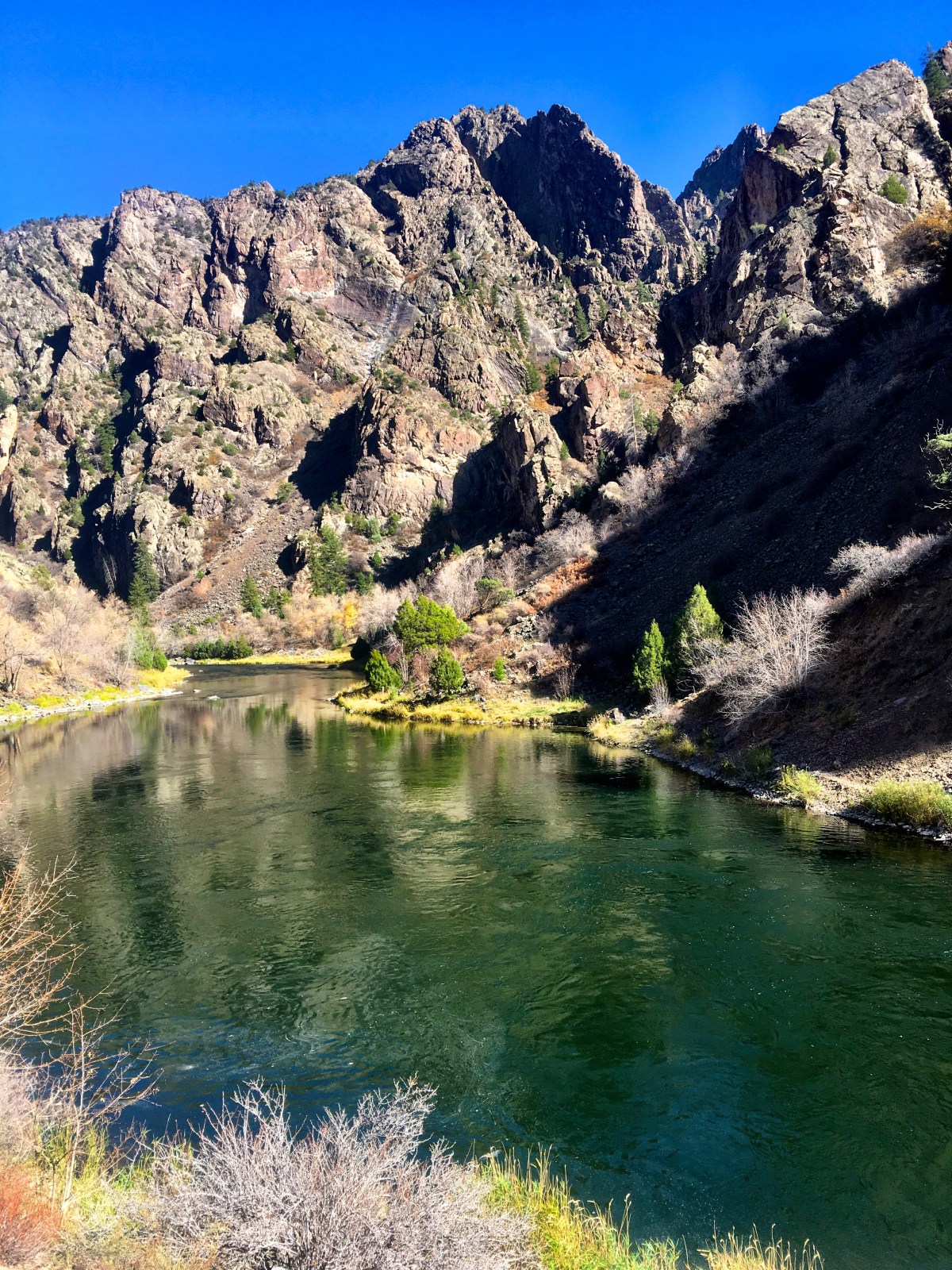
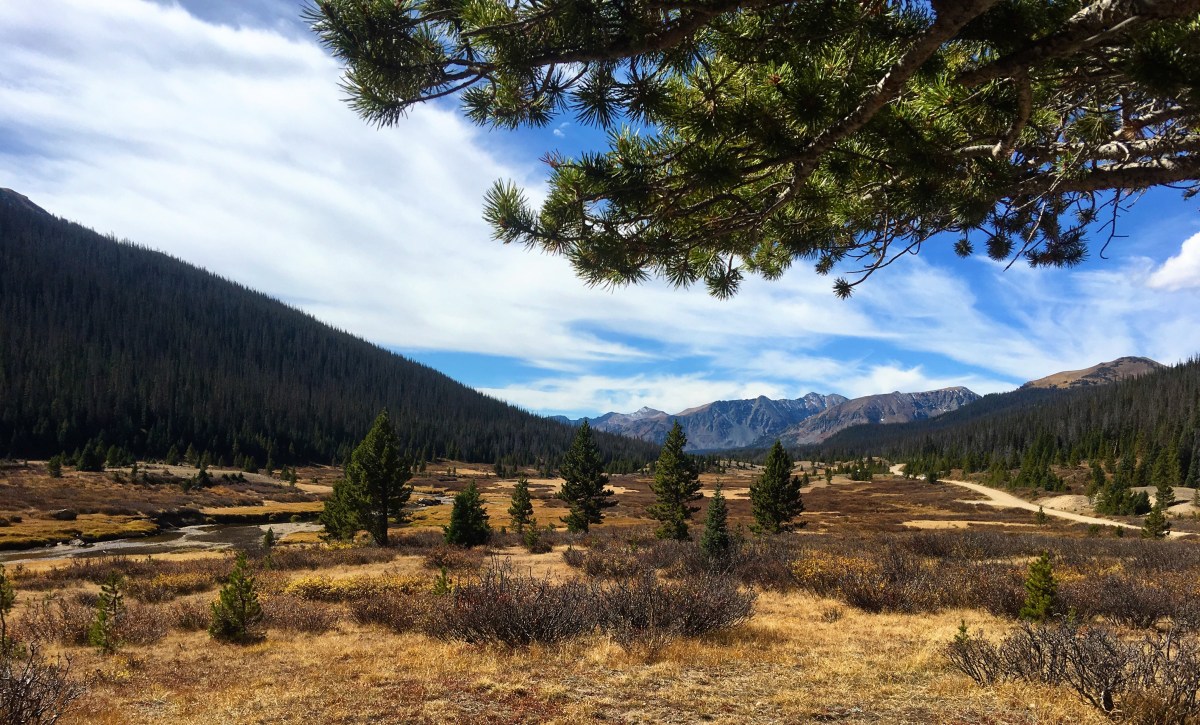
Driving 3 ½ hours through the colorful Colorado mountains we find the aspen color is pretty much finished, but cottonwoods are still in their full golden full glory in the creek bottoms.

















 David Willett